

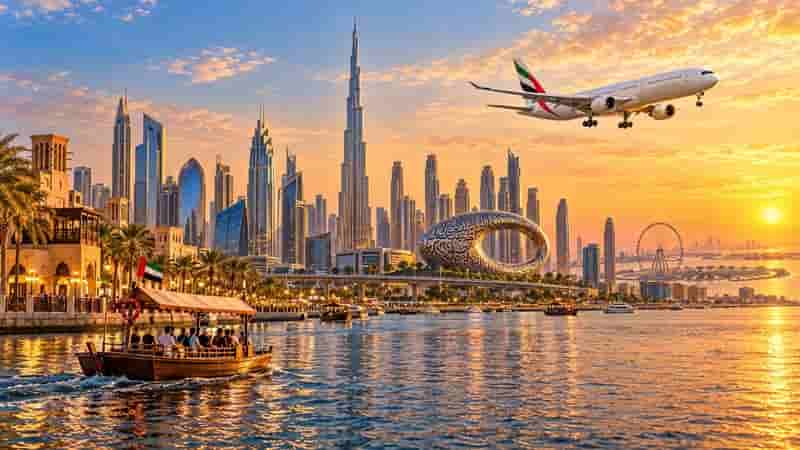
With nervous travellers eyeing Middle East headlines, Emirates has adopted an unusually candid approach to selling Dubai. Its latest advertising confronts the doubts, celebrates the attractions and offers a few incentives to persuade passengers that the city deserves more than a fleeting glimpse between flights.
There are easier ways to sell a holiday than reminding prospective customers of the headlines that made them nervous in the first place. A turquoise swimming pool, a smiling cabin crew member and a suspiciously deserted beach normally do the trick.
Emirates, however, has decided to try something rather more interesting. It has looked the headlines in the eye, adjusted its immaculate uniform and invited the world back to Dubai.
In a video released in September, a crew member holds a fictional newspaper, the Daily Made Up, while colleagues take viewers around the city. There is even a disarming admission:
“We know Dubai isn’t everyone’s cup of tea, and we don’t expect it to be.”
Coming from an airline whose advertising usually specialises in glamour at 35,000 feet, that is quite a change of altitude.
The campaign targets a problem no amount of gold-plated hotel plumbing can solve on its own: travellers need confidence before they need a room with a view.
Regional conflict and flight disruption have made that a more complicated proposition in 2026. Emirates is not claiming the news never happened. It is asking would-be visitors to look beyond it.
And Dubai has certainly given them plenty to look at.
The City Behind the Sales Pitch
Emirates announced a wider winter destination campaign on 29 September, promoting the emirate’s attractions, shopping, restaurants and events.
The package included three complimentary experiences: Aquaventure Waterpark, Lost World Aquarium and a 24-hour City Sightseeing bus tour, a bundle the airline valued at AED 535.
There is an important catch, particularly for travel agents: the booking window ran from 21 September to 11 October 2026. It has closed.
Eligible passengers who bought qualifying return fares can still travel during the offer period, which ends on 13 December. It is not a fresh freebie that every latecomer can claim.
Emirates is also pushing its My Emirates Pass discounts and Dubai Experience planning platform, both intended to move travellers beyond the arrivals hall and into the visitor economy.
Then, on 22 October, a new enticement arrived: one Skywards Mile for every minute of a qualifying Dubai stay, capped at 7,200 bonus miles.
Members living outside the UAE must register and book eligible Emirates or flydubai return travel between 21 October and 5 November, with travel completed between 21 October and 13 December. A stay must last at least 24 hours and no more than 30 days.
The reward caps after five days. Stay another week, and the clock will keep ticking, but the bonus miles will not.
Even the world’s more enthusiastic loyalty schemes occasionally remember they have accountants.
All this is cleverer than a simple fares sale. Emirates wants travellers to think of Dubai as a destination, not an interruption between two aircraft meals.
There is money in that distinction.
A transit passenger might buy a coffee and a neck pillow. A holidaymaker pays for a hotel, eats in restaurants, visits attractions, and may discover that a brief look around Dubai Mall becomes a major financial undertaking.
It is not a small business that needs protecting.
Dubai welcomed 19.59 million international overnight visitors in 2025, up 5 per cent from 2024, according to its Department of Economy and Tourism.
Average hotel occupancy reached 80.7 per cent, and the city recorded 44.85 million occupied room nights.
Australasia supplied 401,000 visitors, a regional figure that must not be confused with Australia alone.
Those are last year’s results, not evidence that the new advertisements have succeeded.
For that, we need booking and visitor figures, not applause for a well-made commercial.
Ten Reasons to Get Off the Plane
1. Burj Khalifa – The View from the Top
At 828 metres, the Burj Khalifa still wins the argument about who has the tallest building.
Observation decks offer a remarkable view of a city apparently designed by people who regard the word ‘modest’ as an administrative error.
Look out across the skyscrapers, desert and Gulf; then look down, if your knees allow it.
2. Museum of the Future – Tomorrow Has Arrived
This gleaming, calligraphy-covered landmark looks like a spacecraft that found an exceptionally good architect.
Inside, visitors explore ideas about science, technology and the decades ahead.
In a city famous for building tomorrow before most places have finished discussing yesterday, it feels perfectly at home.
3. Al Fahidi – The Dubai That Came First
Another Dubai exists, quieter and considerably older than the Instagram skyline.
In Al Fahidi Historical Neighbourhood, wind towers, courtyard houses and narrow lanes recall the trading settlement that preceded the city’s astonishing expansion.
If you think the emirate began as a shopping centre, start here.
4. Dubai Creek – Take the Slow Boat
Cross the Creek on a traditional abra and discover an inexpensive thrill in a city rarely accused of understatement.
Around Deira and the old souks, gold glitters, spices perfume the air and trading traditions remain very much alive.
The crossing offers something the skyscrapers cannot: a feel for how Dubai earned its living before it became a global aviation hub.
5. Palm Jumeirah – Because a Normal Island Wouldn’t Do
The palm-shaped island is Dubai’s ambition rendered in sand and engineering.
Luxury resorts, beaches and restaurants line its branches, while Atlantis The Palm and the separate Atlantis The Royal have become landmarks in their own right.
A useful reminder: when Dubai wants more waterfront, it has occasionally preferred making its own.
6. Burj Al Arab – Full Sail, Full Wallet
The sail-shaped Burj Al Arab remains a shorthand for extravagant hospitality.
Its much-repeated ‘seven-star’ label is a nickname, not an official classification, but nobody would mistake it for a budget motel.
Visitors can admire it from the shore or book an authorised hotel experience.
Taking home the photograph is considerably cheaper than taking home the minibar bill.
7. Dubai Mall and the Fountain – A Little Retail Theatre
Dubai Mall is less a quick shopping trip than a test of endurance, with shops, dining and family attractions on an extraordinary scale.
Outside, the Dubai Fountain puts on choreographed evening performances beneath Burj Khalifa.
The official tourism site lists shows every half hour from 6 pm to 11 pm, though schedules can change.
At least the fountains will not ask whether you want an extended warranty.
8. Dubai Frame – Old and New in One Glance
Stand inside a giant golden picture frame, about 150 metres high, and the city’s split personality becomes beautifully clear.
Historic districts lie in one direction; the modern skyline in the other.
The glass-floored walkway adds a little excitement for those who prefer their sightseeing accompanied by a discussion with their nerves.
9. The Desert – Finally, Some Space
A short journey out of the city replaces towers and traffic with dunes, open horizons and evening light.
Choose a responsible desert excursion for landscapes, wildlife and traditional hospitality; adrenaline is optional.
The real luxury may be hearing the wind rather than another hotel lobby playlist.
10. Ain Dubai – Round and Round in Style
On Bluewaters Island, the approximately 250-metre Ain Dubai observation wheel makes a leisurely circuit high above the waterfront.
From its cabins, you can see Palm Jumeirah and the wider coastline.
Check current operating times and ticket arrangements before you go.
Even a very large wheel occasionally has a day off.
The Australian Reality Check
For Australian holidaymakers and travel agents, Dubai is an obvious stopover en route to Europe or elsewhere.
The cooler months suit outdoor sightseeing, and an airline with a global network can make a three- or four-night detour seem almost irresistible.
But a polished advertisement is not a travel advisory.
On 8 October, Australia’s Smartraveller lowered its advice for the United Arab Emirates to Level 2: exercise a high degree of caution.
It continues to warn that regional security conditions are unpredictable and that flights or airspace access can change at short notice.
Travellers should review official advice, flight arrangements and insurance cover before committing to plans.
That caveat does not undermine Emirates’ campaign. It gives it a credible context.
Selling a destination responsibly means acknowledging what travellers need to know, not burying it underneath footage of another infinity pool.
The Big Question
The airline has made an appealing case.
Dubai has history, theatre, desert silence, conspicuous luxury and enough architectural bravado to keep a structural engineer awake at night.
It also has a hotel industry and a visitor economy that give passengers strong reasons to stay in town.
What Emirates cannot yet show is whether a frank advertisement and a handful of incentives will change hesitant travellers’ minds.
Customers, and eventually booking figures, will decide.
Still, there is something refreshingly confident about a destination prepared to acknowledge the headlines and make its case anyway.
After all, Dubai didn’t build the world’s tallest tower so everyone could admire it from a connecting-flight window.
By: Stephen Morton – © 2026.
Read Time: 7 minutes.
Author Bio:
 Stephen Morton has spent nearly fifty years shaping how the travel industry thinks, speaks and sells itself. From a family agency in 1976 to today’s digital frontier, he’s rarely followed the crowd; more often, he’s been waiting at the front long before anyone noticed the line forming.
In the mid-nineties, he pushed Agents Support Systems online while the industry still clung lovingly to the fax machine. In 2001 came e-Travel Blackboard, a daily bulletin that grew into Australia’s most read industry newsletter, expanding across New Zealand, Asia, the Americas, and MICE.
EGT Media followed in 2009, earning international awards and spawning new titles, from DTN News to Global Cruise News and now GTM Holidays and the forthcoming GTM Mall.
Lecturer, founder, and agitator Morton has always turned instinct into impact.











