

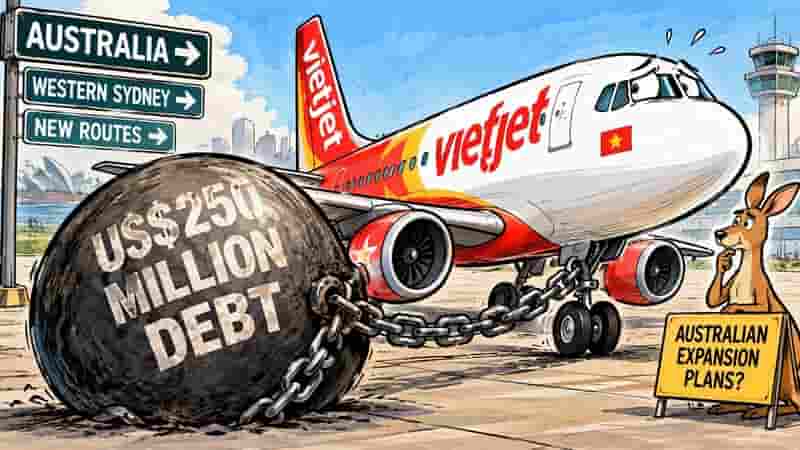
Vietnamese budget carrier Vietjet has been hit with a worldwide asset-freezing order after a British judge concluded the airline was unwilling, not unable, to pay a US$250 million debt. Its ambitious Australian expansion plans now face some awkward questions.
Vietjet has discovered that while aircraft can cross international borders with remarkable ease, unpaid court judgments have an irritating habit of following them.
A London High Court judge has granted a worldwide freezing order against the Vietnamese airline following a five-year dispute over four Airbus A321 aircraft.
The carrier is still flying. Its passengers are still travelling. But its creditors have apparently had enough of waiting for their money.
The order, issued on 15 October 2026, follows a series of judgments requiring Vietjet to pay approximately US$250 million to aircraft finance company FW Aviation (Holdings) 1 Limited.
The amount represents roughly A$360 million, depending on exchange rates.
Mr Justice Pushpinder Singh Saini was distinctly unimpressed by Vietjet’s approach to settling the bill.
The judge found that the evidence supported describing the carrier as a “won’t pay” rather than a “can’t pay” debtor.
This distinction is unlikely to feature prominently in Vietjet’s next promotional campaign.
The dispute began with four Airbus A321 aircraft leased under financing arrangements known as Japanese Operating Leases with Call Options.
Vietjet missed rental payments during the COVID-19 pandemic. The leases were terminated in October 2021, and the aircraft were recovered.
Unfortunately for Vietjet, returning the aircraft did not eliminate its outstanding financial obligations.
In April 2025, the English High Court ordered the airline to pay approximately US$182 million, plus interest and costs. A further judgment in July 2026 added more than US$18 million.
By October, the total outstanding judgment debt had reached approximately US$250 million.
Vietjet had paid just US$2 million towards it, according to the court.
The airline’s reluctance to settle was particularly striking given its apparent financial strength.
The judgment recorded Vietjet’s market capitalisation at more than US$3.8 billion and total assets of about US$5.4 billion.
The airline has also continued ordering aircraft from Boeing and Airbus.
Apparently, raising money for new aircraft and paying old judgments are different exercises.
The court examined transactions involving Angelica Holding Limited, a Cayman Islands company connected with valuable economic rights in Vietjet’s future aircraft order book.
Justice Saini found that agreements had transferred essentially all the economic value of the relevant order book, as it stood in December 2024, to Angelica.
He described the receivables supposedly due to Vietjet in exchange as “wholly illusory”.
Vietjet argued that the arrangements were legitimate financing transactions.
The judge disagreed, finding that the evidence did not dispel the risk of assets being moved beyond creditors’ reach.
He concluded that solid evidence showed a real risk of asset dissipation.
That finding justified the worldwide freezing order.
The court also approved separate arrangements for receivers to pursue enforcement against a broad range of Vietjet assets.
The freezing order restricts dealings with assets, subject to its terms and exceptions. It is not a wholesale seizure of the airline’s fleet.
Ordinary and proper business transactions may continue.
Vietjet has not been declared bankrupt, and the judgment does not prevent its aircraft from operating scheduled services.
That is an important distinction for Australian travellers.
For Australian aviation, however, the story has another dimension.
Vietjet has been linked to plans for a domestic Australian airline through Melbourne-based Cherrie Aviation.
In September, Australia registered a Boeing 737 MAX 8 as VH-T8A, with Vietjet listed as the owner and Cherrie Aviation as the registered operator.
Vietjet confirmed that it had agreed to lease the aircraft to an Australian entity seeking regulatory approval.
An aircraft registration, however, is not an airline operating licence.
The proposed operation still requires the necessary approvals from Australia’s Civil Aviation Safety Authority.
There is no evidence that the British court ruling has caused CASA to reject the venture.
Nevertheless, financiers and commercial partners may have some additional questions about aircraft leasing and ownership arrangements.
Western Sydney International Airport also has an interest in the outcome.
Vietjet has announced plans to launch Ho Chi Minh City–Western Sydney services in January 2027, initially twice weekly, increasing to three flights a week in March.
The airline’s own announcement identifies 9 January as the commencement date, while Australian Government material refers more generally to January.
The flights are planned to use Airbus A330 aircraft, each carrying up to 377 passengers.
Vietjet Thailand has also announced plans for four weekly Bangkok services from November 2027, subject to regulatory approvals.
The new routes are important to Western Sydney’s efforts to establish itself as a major international gateway.
They could also provide welcome competition for passengers travelling between Australia and Southeast Asia.
No confirmed evidence suggests the freezing order has led Vietjet to cancel or postpone either Australian expansion proposal.
But the airline’s legal difficulties will undoubtedly attract attention in an industry where aircraft financing is rarely a minor consideration.
FW Aviation has already pursued enforcement proceedings in several countries, including Australia, Singapore, Malaysia and France.
In Singapore, the English court found that Vietjet stopped operating certain aircraft into the country after measures were obtained to facilitate their seizure.
In Australia, the dispute has also reached Queensland courts through proceedings concerning recognition and enforcement of the English judgments.
Vietjet has challenged enforcement and argued that restrictions on transferring money from Vietnam have complicated payment.
Vietnamese courts have declined to recognise the principal English judgment.
The English court nevertheless concluded that the worldwide freezing order was justified.
For the airline’s passengers, the immediate position remains straightforward. The ruling does not automatically invalidate tickets or cancel flights.
For the airline’s creditors, the situation is rather less satisfactory.
For Australia’s aviation industry, Vietjet’s proposed expansion now faces a legal complication that will be hard to overlook.
Vietjet continues to announce new routes, acquire aircraft and pursue new markets.
Its creditors continue to pursue approximately US$250 million.
The aircraft may be taking off on schedule.
Meanwhile, the debt has been waiting at the gate for five years.
By: Christine Nguyen – © 2026.
Read Time: 5 minutes.
Author Bio:
 Christine’s story is one of quiet courage, told without fuss and lived with remarkable grace. She arrived in Australia as a young refugee from Vietnam, carrying little more than hope, family, and a curiosity that refused to be extinguished. Sydney became home, built patiently, brick by careful brick.
She studied Tourism at TAFE and soon found her place in inbound travel, working with one of the city’s leading destination companies. Christine loved showing visitors the Australia that lives beyond postcards, warmer, truer, and far more interesting.
When the sea began to whisper, and life asked for a gentler rhythm, she listened. Designing brochures, writing blogs, she discovered storytelling waiting quietly inside her.
Today, at EGT Media, Christine writes with warmth and wisdom, reminding us, softly and persuasively, why travel still matters.











