

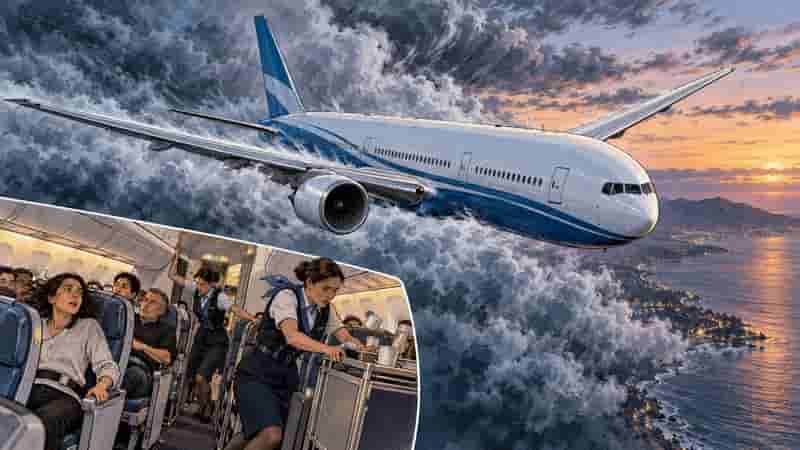
A routine flight from Hawaii to Los Angeles turned into an airborne fright show, leaving four cabin crew injured and passengers wondering what happened to the friendly skies.
An airline ticket from Honolulu to Los Angeles usually includes an ocean crossing, a film or two, and the reasonable expectation that the floor will stay beneath your feet.
Passengers aboard United Airlines flight UA1157 discovered on Wednesday that the final item is not always as dependable as it sounds.
A sudden encounter with severe turbulence during descent into Los Angeles International Airport left four flight attendants needing medical attention. One was taken to hospital. All 190 passengers escaped without reported injury, though some may now regard the seatbelt sign with newfound respect.
There were 10 crew members on board the Boeing 777-200, which landed safely on the evening of 21 October 2026.
It was an ordinary trans-Pacific service until, for a few seconds, it wasn’t.
A film with unexpected special effects
San Diego passenger Marly Wadlington was watching a movie when the aircraft lurched. She told ABC7 Los Angeles it felt as though the plane had dropped, prompting screams and alarm in the cabin.
Another passenger, Coral Pena, recalled hearing a loud bang. A traveller reported seeing an injured flight attendant with blood on her head and leg.
It is hard to imagine a less welcome interruption to an in-flight film. At least at the cinema, the floor generally stays put.
The pilot reportedly told air traffic control the disturbance lasted only a few seconds and “felt like wake turbulence”. He also reported that the flight was smooth again.
Wake turbulence is the disturbed air left behind another aircraft, including vortices that can persist after the aircraft generating them has passed.
The pilot’s description is a possible explanation, not the result of an investigation. The US Federal Aviation Administration (FAA) has said it will investigate the incident.
Following the landing, emergency medical personnel attended to the injured staff. United said four flight attendants were examined and one was taken to hospital for further treatment. The airline reported no passenger injuries.
ABC7 said the aircraft remained on the tarmac for at least half an hour after landing before reaching a gate.
That would be an unwelcome delay on an ordinary flight. With injured colleagues aboard, it was anything but ordinary.
The 3,000-foot drop that needs explaining
The incident quickly acquired an eye-catching extra detail: the United jet had supposedly ‘plunged’ more than 3,000 feet.
According to the Los Angeles Times, flight-tracking data showed UA1157 descending about 3,675 feet (approximately 1,120 metres) in one minute during the last 20 minutes of its journey.
The number is real enough. The interpretation is another matter.
The Boeing was approaching Los Angeles and was already descending. Aeroplanes are expected to lose altitude before landing; otherwise, it is difficult to reach the runway.
That recorded minute of descent does not prove that turbulence caused an uncontrolled 3,675-foot fall.
Establishing whether there was any unexpected deviation, and how severe it was, requires evidence beyond a public flight-tracking graph.
The passengers’ fright was genuine. So were the crew injuries. Neither needs an inflated altitude claim to make the story worth reporting.
Hawaii has seen worse
The Pacific has produced other unpleasant surprises for airline travellers.
In December 2022, Hawaiian Airlines flight HA35 from Phoenix to Honolulu struck severe turbulence near Maui.
The US National Transportation Safety Board’s (NTSB) final investigation recorded 24 injured people, four of them seriously.
Investigators attributed the encounter to the crew’s decision to fly over a developing storm cell despite information indicating the potential for severe convective weather.
In June 2023, turbulence interrupted Hawaiian Airlines flight HA451 from Honolulu to Sydney.
Four passengers and three flight attendants initially needed medical attention, and three people were taken to hospital after the aircraft arrived in Sydney.
These incidents underline the consequences of violent air movement.
They do not establish that the same weather phenomenon caused the latest United encounter, nor that a particular Pacific flight is unusually dangerous.
The people who cannot simply buckle up
Anyone who flies regularly knows the familiar instruction to keep a seatbelt fastened while seated.
Cabin crew don’t have the luxury of doing so the entire flight.
They check the cabin, assist passengers, move through the aisles, and secure equipment. When an aircraft jolts without warning, being upright can become a considerable disadvantage.
The FAA’s published figures for 2019 to 2024 list 71 serious turbulence-related injuries among crew members and 13 among passengers.
Based on those category figures, crew accounted for about 85 per cent of cases. The FAA uses ‘crew’ as a category; the statistic should not be mistaken for a count of flight attendants alone.
It is a sobering imbalance. And unlike a Hollywood disaster film, there is no stunt double waiting beside the drinks trolley.
Are the skies getting bumpier?
Some kinds of turbulence have increased, but it is important not to confuse long-term trends with the cause of any single incident.
University of Reading researchers found that the annual duration of severe clear-air turbulence at a representative North Atlantic location increased by 55 per cent between 1979 and 2020.
They linked wider changes in atmospheric wind shear to a warming climate.
That does not mean turbulence increased by 55 per cent everywhere. Nor does it establish whether UA1157 encountered wake turbulence, clear-air turbulence or something else.
Investigators must settle that question.
For now, the practical advice has hardly changed since the early days of jet travel: fasten your seat belt when seated, listen to the crew, and don’t assume smooth air will stay smooth.
United flight UA1157 arrived safely in Los Angeles. Four flight attendants had a much rougher journey than anyone expected.
And while the aviation industry continues to improve forecasting and reporting, one old-fashioned item of cabin equipment remains remarkably effective: the humble seatbelt.
Not glamorous, admittedly. But more useful than the in-flight movie when the atmosphere decides to improvise.
By: John Alwyn-Jones – © 2026.
Read Time: 5 minutes.
Author Bio:
 John Alwyn-Jones is one of those rare figures who can make the business of travel sound positively adventurous.
A lifelong communicator with the polish of a broadcaster and the curiosity of a journalist, he’s spent decades shaping stories and strategies across tourism, aviation, and the cruise world. He’s led from the front as CEO, director, mentor, and advisor, and still brings warmth and wit to every boardroom and microphone.
Known for his sharp insight into global cruise lines and destinations, John has an old-school belief in professionalism, tempered with the sparkle of someone who’s genuinely seen the world. He’s not just in the travel business; he’s made it an art form.











