

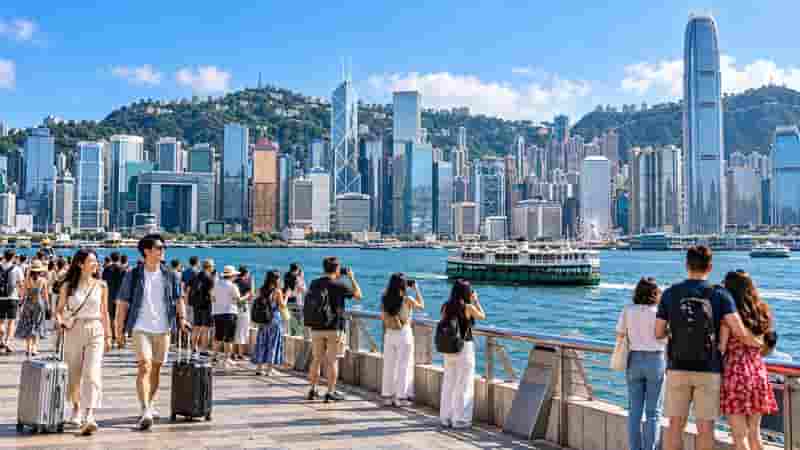
Hong Kong has rediscovered one of its favourite sounds: the rattle of suitcase wheels, preferably accompanied by the rustle of somebody else’s money.
The airport is busy. Border crossings are bustling. Concerts and sporting events are filling seats. And Victoria Harbour, never a destination inclined towards modesty, is once again providing the grand entrance that travel brochures dream about.
But an awkward detail mars Hong Kong’s celebrated tourism recovery. More people are arriving, yet fewer are staying overnight, at least in the latest monthly figures. This arithmetic deserves more attention than another photograph of a smiling arrival holding a shopping bag.
The question is no longer simply whether tourists are returning. They are. The more important question is whether the recovery is producing lasting business for hotels, restaurants, independent operators and the wider visitor economy or whether too many of its rewards disappear across the border before bedtime.
The Hong Kong tourism boom has a curious catch
The Hong Kong Tourism Board’s detailed August 2026 report, published in September, records 5,456,320 visitor arrivals during the month, up 5.9 per cent from August 2025. That was the strongest monthly arrival count since the pandemic. From January to August, Hong Kong received 36,672,650 visits, up 10.5 per cent.
Fine numbers, certainly. Now read the next page.
Overnight arrivals fell 3.7 per cent in August, to 2,209,663. Same-day arrivals, by contrast, surged 13.6 per cent to 3,246,657. Over the first eight months, overnight arrivals rose only 0.4 per cent to 15,696,391 while same-day visits climbed 19.5 per cent to 20,976,259.
That is the story hiding behind the applause. Hong Kong’s arrival count is growing much faster than its pool of overnight visitors. The headline doesn’t mean hotels are empty; hotel trading has improved. It does mean the type of visitor driving growth deserves serious examination.
An arrival is a recorded visit, not necessarily a different individual, a hotel booking or a night out in the city. Someone crossing the border repeatedly can contribute multiple arrivals. The industry therefore needs to look beyond the turnstile to understand the economic return.
Mainland numbers climb as short-haul markets stumble
Mainland China accounted for 4,569,228 August arrivals, up 8.2 per cent, and remains Hong Kong’s largest source market by far. Non-mainland arrivals slipped 4.6 per cent, to 887,092.
Among short-haul markets excluding mainland China and Macao, August arrivals dropped 16.2 per cent. The Philippines fell 28.5 per cent, Japan 25.2 per cent and South Korea 19.9 per cent. Not every nearby market retreated: Singapore rose 8.6 per cent.
Long-haul arrivals offered a happier counterpoint, rising 18 per cent. Australian arrivals advanced 26.6 per cent to 26,508 in August; Australian overnight arrivals rose 21 per cent to 17,814. From January to August, Australian visits rose 20.2 per cent to 327,864.
Those Australian figures are encouraging for airlines, destination marketers and travel advisers. They also suggest room to build more substantial stays from markets willing to travel further. The tourism board has acknowledged that flight capacity, fuel surcharges and regional competition remain challenges for some short-haul markets.
However, it would be a mistake to assume every nationality or trip type behaves alike. Hong Kong’s recovery has several moving parts, and a useful tourism strategy must account for each.
One extra night can mean a great deal
The difference between an overnight guest and a day visitor is not a matter of snobbery. It is a matter of spending opportunities.
In a July 2026 Legislative Council response, the Hong Kong Government reported average 2025 spending of HK$5,503 per overnight visitor, compared with HK$1,139 per same-day visitor. For 2026, it forecast overnight spending of HK$5,530 per person, with same-day spending expected to remain near its 2025 level.
These are different visitor groups, with different itineraries and budgets; the figures do not prove that persuading any particular day visitor to stay an extra night would produce the entire difference. Nevertheless, they show why overnight tourism matters commercially.
A night in the city creates the possibility of accommodation revenue, dinner, breakfast, another local journey and perhaps a guided experience. After two nights, even the most disciplined traveller may discover a market, a neighbourhood restaurant, or a bar that wasn’t on the original list.
Day visitors matter too. They use transport, eat, shop and attend events. Hong Kong’s Government is right to stress that their contribution should not be dismissed. But a destination chasing economic value cannot afford to treat an afternoon visit and a three-night holiday as interchangeable achievements.
Hotels look healthier, although profits need scrutiny
A welcome complication to the overnight-arrivals story is that hotels have been reporting stronger operating performance.
According to Colliers’ August 2026 hospitality research, first-half hotel occupancy averaged 86 per cent. The average daily room rate rose 7.6 per cent to HK$1,313, while revenue per available room increased 8.9 per cent to HK$1,129.
Those figures describe the first half, not August alone, and they reflect room performance rather than hotel profitability. They are nevertheless encouraging. Guests don’t always prefer more expensive rooms, but they can be an attractive proposition to owners if costs behave.
Colliers warns that higher operating costs and pressure on food-and-beverage and other non-room revenue are still squeezing margins. It also reports investor interest in buying existing hotels to convert into student accommodation and other living-sector uses.
That is not necessarily bad for property investors. For tourism operators, however, it raises questions about the future accommodation mix, particularly in the midscale segment. A city needs more than glamorous suites to welcome families, younger travellers, tour groups, and visitors on sensible budgets.
The lesson is straightforward: occupancy, room revenue and profit are three different measures. A busy lobby is promising, but the accounts department has the final say.
Retail has improved, but not every till is ringing
Hong Kong has earned its reputation as a shopping destination over decades. The current retail picture, however, resists a simple comeback narrative.
According to the Census and Statistics Department’s 2 October release, August 2026 retail sales were provisionally estimated at HK$32.1 billion, up 5.6 per cent in value year on year. For the first eight months, retail sales value rose 8.5 per cent.
But the individual categories tell very different stories. Jewellery, watches, clocks and valuable gifts rose 11.9 per cent. Wearing apparel declined 0.5 per cent, and department-store sales fell 2.6 per cent. Online sales, meanwhile, increased 9.9 per cent in August.
Nor should visitors account for the entire retail increase. Official retail statistics include purchases by local residents and tourists, and they measure goods rather than services such as hotel stays and restaurant meals. Sales value also differs from inflation-adjusted sales volume.
For the independent shopkeeper, a rise in overall retail sales is pleasant reading but no substitute for customers through the door. A high-end jeweller and a family-run neighbourhood business may experience the same tourism boom quite differently. Available citywide statistics cannot show exactly how the benefits are divided.
That distribution deserves attention. The challenge is to turn international interest in Hong Kong’s shopping and culture into business beyond a handful of familiar commercial districts.
Cruise ships return, but what happens ashore?
Cruise tourism is another genuine bright spot. In a May 2026 Legislative Council reply, the Government reported 189 cruise-ship calls in 2025, up 26 per cent, and approximately 631,000 passenger movements, up 22 per cent, across vessels from 22 international cruise brands.
A separate tourism-board announcement referred to approximately 430,000 inbound cruise visitors in 2025. These statistics measure different things. Passenger movements are not the same as unique travellers, and you must not add the two totals together.
For cruise companies, Hong Kong offers clear selling points: Victoria Harbour’s spectacular setting, international air links, Kai Tak Cruise Terminal, Ocean Terminal, and the prospect of wider Asian itineraries.
But a cruise call is an opportunity, not a guaranteed windfall for every shore-based business. Passengers may take a brief excursion and return to their ship, or they may book a guide, explore local restaurants and extend their visit with a hotel stay. Cruise calls also support port services, transport and provisioning, so their economic contribution extends beyond passengers’ shopping bags.
For the travel trade, the sensible opportunity is to make it easier to arrive before a sailing or stay afterwards. A two-night Hong Kong extension can turn a port call into a destination experience, giving local suppliers more scope to earn a share.
The mega-event test: applause is not a business model
Concerts, sport, conventions and cultural festivals are central to Hong Kong’s visitor strategy. Events including the Hong Kong Football Festival and the TMElive International Music Awards helped draw attention and visitors in August, according to the tourism board.
The Government has set a 2026 target of 53.8 million visitor arrivals. It also expects total inbound tourism expenditure to reach HK$238.1 billion in 2026, up from HK$217.5 billion in 2025. The former is a target and the latter is a forecast, not an end-of-year result.
In her 18 March 2026 tourism keynote, Secretary for Culture, Sports and Tourism Rosanna Law put the ambition plainly: “we are not just chasing numbers; we are pursuing value, quality and lasting impact.”
An excellent ambition. Now comes the difficult bit: proving that it reaches beyond ticket counters and stadium gates.
A successful event may produce restaurant bookings, taxi journeys, hotel nights, jobs and spending in surrounding districts. It may also attract day visitors who return home immediately afterwards. To judge its wider return, the industry needs transparent evidence of where visitors go, how long they stay and what they spend, not merely an attendance figure large enough to frighten the printer.
That makes neighbourhood experiences especially important. Sham Shui Po’s markets, Yau Ma Tei’s food scene, Sheung Wan’s galleries and the outlying islands can offer the sort of local discovery that a rushed airport-to-stadium visit simply cannot deliver. Promoting those experiences is one thing; making them visible, bookable and commercially rewarding for local operators is another.
What Australian travel advisers can sell now?
For Australian advisers, the strongest Hong Kong proposition is not simply a convenient connection. It is a chance to build a worthwhile city stay around an Asian cruise, a family trip, a cultural festival, or a broader Greater Bay Area itinerary.
Package the essentials carefully: realistic transfer times, a hotel in a suitable district, accessible local experiences and enough free time to discover why Hong Kong has kept travellers talking for generations. A stopover that allows only a hurried airport transfer and a skyline photo sells the destination short.
Australian visitor growth in 2026 provides a reason to revisit Hong Kong itineraries. It does not, by itself, tell agents which hotels or operators offer the best value. That requires current supplier information, sensible commissions, clear cancellation conditions and products that genuinely suit the traveller.
For tourism authorities and hotel groups, advisers can also offer something particularly valuable: turning interest into longer, better-planned visits. Nobody needs another itinerary designed entirely around a duty-free receipt.
Hong Kong’s real victory will be measured after checkout
Hong Kong deserves credit for rebuilding visitor demand. Its attractions, restaurants, hotels, and events calendar offer plenty, and the latest data show strong momentum in overall arrivals and long-haul markets.
But August’s detailed figures reveal an uncomfortable contrast: total arrivals increased while overnight arrivals declined. Year-to-date through August, day visits accounted for much of the growth. Meanwhile, hotels have recorded stronger room revenue, and retail performance remains uneven.
None of those findings means that tourism is failing. They mean the recovery is complex, and no single headline number tells the whole story.
To determine who really benefits, Hong Kong will need continued reporting on visitor expenditure, nights stayed, local business revenue, hotel costs and the performance of districts beyond the conventional tourist trail. The published figures offer strong clues, but they don’t map every dollar to its final recipient.
The crowds are back. Wonderful. The greater triumph will come when more of those crowds stay for dinner, stay for breakfast and leave enough business behind to make the welcome sustainable.
After all, a full house looks impressive. A full house that pays its bills is something worth celebrating.
By Michelle Warner – © 2026.
Read Time: 12 minutes.
Author Bio:
 Michelle Warner has always carried stories the way others carry passports lightly, faithfully, and with purpose. She learned her craft in newsrooms, shaping sentences with care, before swapping deadlines for departures as a flight attendant with some of the world’s great airlines. Years aloft sharpened her eye for character and deepened her fondness for travel’s small, dignified rituals: the quiet kindness of strangers, the poetry of arrival, the patience learned between time zones.
Now grounded by choice, Michelle has come home to writing with the same calm authority she once brought to turbulent cabins. Her prose blends an editor’s discipline with a traveller’s wonder, tinged with humour and reverence for the golden age of travel. Each piece feels like a handwritten boarding pass, gracious, observant, and unmistakably alive.











