

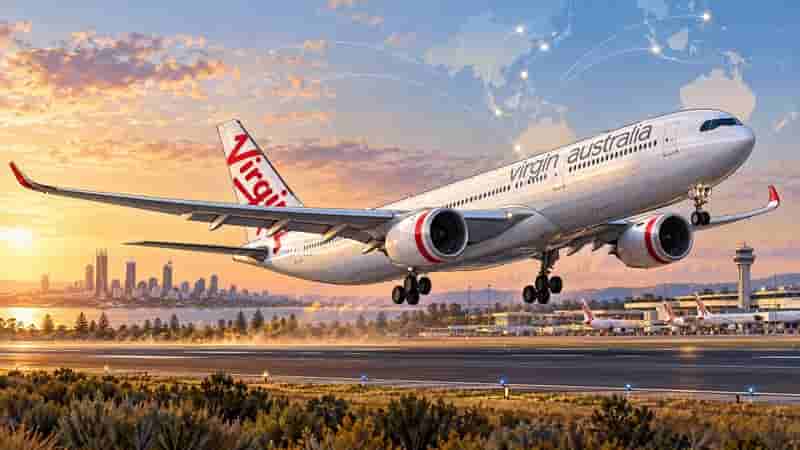
Cabin crew-sourced whispers point to a possible return flight on a 343-seat Airbus, with Perth and Asia in the frame. But the airline has announced no such plan.
One does not normally expect an aircraft rumour to interrupt a perfectly good cup of coffee. Yet talk of a possible Virgin Australia Airbus A330-900neo fleet has managed precisely that.
If the information proves correct, the airline could consider returning to its own widebody aircraft around 2028, with transcontinental flights and selected Asian destinations among the suggested assignments.
That, however, is a very large if.
The claims, attributed to reported conversations with Virgin Australia cabin crew and information shared on earlier occasions, describe an A330-900neo seating 343 passengers. Neither the proposed aircraft acquisition nor the seating plan, timetable or routes have been independently substantiated.
Virgin Australia has not publicly announced an A330-900neo order or confirmed a 2028 introduction. For now, this is an intriguing aviation lead, not an aircraft waiting at the departure gate.
What Virgin Australia has actually announced
The airline’s published fleet programme tells a more conventional, Boeing-shaped story.
In June 2026, Virgin Australia confirmed that its first Boeing 737-10 was expected in late 2027, subject to Boeing’s certification progress. It has 10 firm orders for the type, which it described as the future largest aircraft in its fleet.
Chief executive Dave Emerson said: “The 737-10 will be the largest aircraft in Virgin Australia’s fleet and will give us more capacity and more flexibility across our network.”
That statement was made about the airline’s announced fleet, not a hypothetical A330neo operation. It does not rule out future widebodies, but it also does not establish a secret Airbus programme.
There is another reason the suggestion merits serious scrutiny. Emerson has previously acknowledged that Virgin could revisit the business case for operating widebody aircraft. Reporting in July 2025 indicated any ordering decision remained several years away, with the airline keen to understand the economics of its Qatar Airways partnership first.
In short, the door has not been slammed. Nobody has confirmed anyone is walking through it, either.
The 343-seat mystery: 56 Business, 287 Economy
The reported A330neo configuration is unusually specific: 56 Business Class seats and 287 Economy seats, giving a total of 343 passengers.
According to the account, Business Class would be arranged seven abreast in a 2-3-2 layout. Economy would use the familiar A330 eight-abreast 2-4-2 arrangement, with 152 seats in a forward section and 135 in the rear.
The arithmetic works. The commercial logic needs further examination.
Airbus lists the A330-900’s maximum published seating capacity at 465 passengers, so a 343-seat proposal falls within the aircraft’s overall capacity. But a 56-seat Business cabin with a middle seat in each three-seat centre block would be an unusual offering for a modern international premium product.
Perhaps the proposed layout reflects a domestic-focused cabin rather than a conventional long-haul suite. Perhaps the figures are preliminary. Or perhaps the grapevine has developed a few extra branches.
Without an airline-approved cabin diagram, none of those explanations can be presented as fact.
Perth could be the natural starting point
The reported domestic routes would link Perth with Sydney, Melbourne and Brisbane.
Here, at least, history provides a useful compass.
Virgin Australia previously operated Airbus A330-200 aircraft on major transcontinental services, offering a widebody alternative to the narrowbody fleets serving the east–west market. Perth business travellers of a certain vintage will recall those aircraft rather fondly, particularly the additional space up front.
A new-generation A330neo could potentially offer more seats on busy departures while providing capacity for baggage and freight. Yet deploying a large twin-aisle jet is not automatically more profitable than flying smaller aircraft more frequently.
Business demand, aircraft utilisation, scheduling, airport costs and yields would have to justify the investment. An impressive aircraft is one thing; an impressive balance sheet is quite another.
Tokyo, Hong Kong and Bali: an ambitious Asian wish list
The international possibilities are where this whisper becomes positively operatic.
The routes mentioned are Brisbane and Sydney to Tokyo; Brisbane and Sydney to Hong Kong; and Brisbane and Sydney to Bali.
Tokyo would represent a fresh challenge. Virgin withdrew its Cairns-Tokyo Haneda service from 24 February 2025, citing the weak recovery in Japanese visitors to Australia and unfavourable route economics. Any future Sydney or Brisbane service would require a new commercial case, not simply a bigger aircraft.
Hong Kong has its own history. Virgin ended Melbourne-Hong Kong services in February 2020 and Sydney–Hong Kong flights on 2 March that year. A return would therefore be noteworthy, but no plan to restart those routes has been confirmed.
Bali is different. Virgin already operates direct services from Brisbane and Sydney to Denpasar, so an A330neo on either route would be a possible aircraft upgauge rather than the launch of an entirely new destination.
Mind you, when Australians set their hearts on Bali, it sometimes seems the suitcases reach the airport before their owners have checked their passports.
The demand is evident. Whether that demand would support the economics of the rumoured aircraft is a separate question.
Ten cabin crew and another unanswered question
One further detail in the account suggests approximately 10 cabin crew, with two allocated to Business Class and eight to Economy.
Again, this is a reported proposal, not an approved staffing arrangement. Actual crew numbers and duties would depend on the certified aircraft layout, applicable safety requirements, service design and operating procedures.
The suggested allocation raises an obvious service question: how would two attendants deliver the promised premium experience to 56 Business passengers, particularly on longer Asian sectors?
Until the airline confirms a staffing model, it would be premature to treat the numbers as anything more than an unverified indication.
The Qatar Airways factor cannot be ignored
Virgin Australia’s long-haul ambitions must also be viewed through its partnership with Qatar Airways.
The airlines have established a wet-lease arrangement under which Qatar Airways provides aircraft and crew for Virgin Australia-coded Doha flights. That allows Virgin to participate in long-haul markets without immediately taking on the full capital and operating burden of its own widebody fleet.
Buying or leasing A330neos for Virgin to operate itself would be a distinctly different proposition. Aircraft acquisition, pilot training, engineering support, cabin staffing, and international route rights all require substantial commitments.
The rumoured 2028 date is therefore worth discussing, but impossible to endorse without evidence of aircraft availability, a fleet decision, and a credible introduction programme.
So, are the big birds coming back?
Important questions still await answers. Has Virgin Australia genuinely examined the A330-900neo? Are the 343-seat figures linked to a real planning exercise? Is 2028 a target, an aspiration or merely a date that has travelled enthusiastically through the crew room?
And, perhaps most importantly, does the airline see a sufficiently profitable reason to put its own widebodies back into service?
For the moment, the answers remain unknown.
The potential story is substantial because a Virgin-operated A330neo fleet could reshape competition on Australia’s transcontinental routes and selected services into Asia. It would also mark a significant departure from the airline’s present fleet strategy.
But industry intelligence and confirmed corporate strategy are different.
The Airbus-shaped rabbit may yet emerge from the hangar. Until then, the sensible instruction is to keep watching the departure board.
Status: unconfirmed. Excitement level: rather higher.
By: John Alwyn-Jones – © 2026.
Read Time: 8 minutes.
Author Bio:
 John Alwyn-Jones is one of those rare figures who can make the business of travel sound positively adventurous.
A lifelong communicator with the polish of a broadcaster and the curiosity of a journalist, he’s spent decades shaping stories and strategies across tourism, aviation, and the cruise world. He’s led from the front as CEO, director, mentor, and advisor, and still brings warmth and wit to every boardroom and microphone.
Known for his sharp insight into global cruise lines and destinations, John has an old-school belief in professionalism, tempered with the sparkle of someone who’s genuinely seen the world. He’s not just in the travel business; he’s made it an art form.











