


Philippine Airlines has stormed into the Farnborough International Airshow with both hands on the widebody chequebook.
In just two days, the Philippine flag carrier revealed plans for as many as 29 new long-range jets from Boeing and Airbus. It first committed to order up to 20 Boeing 787-10 Dreamliners. It then signed a Memorandum of Understanding for nine more Airbus A350-1000s.
Neither deal is yet a final firm order. Even so, the combined move is a bold statement. PAL wants to grow across Asia, North America and other key markets. It also wants a younger, more efficient fleet with a stronger premium product.
At Farnborough, aircraft makers arrive with glossy displays and airlines arrive with serious shopping lists. PAL has gone one step further. It has presented a clear plan for the next stage of its global network.
Boeing Dreamliner commitment breaks PAL records
The Boeing commitment covers 15 787-10s, with rights to buy five more. Once finalised, Boeing says it will be PAL’s largest-ever widebody order.
The jets will join the airline’s fleet of 10 Boeing 777s. They will support medium- and long-haul routes while giving PAL more freedom to match aircraft capacity with demand.
A day later, PAL raised the stakes with Airbus. Its Memorandum of Understanding covers nine more A350-1000s. Should it become a firm order, PAL’s total commitment for the aircraft will double to 18.
Two A350-1000s have already joined the airline. Airbus delivered the first in December 2025, making PAL the tenth airline worldwide to operate the largest A350 variant. The second was assigned to PAL’s Manila–Toronto service from June 2026.
This is not a case of an airline being unable to choose between two fine aircraft. The Dreamliner and the A350-1000 are being lined up for different jobs.
A350-1000 takes the flagship role
The 382-seat A350-1000 is PAL’s long-range flagship. Its cabin has three classes.
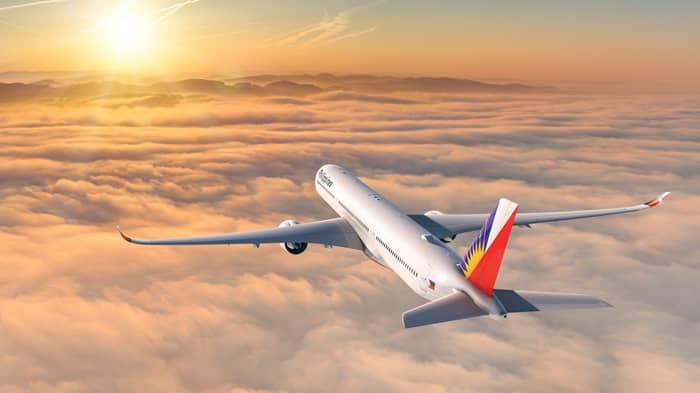
Rendering of Philippine Airlines A350-1000 © Airbus
There are 42 Business Class suites with privacy doors and fully flat beds. Premium Economy has 24 seats, while Economy has 316. Every cabin will offer updated entertainment and connectivity.
PAL plans to use the aircraft to grow in the premium transpacific market. Its ambitions include non-stop flights between Manila and cities on the east coasts of the United States and Canada.
The 787-10 has a different role. It gives PAL a large and efficient jet for medium- and long-haul flying.
Boeing lists space for between 300 and 375 passengers. The aircraft can fly up to 13,890 kilometres, depending on its configuration and operating conditions.
That mix gives PAL more choice. It can match aircraft size, range and cost with each route.
In plain English, the A350-1000 is the long-distance thoroughbred. The 787-10 is the flexible workhorse with a sharp eye on the fuel bill.
Airlines may sell dreams. Accountants still insist on spreadsheets.
PAL backs continued growth in international travel
Lucio C. Tan III, president and chief operating officer of PAL Holdings, said the Boeing investment showed “our confidence in the future of Philippine Airlines and the continued growth of air travel”.
Speaking about the Airbus deal, Tan said: “The A350-1000 will continue to define the future of our international operations for many years to come.”
Both aircraft makers claim major gains in efficiency.
Boeing says the composite 787 uses 25 per cent less fuel than the aircraft it usually replaces. Airbus says the A350 offers a 25 per cent gain in fuel use, operating costs and carbon dioxide emissions against previous-generation competitor aircraft.
Such claims need context. Real results depend on the route, cabin, payload, weather and operating method.
Yet the broad case is strong. New jets can cut the cost per seat. They can also improve reliability and give passengers a better journey.
Passenger comfort becomes a commercial weapon
The cabin is a major part of that business case.
The Dreamliner has large dimmable windows and higher cabin humidity. It also uses technology designed to reduce the effect of turbulence and provide a smoother ride.
PAL’s A350-1000 carries its newest premium product. Business Class has private suites. Premium Economy sits in its own cabin. Every class has modern entertainment and connectivity.
For travel advisers and corporate buyers, these details matter. Aircraft type can shape the whole journey.
A better cabin, a non-stop flight and a useful schedule can turn a difficult trip into a far easier sale. It may also support higher-value bookings from passengers prepared to pay for privacy, rest and fewer connections.
Profits provide a platform for growth
There is also a wider business story.
PAL reported net income of US$160.4 million for 2025. It carried 16.3 million passengers, an increase of 4.3 per cent from the year before. The airline is entering this growth phase with renewed commercial confidence.
Big fleet plans still bring risk. PAL must fund the aircraft, train crews and manage delivery dates. It must also add capacity with care.
Too many seats at the wrong time can make even a beautiful new jet look rather less glamorous.
Using both Boeing and Airbus may spread some commercial and fleet-planning risk. PAL already flies Airbus A330s, A320s and A321s, as well as Boeing 777s.
Adding more A350-1000s and bringing in the 787-10 will give it a wider set of tools. It will also add behind-the-scenes work.
The airline will need more training, spare parts, engineering support and maintenance planning. Fleet management rarely earns a glossy travel brochure, but it keeps the brochure promise in the air.
What the fleet plan means for Australia
For Australian travellers, the announcements do not yet confirm new routes or aircraft changes.
PAL currently uses A330-300s on services to Australia, as well as to the Middle East and destinations across Asia.
Still, the wider renewal should give the airline more freedom to adjust seats, schedules and connections through Manila as new aircraft arrive.
That could eventually strengthen PAL’s appeal as a one-stop carrier between Australia, the Philippines, North America and other Asian markets. However, specific Australian deployments will depend on future network decisions.
An 85-year-old airline looks firmly ahead
The timing carries weight.
Philippine Airlines marked its 85th anniversary in 2026. Its partnership with Boeing also reached 80 years. At the same time, its Airbus relationship is growing fast, with the A350-1000 now serving as PAL’s flagship.
Boeing Commercial Aeroplanes president and chief executive Stephanie Pope called the Dreamliner choice an important step in the long partnership.
Airbus executive vice-president sales Benoît de Saint-Exupéry said the A350-1000 was well suited to PAL’s future premium transpacific growth.
The figures are large, but the message is simple.
PAL is not merely replacing old aircraft. It is building a two-part widebody fleet that can fly farther, compete harder and carry more people in comfort.
Contracts still need to be signed. Delivery slots must be secured. Route plans will take time.
Yet PAL has used Farnborough to put its rivals on notice.
Asia’s oldest commercial airline is planning its future with two modern flagships, up to 29 new jets and not a trace of retirement in its flight plan.
By: Octavia Koo – © 2026.
Read Time: 2 minutes.
Author Bio:
 Octavia Koo arrived in Australia in the early eighties with little fuss and a good eye. Sydney suited her. At UNSW, she studied Arts, then found her footing in graphic design before drifting, quite naturally, into the digital side of things, building websites and shaping words that made people want to stay.
Singapore followed, and with it, the fast pace of tourism platforms and ITB Asia. Long before SEO became a buzzword, Octavia understood how stories travelled online. That’s where she met Stephen, and the seed for something more was planted.
A few years later, she joined Global Travel Media.
Today, Octavia works with quiet assurance, blending art, instinct and experience to produce stories that don’t shout; they simply work and linger.











