

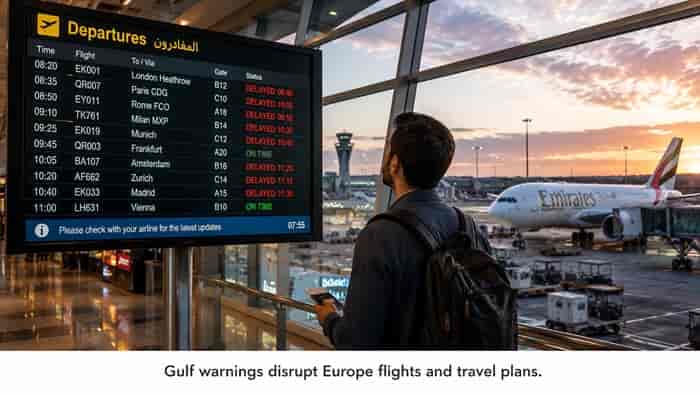
Australia’s expanded Level 3 travel advice across key Middle Eastern transit hubs is complicating flights to Europe and preparations for Arabian Travel Market, while placing travel insurance and professional advice firmly back in the departure lounge.
For decades, Australians and Asian travellers heading to Europe have followed one of aviation’s most dependable formulas: fly north-west, change aircraft beneath the polished ceilings of a Gulf airport and emerge several hours later in London, Paris, Rome or wherever the annual leave permits.
It was efficient, familiar and almost clockwork.
That clock is now ticking rather nervously.
Australia’s Smartraveller service says the situation across the Middle East remains unpredictable following military strikes and reprisal attacks in several locations. It warns of the risk of further escalation, airspace closures, flight cancellations and other disruptions occurring with limited notice.
The warnings matter not only to people holidaying or conducting business in the Middle East. They also affect travellers passing through the region on their way to Europe, Africa, Asia and the Americas.
Dubai, Doha, Abu Dhabi and other Gulf gateways sit at the heart of modern long-haul aviation. When their skies close or schedules buckle, the consequences spread quickly across continents rather like misplaced luggage, although considerably less likely to arrive on tomorrow’s flight.
Level 3 applies to transit, not merely holidays
As of 22 July 2026, Australia advises travellers to reconsider their need to travel to several Middle Eastern countries, including the United Arab Emirates, Qatar, Saudi Arabia, Oman, Jordan, Bahrain and Kuwait. Conditions and advice levels vary between countries, while higher warnings apply in certain border regions and other locations.
That Level 3 wording is not government decoration.
Smartraveller says “reconsider your need to travel” means serious and potentially life-threatening risks may make a destination unsuitable for most travellers. Its current regional guidance also makes clear that reconsidering travel includes reconsidering transit through a Level 3 location.
A passenger flying from Sydney to London may have no intention of leaving Dubai International Airport. Nevertheless, that journey depends upon UAE airspace remaining open, the connecting aircraft arriving, crews remaining within operating limits and the airport continuing to function normally.
A transit lounge, despite its duty-free perfume and heroic quantity of seating, is still physically located in a country carrying a travel warning.
The current UAE advice warns that its airspace may open or close at short notice, affecting Dubai and Abu Dhabi airports. Australia also advises travellers to monitor local warnings and follow instructions from authorities if an attack is anticipated.
Oman’s overall advice was raised to Level 3 on 21 July, while Saudi Arabia and Jordan have also moved to “reconsider your need to travel” amid regional strikes and instability.
Europe remains open, but the journey has changed
The warnings do not mean Europe is closed, nor that every flight through the Gulf will be cancelled.
They do mean travellers must scrutinise the route as carefully as the destination.
Regional airspace restrictions may force airlines to reroute aircraft, increasing flight times and placing pressure on fuel planning, aircraft rotations, crew hours and onward connections.
One delayed inbound service can become a missed connection in Dubai, a misplaced hotel booking in Rome and a rather expensive discussion beside an airport customer-service desk.
Passengers travelling from Asia face similar exposure because many journeys to Europe depend upon Gulf connections. US travellers and businesses attending events in the region must likewise consider destination-specific government advice, changing airline schedules and corporate duty-of-care obligations.
Travellers should not assume that a service is operating simply because it remains visible in a booking application. Flight status should be confirmed with the airline or travel adviser shortly before departure and monitored throughout the journey.
Recent eGlobal Travel Media coverage has already highlighted how Middle East disruption has forced Europe flights onto alternative routings and how the Australian travel sector has united to provide clearer guidance when regional operations are interrupted.
That reporting remains instructive: disruption rarely respects the neat boundaries between an airline ticket, hotel booking, tour departure and cruise embarkation.
Arabian Travel Market moves into the spotlight
The situation carries particular significance for Arabian Travel Market 2026, which has been rescheduled to run from 14 to 17 September 2026 at Dubai World Trade Centre.
Organisers say ATM is proceeding as scheduled while regional developments are monitored closely.
The show remains one of the international travel industry’s major commercial gatherings, drawing tourism boards, airlines, hotels, technology companies, buyers, sellers and media representatives from Australia, Asia, the United States and beyond.
eGlobal Travel Media previously reported that ATM’s September dates were selected following consultation with exhibitors and industry stakeholders.
In unsettled times, industry gatherings arguably become more important rather than less. Destinations need to reassure trade partners, airlines must explain operational changes, insurers must clarify policy responses and travel businesses need facts rather than rumours travelling at broadband speed.
Nevertheless, ATM delegates should avoid approaching the event with “business as usual” stamped across the itinerary.
Companies sending employees should review:
- government advice for the UAE and every transit country;
- flexible and refundable fare conditions;
- hotel cancellation and amendment rules;
- emergency contact procedures;
- corporate travel insurance;
- staff welfare and duty-of-care obligations;
- alternative flight routings; and
- plans for sheltering or departing if conditions deteriorate.
A beautiful exhibition stand offers little consolation when its representatives and brochures are stranded in different countries.
Travel insurance is essential but never automatic
Travel insurance has never been the glamorous part of an overseas journey.
Nobody returns from Paris eager to show friends photographs of a Product Disclosure Statement. Yet when the departures board turns red, that document can become considerably more interesting than the view from the airport lounge.
Smartraveller advises people to purchase appropriate cover for every destination and transit point and to understand whether changes in government advice may affect the policy.
Coverage varies enormously.
Some policies may cover defined cancellation costs, additional accommodation, medical treatment, missed connections or replacement travel. Others may exclude losses arising from war, civil unrest, known events or a decision to travel against official government advice.
The outcome may depend upon:
- the policy wording;
- when the policy was purchased;
- when the disruption became a known event;
- the government advice applying at the time;
- whether the airline cancelled the service;
- whether the traveller chose not to proceed; and
- whether separate or connecting tickets were used.
Travel insurance is a contract, not a lucky charm.
Travellers should ask their insurer, preferably in writing:
Questions every traveller should ask
Does the policy cover every country and airport on the itinerary?
What happens if Gulf airspace closes?
Are additional accommodation and replacement flights covered?
Will the policy respond if government advice rises after booking?
Does it cover missed connections on separate tickets?
Are claims arising from armed conflict or civil unrest excluded?
Does business travel or attendance at ATM require specialised cover?
eGlobal Travel Media’s report on the ATIA travel-insurance briefing for Middle East journeys underlined an important truth: policies respond differently, and neither clients nor advisers should guess what is covered.
Its recent coverage of travel insurance and natural-disaster risks also provides useful background on cancellation, emergency assistance and medical cover.
Why professional travel advisers matter more than ever
This is precisely where a professional travel adviser earns their place.
During calm periods, an online booking engine can look wonderfully efficient. It produces a fare, issues a ticket and sends an email featuring a cheerful suitcase icon.
What it may not do is assess the complete journey as a chain of interconnected risks.
A professional adviser can examine:
- government warnings affecting each transit point;
- minimum and realistic connection times;
- protected through-tickets versus separate bookings;
- airline partnerships and interline arrangements;
- fare flexibility;
- alternative gateways;
- hotel and tour cancellation rules;
- insurance requirements; and
- contingency options if the original routing fails.
The difference between a protected through-ticket and two unrelated bookings may look insignificant when everything operates on schedule. It becomes painfully clear when the first flight is delayed and the second airline regards the missed connection as somebody else’s problem.
An experienced adviser may also monitor schedule changes, communicate with suppliers and investigate alternative routes when disruption occurs.
No adviser can reopen an airport, manufacture an empty seat or conduct private negotiations with geopolitics. However, a knowledgeable professional who understands the reservation and airline rules is vastly preferable to joining an international call-centre queue at three in the morning.
The industry’s coordinated response during previous disruption, covered in ATIA Unites Industry as Middle East Disruption Bites, showed why advisers remain central when airlines, insurers and tour operators introduce changing policies.
For ATM delegates, corporate travellers and Europe-bound holidaymakers, the adviser should be consulted before the booking is issued — not summoned after the itinerary has gone pear-shaped.
What travellers should do now?
Travellers heading to Europe through the Gulf or preparing to attend Arabian Travel Market should:
- check Smartraveller advice for every destination and transit point;
- subscribe to official travel-advice updates;
- confirm services with the airline or professional travel adviser;
- avoid unnecessarily tight connections;
- use protected through-tickets where practical;
- select flexible airfares and accommodation;
- purchase comprehensive insurance promptly;
- read the PDS and obtain written clarification of exclusions;
- retain copies of bookings, policies and emergency contacts; and
- prepare a realistic alternative routing.
Travellers using Emirates or Qatar Airways may also find eGlobal Travel Media’s reports on Emirates’ Australian links through Dubai and Qatar Airways-supported European travel packages useful when examining the scale and importance of Gulf connectivity.
The Middle East remains one of global aviation’s great success stories. Its airlines and airports have transformed how Australia and Asia connect with Europe, Africa and the Americas.
The current warnings do not erase that achievement.
They do, however, remove any excuse for complacency.
Travellers should prepare rather than panic, remain alert rather than alarmed and seek professional advice rather than placing a complicated international journey entirely in the hands of an algorithm.
Because when airspace closes, and the departures board resembles a Christmas tree of delays, good old-fashioned professional advice has a habit of proving exactly what it is worth.
By: Michelle Warner – © 2026.
Read Time: 8 minutes.
Author Bio:
 Michelle Warner has always carried stories the way others carry passports lightly, faithfully, and with purpose. She learned her craft in newsrooms, shaping sentences with care, before swapping deadlines for departures as a flight attendant with some of the world’s great airlines. Years aloft sharpened her eye for character and deepened her fondness for the small, dignified rituals of travel, the quiet kindness of strangers, the poetry of arrival, the patience learned between time zones.
Now grounded by choice, Michelle has come home to writing with the same calm authority she once brought to turbulent cabins. Her prose blends an editor’s discipline with a traveller’s wonder, tinged with humour and reverence for the golden age of travel. Each piece feels like a handwritten boarding pass, gracious, observant, and unmistakably alive.











