

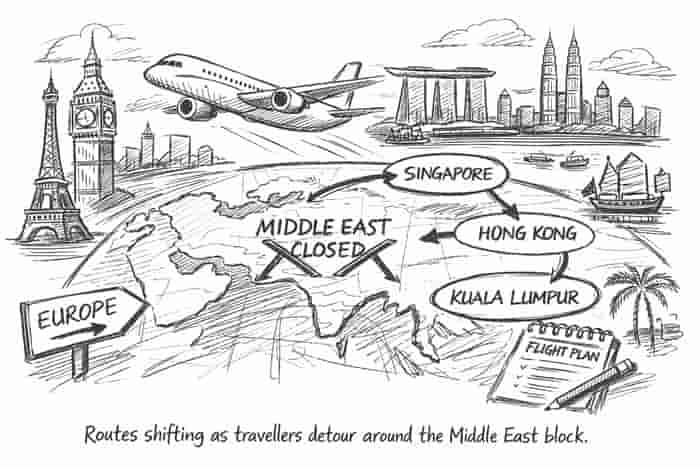
If the past few days have taught the global travel industry anything, it’s this: aviation rarely likes surprises. Yet here we are again, watching geopolitics redraw the world’s flight paths almost overnight.
With ongoing conflict across parts of the Middle East forcing widespread airspace closures, thousands of flights have been cancelled or diverted, leaving many Australian travellers in Europe anxiously asking a simple question: how do we get home?
The good news, at least in aviation terms, is that the world’s route map still has plenty of alternatives. And, according to industry leaders, most of them never entered Middle Eastern airspace in the first place.
Asia Hubs Become the Industry’s Safety Valve
In practical terms, the travel industry has quickly reverted to what it does best during crises: rerouting traffic through the most reliable hubs available.
According to FCM Travel and Corporate Traveller, both divisions of the global Flight Centre Travel Group, the majority of viable Europe–Australia connections are now running through Asia rather than the Middle East.
Those hubs include:
-
Singapore
-
Hong Kong
-
Kuala Lumpur
-
Bangkok
-
Taipei
-
Major Chinese gateways
It’s a familiar pattern. Historically, these routes have served as aviation’s pressure valves whenever instability ripples across the Middle East corridor.
Melissa Elf, Global Chief Operating Officer at FCM Travel and Corporate Traveller, says travellers should not panic, but they should move quickly.

Melissa Elf, Global Chief Operating Officer at FCM Travel and Corporate Traveller
“The safety and well-being of our customers and staff is our top priority during this challenging time we’re closely and actively monitoring the situation,” Elf said.
“We understand the urgency for travellers to secure a safe return home, and there is some good news in that department.”
Elf explained that many of the most reliable flight options were already structured around Asian hub networks.
“The majority of Europe to Australia flight connections operate via Asian hubs, not the Middle East, including Singapore, Hong Kong, and other major regional airports, with these routes continuing to operate normally.”
The shift has happened quickly. In the past several days, flights connecting through Singapore, Hong Kong and Kuala Lumpur have become some of the most sought-after seats in global aviation.
“Passengers transferring via Asia especially Singapore, Hong Kong, and Kuala Lumpur have become very popular in the last few days,” Elf said.
For travellers, the message is clear: flexibility and speed now matter more than loyalty programs.
Seat availability, Elf warns, is changing rapidly.
“Travel Managers and passengers should note that seat availability on these alternative routes is limited and subject to rapid change. Securing a booking requires prompt action and flexibility.”
Airlines Keeping the Lifelines Open
Despite the upheaval, many of the world’s major carriers are continuing to operate Europe–Australia services through Asia.
These include:
-
Singapore Airlines via Singapore
-
Cathay Pacific via Hong Kong
-
Malaysia Airlines via Kuala Lumpur
-
Thai Airways via Bangkok
-
China Southern and China Eastern via mainland Chinese hubs
-
EVA Air and China Airlines via Taipei
-
Qantas, which operates selected services through Singapore
In addition, some travellers are exploring long-haul alternatives through North America.
That option, Europe to the United States or Canada before crossing the Pacific, may add hours to the journey, but it remains a viable fallback when traditional routes tighten.
Qantas’ non-stop Perth to London service is also operating as a key bridge between Australia and Europe.
The flight, often described as one of the most ambitious long-haul routes in the airline’s history, has unexpectedly become one of the most strategically important in today’s disrupted aviation map.
Travel Advisors Step Back Into the Spotlight
In times like this, the value of a professional travel advisor becomes painfully obvious.
Rebooking complex international itineraries across multiple carriers, navigating airline inventory systems, and securing scarce seats is rarely straightforward.
Elf says travel management companies are stepping in to shoulder that burden.
“As a travel management company, we continue to assist as we can access different inventory systems, manage re-bookings, and handle ticketing complexities, significantly easing the burden on travellers and their companies.”
Behind the scenes, travel advisors are doing what they have done for decades: untangling airline systems and finding seats where none appeared to exist.
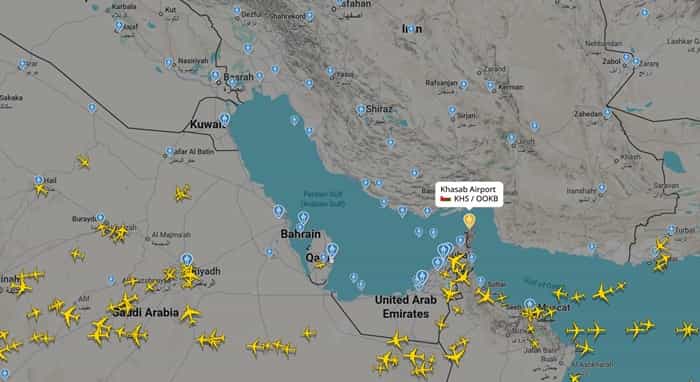
Flight paths bend around the Middle East as airlines redraw the global map. ✈️
ATIA Leads National Industry Coordination
Back home in Australia, the industry’s response has been swift.
The Australian Travel Industry Association (ATIA) has activated a coordinated national response to support travel businesses navigating the disruption.
ATIA’s board and executive leadership spent the weekend working alongside member agencies and airline partners to streamline communication and operational support.

ATIA CEO Dean Long
Central to the effort is the organisation’s Incident Response Group, tasked with consolidating fragmented information and distributing consistent guidance to travel professionals nationwide.
ATIA CEO Dean Long said the industry is working around the clock to support travellers.
“ATIA’s Incident Response Group is actively coordinating with airlines, agency groups, tour operators and travel insurance providers to cut through fragmented updates and deliver authoritative, practical guidance members can act on immediately.”
The association’s directors have also been heavily involved in the response.
“All ATIA Directors have been actively engaged over the weekend shaping and steering our response so members are supported from every angle,” Long said.
In the background, accredited travel professionals across the country are managing a flood of calls from concerned travellers.
“Across the country, accredited travel professionals are working around the clock for their clients and we are making sure that effort is recognised publicly in every single mainstream media interview that we do,” Long added.
Charter Operators Step Into Crisis Mode
While commercial airlines adjust their schedules, charter operators are also stepping up.
Global aviation specialist Chapman Freeborn has activated its crisis response framework to support evacuation flights and emergency logistics.
The company has been working with governments, humanitarian organisations and civil aviation authorities to maintain air connectivity as traditional routes become constrained.
According to Flightradar24, more than 2,000 flights to and from major Gulf airports have already been cancelled, a stark reminder of the scale of disruption facing global aviation.
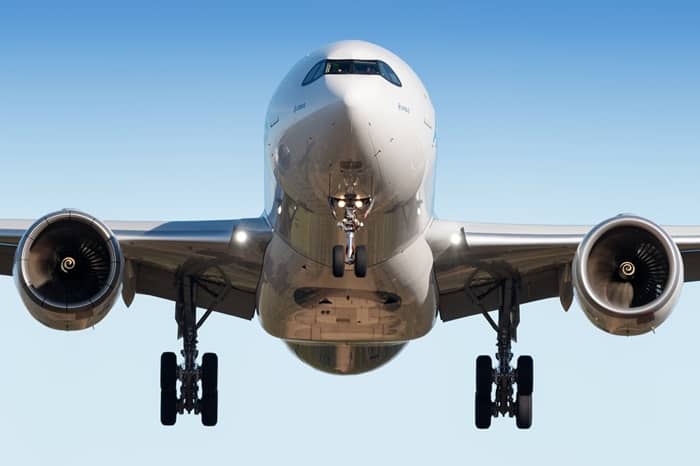
Chapman Freeborn aircraft
Chapman Freeborn has responded by arranging:
-
Emergency passenger evacuation flights
-
Time-critical cargo charters
-
Strategic rerouting across disrupted air corridors
-
Rapid deployment charter aircraft for governments and corporations
Saska Gerasimova, Group Chief Executive Officer at Chapman Freeborn, says speed and adaptability are essential during geopolitical crises.
“During periods of geopolitical uncertainty, speed, flexibility, and reliable operational planning are critical for our clients,” Gerasimova said.
“Our global teams remain ready to support airlines, cargo operators, and governments with safe, compliant, and responsive charter solutions as conditions continue to evolve, with a constant focus on protecting lives and safeguarding operations.”
Aviation’s Old Lesson Returns
For seasoned aviation observers, the current disruption carries a familiar message.
Air travel has always been a finely balanced system, one where politics, geography and logistics intersect thousands of metres above the Earth.
When one corridor closes, the industry simply redraws the map.
Asian hubs are once again proving their resilience, airlines are adapting their networks, and travel professionals are quietly working through the night to reunite travellers with home.
In other words, the aviation system bendsbut rarely breaks.
And for Australians currently stranded somewhere between Paris and Perth, that resilience may be the most reassuring news of all.
Meanwhile, the uncertainty shows little sign of easing for airlines operating through the Gulf. Qatar Airways confirmed that its scheduled flight operations remain temporarily suspended following the closure of Qatari airspace. The airline said services will only resume once the Qatar Civil Aviation Authority declares the skies safe to reopen. For the moment, passengers and travel planners alike remain in a holding pattern, with the carrier advising that a further operational update will be issued on 06 March at 0900 Doha time (0600 UTC). In aviation terms, it’s a polite way of saying everyone is waiting for the green light, and until that happens, the world’s most connected hub remains firmly paused.












