

For global companies, international travel isn’t a perk; it’s an operational requirement. Deals still get done face-to-face. Projects still require boots on the ground. Relationships still depend on presence. But the security environment surrounding business travel has shifted, and the people who feel it first are the travellers themselves.
Global Rescue’s Winter 2026 Traveller Sentiment and Safety Survey found that travellers increasingly see international mobility as defined by instability: 38% describe travel danger in 2026 as unpredictable, and 36% say it will be more dangerous than pre-2020. Even more telling for employers: 82% express some level of concern about personal security risks, especially kidnapping, extortion and violent crime.
That gap, between corporate necessity and employee traveller apprehension, is where business continuity can break. When your workforce believes the world is more dangerous and less predictable, productivity becomes fragile. People hesitate to deploy. Teams lose focus in-country. Leaders waste time chasing clarity in fast-moving situations. And when something goes wrong, the cost isn’t only medical or security, it’s momentum, morale and mission success.
The survey also highlights how risk perceptions are reshaping destination decisions in places where business travel has long been routine. Nearly 67% say they would avoid travel to Israel and neighbouring states entirely or don’t plan to go regardless of conditions, while only 5% would travel as planned and accept the risk. Mexico produces a more nuanced response: 25% would avoid travel altogether, 36% would go only to specific areas with added precautions, and 23% aren’t interested regardless of risk. Colombia sees similar restraint: 36% would avoid travelling there, and 42% have no plans to travel there regardless of security challenges.
For corporate travel managers, those findings matter because Israel, Mexico and Colombia aren’t fringe destinations. They’re common nodes in supply chains, manufacturing, energy, finance, consulting and field operations. And each one illustrates a modern truth: country-level labels hide the real issue, risk is often localised, time-bound and capable of shifting faster than policy updates.
Then there are destinations where the risk profile is less complex and more acute.
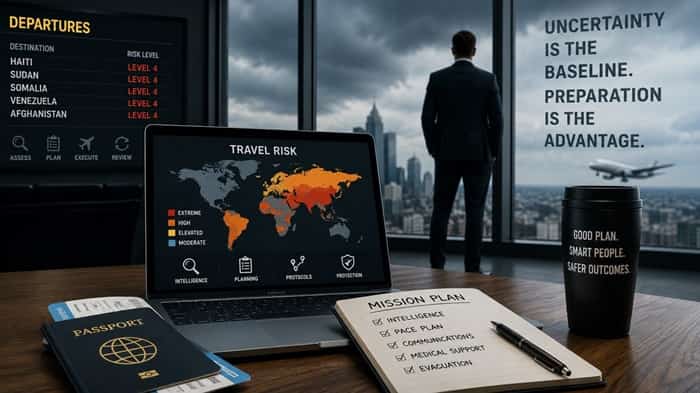
Based on 2026 risk outlooks for organisations, there is broad alignment on which places remain consistently high-risk for personnel movement: countries where terrorism, kidnapping, civil unrest and weak infrastructure converge. In the State Department’s system, several of these are explicitly “Level 4: Do Not Travel,” including Afghanistan, Haiti, Sudan, Somalia and Venezuela.
That list should sound familiar to anyone running international operations, because despite the danger, North American companies and organisations still operate there, often in oil and energy, mining, telecom, maritime security, government-adjacent contracting and NGOs. Sometimes it’s legacy assets. Sometimes it’s a strategic necessity. Sometimes it’s a humanitarian reality. Whatever the reason, the risk doesn’t care why you’re there.
Haiti’s advisory cites kidnapping, crime, civil unrest and limited health care, conditions that can rapidly trap travellers in place and cut off reliable services. Sudan’s Level 4 status reflects armed conflict and the inability of the US government to provide routine or emergency consular services, alongside kidnapping and health threats. Somalia’s advisory warns of terrorism, kidnapping, piracy and severely constrained support outside hardened areas. Venezuela remains Level 4 due to risks including wrongful detention, kidnapping, civil unrest and poor health infrastructure, an especially relevant factor for business travellers who assume they can “solve problems locally” when a medical issue arises.
So what should companies do with this reality?
First, stop treating travel risk as a compliance exercise. Risk is now operational, and the survey proves your travellers already understand that. Replace “country risk” thinking with trip-specific intelligence: where the traveller will sleep, how they’ll move, what the local pattern of crime or unrest looks like this month, not last year.
That shift requires a more disciplined approach from the moment a mission is approved. Organisations should begin with a comprehensive intelligence assessment of the destination, not just at the country level, but at the city, neighbourhood, and transit-route level, with a focus on recent activity and emerging patterns. This allows teams to identify triggers, threat vectors and likely scenarios in advance, while informing decisions about the tools, resources and capabilities required to support the mission, particularly in communications.
From there, planning should extend into structured redundancy. A PACE framework (Primary, Alternate, Contingency, Emergency) should be integrated across all critical functions, including communications, transportation and routing, reporting protocols, medical support and evacuation pathways. In volatile environments, continuity isn’t accidental; it is engineered through layers.
Equally important is defining decision thresholds before departure. Strong intelligence and planning enable leadership to clearly establish risk tolerance, determining what level of exposure is acceptable and what conditions trigger relocation, route changes, shelter-in-place or extraction. When uncertainty is the defining feature, speed and clarity of decision-making become protective capabilities in their own right. Additional security measures, protective services or operational adjustments should always remain viable options when conditions warrant.
Finally, be honest about the stakes: a travelling employee isn’t just a person with a passport and a laptop. They are a moving piece of your business. Protecting them protects the work.
In 2026, the most effective international organisations won’t be the ones that travel the most. They’ll be the ones who travel with the most disciplined preparation. Because a good plan is not one that eliminates risk entirely. It’s one that reduces risk to an acceptable level, protects personnel and assets and ensures the mission can continue, even when conditions change.
Uncertainty isn’t an inconvenience anymore. It’s the baseline.
By Fernando Lopez Medina – (c) 2026.
Read Time: 4 minutes
About the Author.
Author Bio:
 Fernando Lopez Medina is a former U.S. Army Special Forces Green Beret and security operations supervisor at Global Rescue, the world’s leading provider of medical, security, evacuation and travel risk management services.

For more information, visit www.globalrescue.com.











