

There’s a tendency in aviation, particularly in good years, to treat disruption as weather. Something to be flown around, absorbed, politely explained away in a line or two of operational jargon.
This isn’t that.
What’s unfolding across the Gulf right now is not a passing inconvenience. It’s a direct hit on one of the world’s most critical aviation corridors, and the numbers, stripped of their corporate varnish, are telling a far more serious story.
Figures released by Airports Council International Asia-Pacific & Middle East, in partnership with Flare Aviation Consulting, don’t just point to disruption. They point to strain. Real strain. The kind that tests not only schedules and balance sheets, but confidence.
And confidence, in this business, is everything.
The world’s hinge is under pressure
The Middle East didn’t become a global aviation hub by accident. Geography gave it the opportunity. Relentless investment turned it into a necessity.
Take that hub offline or even partially constrain it, and you don’t just inconvenience a few routes. You distort the entire global network.
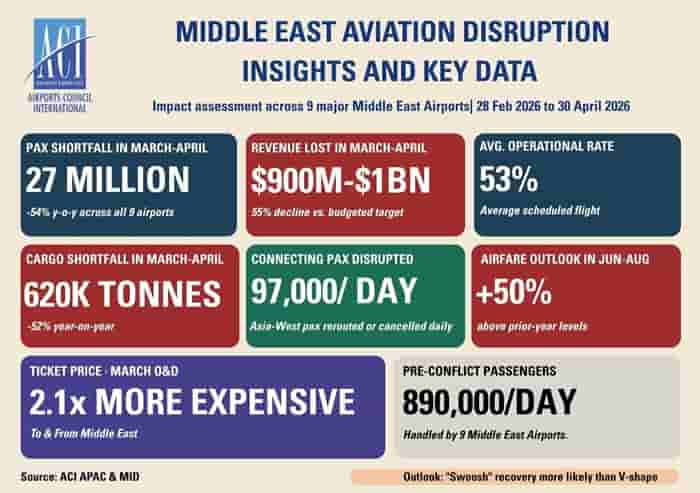
Nine major airports at the heart of this system, responsible for roughly 70% of the region’s traffic, have seen operations fall to just 53% of scheduled capacity across March and April. On the first day of the conflict, that number collapsed to 32%.
Let that sit for a moment.
In an industry calibrated to the minute, built on precision and predictability, losing two-thirds of your capacity overnight isn’t disruption. It’s shocking.
Yes, operations have since clawed back to around 63%. But recovery to “less bad” is not the same as recovery.
The passengers who vanished
Behind the percentages are people and plenty of them.
An estimated 27 million passengers did not travel as planned across those two months. Not delayed. Not rerouted. Simply gone from the system.
March alone accounted for 14 million of them.
That’s not just lost revenue. That’s lost momentum. Aviation had been edging back toward something resembling normality after years of upheaval. This has knocked it sideways again.
And while demand elsewhere in Asia-Pacific remains surprisingly resilient, the fracture is there. You can feel it in the network.
Travel hasn’t stopped. But it’s no longer flowing as it should.
Cargo doesn’t get headlines until it breaks
Passenger numbers tend to dominate the conversation. Cargo, quietly, keeps the world turning.
Until it doesn’t.
Freight volumes at the affected airports have dropped by more than half, down roughly 620,000 tonnes from last year. March alone saw a 59% fall.
That’s not a blip. That’s a supply chain problem in the making.
When cargo slows, goods stall. When goods stall, costs rise. And when costs rise, economies feel it often long after the headlines have moved on.
This is where aviation’s importance becomes impossible to ignore. It isn’t just about holidays. It’s about how the modern world functions.
The bill arrives quickly
For airports, the financial impact has been immediate and unforgiving.
A revenue shortfall approaching US$1 billion in just two months is not something you quietly absorb. It’s the sort of number that forces hard decisions.
Airports don’t have the luxury of scaling down overnight. Their costs are fixed, their infrastructure long-term, their obligations ongoing. Runways don’t get cheaper because fewer planes land on them.
What this creates is pressure not just operational, but structural.
And prolonged structural pressure has consequences.
Fares rise and patience thins
Passengers, predictably, are feeling it where it hurts most.
Airfares on Asia West routes have surged, in some cases dramatically. What was once a modest premium for direct travel has ballooned well beyond that.
Even now, prices remain significantly elevated.
There’s a temptation to look for a villain in that story. Airports aren’t it. Their charges haven’t moved.
The reality is less satisfying, but more honest: less capacity, less competition, higher prices.
It’s the market doing what the market does without much sympathy for the traveller.
Fuel adds another layer of pressure
If capacity constraints weren’t enough, fuel costs have piled on.
Supply remains stable for now, but prices have surged to nearly double pre-conflict levels. For airlines, that’s a margin killer. For airports, it’s another source of operational strain.
The industry has responded with contingency measures, stock management, supplier coordination, and the usual playbook.
But there’s no easy fix here. Fuel is aviation’s constant companion, and right now it’s an expensive one.
A warning that shouldn’t be ignored
Stefano Baronci of ACI APAC & MID put it plainly and, to his credit, without dressing it up.
“Middle Eastern hubs are not only regional assets but essential nodes in the global aviation system.”
He’s right. And the implication is clear: when those nodes are under pressure, the system is, too.
More telling, perhaps, was his caution against layering additional costs onto the sector, particularly government-imposed taxes.
At a time when aviation is already absorbing geopolitical shocks, rising fuel prices, and operational disruption, the appetite for further financial burden is, quite understandably, close to zero.
It’s a message policymakers would do well to hear.
Recovery won’t be neat or quick
There’s no V-shaped rebound waiting in the wings here.
ACI’s “swoosh-shaped” recovery curve is about as realistic as it gets: slow out of the gate, then gradually improving.
Airspace restrictions won’t disappear overnight. Fuel markets won’t suddenly calm. Airlines won’t rebuild networks in a week.
Confidence, once shaken, takes time.
And yet there is a quiet, stubborn optimism in the data. Demand hasn’t collapsed. The broader Asia-Pacific market continues to grow. The long-term trajectory remains intact.
Aviation isn’t retreating. It’s recalibrating.
The industry’s quiet resilience
If you strip away the spreadsheets and the policy statements, what you’re left with is something more human.
An industry that has been here before.
Different crisis, same underlying test: can it adapt quickly enough, absorb the shock, and keep moving?
So far, the answer is yes, but not without cost, and not without consequence.
This Gulf disruption is a serious moment. It deserves to be treated as one.
Because while aviation will endure as it always does, the path through this will not be painless.
And pretending otherwise does the industry no favours at all.












