

There’s a particular kind of quiet frustration that lives in airport queues. You know it well. The slow shuffle. The sideways glance at the clock. The creeping suspicion that the line you chose was, inevitably, the wrong one.
Virgin Australia has decided quite sensibly that enough is enough.
In an announcement that feels less like a tech upgrade and more like a tidy bit of revenge on inefficiency, the airline says it will cut check-in times by up to 50 per cent across key domestic airports. Not trim, not tweak, halve. That’s not a marginal gain. That’s the difference between arriving tense and arriving in control.
And in typical Virgin fashion, the answer isn’t more counters or louder announcements. It’s digital. Quietly powerful, largely invisible, and if it works as promised, transformational.
The queue, reimagined (or quietly removed)
Let’s start at the airport, because that’s where the battle is usually lost.
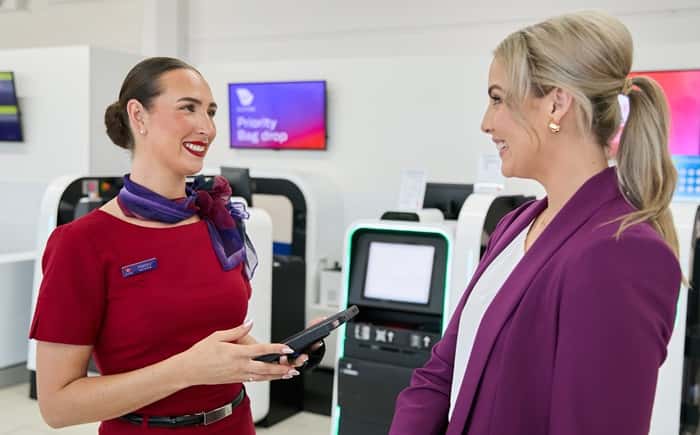
From May next year, Virgin Australia will begin rolling out a new generation of bag-drop systems across 10 domestic airports. Now, airlines have been tinkering with kiosks for years, often with mixed results. This one feels different.
Scan once. Print your bag tag. Drop the bag. Walk away.
No second scan. No awkward pause while a machine thinks about life. No staff intervention unless you actually need it. It’s the sort of simplicity the industry has been promising since the early days of self-service—and rarely delivering cleanly.
Behind the scenes, there’s a camera and barcode recognition doing the heavy lifting. In front of the traveller, it just feels… quicker. Which, in this context, is everything.
During peak periods, those grim windows when half the country seems to be flying somewhere, the impact could be substantial. Fewer queues. Less congestion. A smoother flow that benefits not just Virgin passengers, but the entire terminal ecosystem.
Your phone becomes the check-in desk
Of course, the real story isn’t the machine. It’s the shift away from the machine altogether.
Virgin’s mobile app, already used by nearly 80 per cent of its passengers, is being handed far more authority. For the first time, eligible Velocity Frequent Flyer members can change their flights on the day of travel directly in the app.
That might sound overdue. It is. But it’s also important.
Gold, Platinum, and Platinum Plus members can now request earlier flights, which the airline calls “Fly Ahead,” without having to plead their case at a counter. Platinum Plus travellers can also shift later in the day, a small but meaningful luxury when plans move, as they often do.
There’s even a quiet little twist in the form of “Fly Earlier”. If flights are disrupted or simply under pressure, some passengers will be nudged via the app with an offer to move forward at no extra cost. No phone call. No queue. Just a prompt and a decision.
It’s not revolutionary technology. It’s something better: common sense, finally applied.
A better seat, a smarter bid
Then there’s the matter of comfort, which airlines have learned is best handled with a blend of aspiration and gentle persuasion.
Through the app, passengers can now bid for upgrades to Business Class or the slightly more forgiving legroom of Economy X. It’s not new globally, but it’s been neatly folded into a broader ecosystem that feels coherent rather than bolted on.
In other words, the airline isn’t just speeding up the airport. It’s smoothing out the entire day of travel.
The quiet logic behind it all
What makes this move compelling isn’t the technology itself; it’s the timing.
Passengers have already moved. Nearly eight in ten are managing their journeys digitally. The behaviour is there. Virgin is simply catching up, then pushing ahead.
Alex Plummer, the airline’s General Manager of Digital, puts it plainly enough: customers expect ease. Not eventually. Now.
And he’s right. The modern traveller doesn’t want to stand in line proving they exist. They want to move.
Virgin tends to lean into these shifts early. It began with online check-in back in 2000, a lifetime ago in digital terms, and has since flirted with everything from pets in the cabin to rewarding passengers for tolerating the middle seat. Some ideas stick. Some don’t. But the intent is consistent: make the journey feel less like a process and more like… well, travel.
Will it work?
That’s the only question that matters.
Airports are complex beasts. A slick app can’t fix a delayed aircraft, and no amount of automation will eliminate the occasional bottleneck. But shaving meaningful time off check-in? That’s achievable. And if done properly, it has a ripple effect.
Shorter queues lead to calmer passengers. Calmer passengers move faster. Faster movement reduces congestion. It’s not glamorous, but it’s effective.
And perhaps that’s the real strength of this upgrade. It doesn’t try to dazzle. It tries to remove friction.
A small shift, a noticeable difference
For the traveller, the change may feel almost underwhelming at first.
You arrive. You scan. You drop your bag. And suddenly you’re done.
No drama. No delay. No story to tell except, perhaps, that there wasn’t one.
In an industry that has spent decades adding layers, Virgin Australia is quietly peeling a few away. That alone makes this worth watching.
Because if there’s one thing the modern airport could use less of, it’s waiting.
by May Marclay – (c) 2026.
Read Time: 5 minutes.
About the Author.
 May Marclay’s career hasn’t followed a straight line, and she’s better for it. She began in real estate, then moved into hospitality, finding her rhythm with Centara in the Maldives. There, she worked the Asian markets the old-fashioned way: building trust, closing deals, and turning conversations into lasting business.
The UAE sharpened its focus. At IHG, supporting an Area General Manager, she saw the machinery of a major travel hub from the inside, no gloss, just how things actually get done.
Now, with her sights set on healthcare, May brings a broader lens than most. She speaks three languages, reads widely, travels with intent, and writes with the calm assurance of someone who understands both the detail and the bigger picture without needing to say so too loudly.











