

There’s a certain discipline to the way Hong Kong travels these days. Not the carefree, last-minute dash to the airport that once defined the region’s restless wanderlust, but something more deliberate, almost methodical.
Call it maturity. Call it experience. Or perhaps just call it what it is: strategy.
Fresh data from Visa suggests that Hong Kong’s outbound travellers are no longer simply booking holidays; they’re engineering them. Carefully. Quietly. And with wallets that remain remarkably open despite the broader economic mood music.
A striking 88 per cent are either holding firm or increasing their travel spend. That’s not resilience; that’s intent. More telling still, travel now consumes 23 per cent of household budgets. Nearly a quarter. In any other category, that would raise eyebrows. In travel, it signals something else entirely: priority.
The Holiday Begins at the Kitchen Table
If there’s one shift that stands out, it’s this: Hong Kong travellers are starting earlier. Much earlier.
Six in ten begin plotting their trips between four and twelve months before departure. Not browsing. Planning. Comparing routes, weighing deals, eyeing rewards programs like a seasoned investor studies a prospectus.
The holiday, in other words, now begins long before the suitcase comes out of the cupboard.
“For many Hong Kong travellers, the journey begins long before departure,” said Paulina Leong. “Planning has become part of the experience, a chance to explore options, discover new destinations, and imagine what’s next.”
There’s truth in that. The anticipation has become its own kind of currency.
Points, Plastic and a Very Sharp Eye
Once upon a time, the choice of a credit card was little more than a convenience. Not anymore.
Today’s Hong Kong traveller selects their card with the same care they might apply to a flight itinerary. 61% actively consider rewards when applying. Not as a bonus, but as a return on investment.
It’s a subtle shift, but an important one. Travel is no longer just about where you go; it’s about how efficiently you get there, how cleverly you pay for it, and what you earn along the way.
Global acceptance matters too. Sixty per cent rank it as essential, and rightly so. A card that falters halfway through a multi-country itinerary is about as useful as a passport left at home.
And then there’s security. 32% cite fraud protection, privacy, and safety as their top concern when paying abroad. Sensible travellers, it seems, are still cautious ones.
Artificial Intelligence, Meet the Itinerary
Now, here’s where things get interesting.
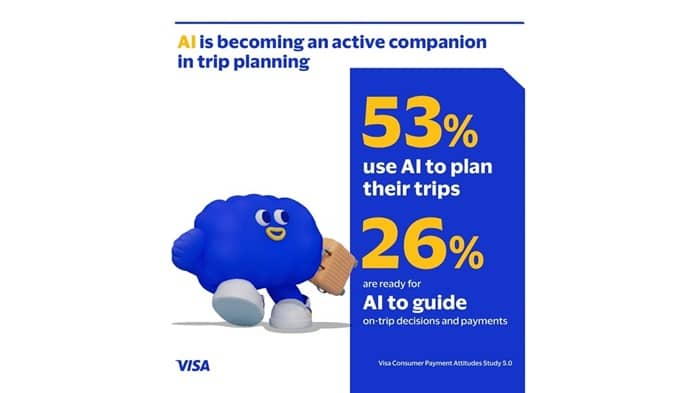
More than half of Hong Kong travellers, 53 per cent, are already using AI tools to help shape their journeys. Not in some vague, experimental way, but as a practical aid: refining itineraries, tailoring recommendations, shaving time off decisions that used to take hours.
Another 26 per cent are open to letting AI guide their spending decisions mid-trip. Not quite there yet, but close enough to matter.
Leong again:
“More travellers now use digital and AI-powered tools to shape their itineraries and extend the joy of travel even before it starts.”
Strip away the corporate phrasing and what you’re left with is this: travellers are outsourcing the heavy lifting. And they’re perfectly comfortable doing so.
Time Poor, Experience Rich
Of course, not everything has changed.
Time remains the perennial constraint. 36% cite limited leave as the biggest hurdle. So they adapt.
The average Hong Kong traveller now visits two destinations per trip, stitching together itineraries that maximise every available day. It’s efficient, certainly, but also telling. These are travellers determined to extract full value from every hour away.
The destination list reads like a familiar Asia-Pacific roll call. Japan leads comfortably at 51 per cent, followed by Taiwan, South Korea, Singapore and Thailand.
Australia, at 11 per cent, sits quietly in the mix, perhaps not dominant, but certainly dependable.
Following Their Nose Quite Literally
If there’s one constant in travel, it’s this: people will go a long way for a good meal.
One in four Hong Kong travellers says food is the primary motivation behind their trips. Not shopping. Not sightseeing. Food.
And once they arrive, they don’t hold back. Fifty-three per cent actively seek out local cuisine, street food, hidden gems, the sort of places that rarely make it into glossy brochures.
It’s a reassuring reminder that, for all the technology and planning, travel still hinges on simple pleasures.
Trust, the Unsung Hero
Behind every smooth journey lies something far less glamorous: payments that just work.
In an environment where travellers hop between currencies, countries and payment systems, reliability is everything. Visa’s data shows that 64 per cent feel confident using contactless payments abroad, a small statistic with large implications.
Because when payments are seamless, they disappear. And when they disappear, the traveller is free to focus on what matters.
The Quiet Evolution of the Traveller
Step back, and a pattern emerges.
Hong Kong’s outbound travellers are not just spending more, they’re thinking differently. Planning earlier. Choosing smarter. Expecting more.
And perhaps most importantly, enjoying the process along the way.
For the industry, the message is as old as travel itself: know your customer. Only now does the customer arrive better prepared than ever.
And if you’re not ready for them, rest assured, they’ve already planned an alternative.
by Kanda Limw – (c) 2026.
Read Time: 5 minutes.
About the Author.
 Kanda Limw is one of those rare people every office quietly depends on. She doesn’t fuss or fanfare her way through the day, she simply notices what needs doing and gets on with it, often before anyone else has drawn breath.
Years behind the scenes have taught her that good administration isn’t about control; it’s about care. Diaries align, tensions soften, loose ends disappear. When the day threatens to tilt, Kanda steadies it without drama.
There’s something reassuringly old-fashioned about her reliability. She listens properly, remembers the small things, and does what she says she will.
Kanda has no appetite for the spotlight. Yet ask anyone who works alongside her, and they’ll tell you that when she’s there, everything runs just a little smoother.











