

There are results that impress, and then there are results that tell you something deeper is going on beneath the surface.
Thailand’s Asset World Corp Public Company Limited, better known as AWC, has delivered a set of numbers for 2025 that do both. Revenue up, profit up, assets up. All reassuring. But more importantly, the business looks composed. Not flashy, not overextended, just quietly getting on with the job.
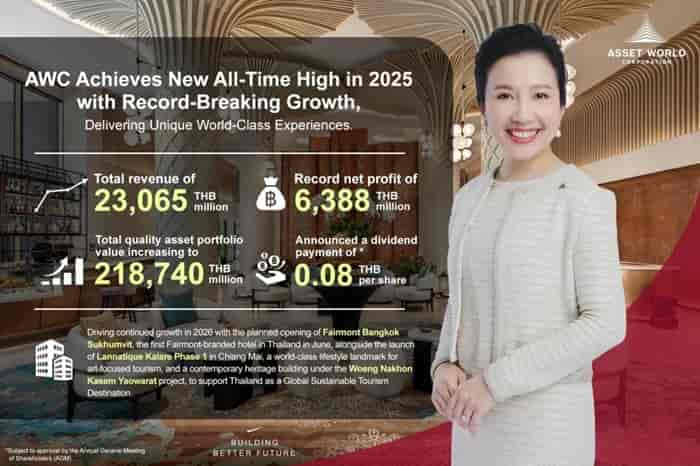
Total revenue came in at THB 23,065 million, a 9.8 per cent lift. Net profit reached THB 6,388 million, up 9.2 per cent. The asset base edged past THB 218 billion. Shareholders will note the dividend increase to THB 0.08 per share.
None of that feels accidental.
Growth Without the Noise
What stands out is not the scale, but the shape of the growth.
AWC has spent the past few years talking about a “Sustainable Growth-led Strategy”, the sort of phrase that usually signals a PowerPoint rather than a plan. Yet in this case, it has translated into something rather practical: a portfolio that actually balances.
Hotels that earn. Retail spaces that draw a crowd. Offices that hold their tenants. And, critically, destinations that give people a reason to stay longer and spend a little more while they’re at it.
Mrs Wallapa Traisorat, AWC’s CEO, put it in suitably measured terms, noting the results reflect “continued portfolio expansion and the conversion of development projects into operating assets.”
It’s a polite way of saying: we built it, and now it works.
Asiatique: From Night Market to Main Event
If there’s a single example of how AWC thinks, it’s Asiatique The Riverfront Destination.
Once a pleasant enough riverside diversion, it has been steadily reworked into something far more deliberate, a place designed to hold visitors from morning through to late evening.
The headline attraction, “Jurassic World: The Experience,” has pulled in more than 300,000 visitors since opening. Nearby, “Skyflyers: Wings of Garudapterus” has added a dose of theatre, drawing early crowds that would make most operators quietly envious.
The effect is not subtle. Visitor numbers climbed 27 per cent year-on-year. Retail operating profit rose 25.8 per cent. Occupancy reached 80 per cent. Rental income followed suit.
It’s the sort of performance that doesn’t come from luck. It comes from understanding that modern travellers’ families, especially, don’t want fragments. They want the whole day planned for them.
And if you can provide that, they will reward you.
Hotels: Steady Hands in a Changing Market
The hospitality division tells a slightly different story, less dramatic, but arguably more important.
Revenue reached THB 12,813 million, up 4.5 per cent on last year and comfortably ahead of pre-pandemic levels. In an environment still adjusting to shifting demand patterns, that qualifies as a solid result.
New properties in Pattaya and Bangkok have added incremental revenue, but the real strength lies further afield.
Chiang Mai, Koh Samui and Krabi continue to do what they have always done well, draw travellers who are prepared to pay for a better experience. Revenue per available room is up across all three.
There’s also a telling detail in the Revenue Generation Index figures. Properties such as Courtyard by Marriott Phuket Town are not merely keeping pace with the market, they are outperforming it decisively.
That usually points to one thing: the right product, in the right place, with the right partnerships.
The Return of the Long-Haul Traveller
AWC’s figures hint at something the broader industry has been waiting for.
The return of high-value international travellers.
Visitors from Europe, the United States and the Middle East are back in meaningful numbers, with revenue from these markets rising more than 12 per cent. That’s ahead of overall inbound growth, which suggests AWC is not just riding the recovery, it’s capturing the better end of it.
And then there’s China.
Advance bookings for 2026 are already up 15 per cent, with clear signs that Chinese travellers are beginning to return in volume. For Thailand, that matters. For operators like AWC, it could be decisive.
Song Wat: A Different Kind of Development
Not all growth needs to be loud.
In Bangkok’s Song Wat district, AWC has taken a more restrained approach, restoring heritage buildings rather than replacing them, and allowing the area’s character to do the heavy lifting.
It’s a slower play. But increasingly, it’s the one that resonates.
When Netflix chose the district for a promotional event tied to Stranger Things, it was less about spectacle and more about atmosphere. The kind of place that feels discovered rather than manufactured.
In a market saturated with polished experiences, that distinction counts.
Looking Ahead: Quiet Confidence
AWC is not standing still.
The upcoming opening of Fairmont Bangkok Sukhumvit will mark the brand’s first presence in Thailand, positioning Bangkok more firmly in the luxury and MICE conversation.
In Chiang Mai, Lannatique Kalare is set to lean into art and culture, while Yaowarat will see another heritage-led project come to life.
Individually, these are sensible developments. Taken together, they point to a broader strategy: fewer bets on volume, more emphasis on value.
Sustainability: Less Talk, More Proof
It would be easy to gloss over AWC’s sustainability credentials as corporate box-ticking. Yet the consistency of its recognition suggests otherwise.
Top 1 per cent in the S&P Global Sustainability Yearbook. AAA ESG rating from MSCI. Full certification across its hotel portfolio from the Tourism Authority of Thailand.
These are not marketing lines. They are signals to investors, to partners, and increasingly to travellers that standards are being met.
And in today’s market, that matters.
A Measured Success Story
There is a temptation, when confronted with record numbers, to reach for superlatives.
But AWC’s 2025 performance doesn’t need them.
It is, at heart, a story about discipline. About building assets that work. About understanding where tourism is heading, without chasing every passing trend.
Thailand’s tourism recovery is real. That much is clear.
What AWC has shown is that recovery, handled properly, can become something more durable, something that lasts beyond the cycle.
And in this business, that’s the result that really counts.
by Supaporn Pholrach – (c) 2026.
Read Time: 6 minutes
About the Author.
 Supaporn Pholrach came up in advertising when deals were sealed with a handshake, and deadlines lived on scraps of paper, not dashboards. She learned early that people mattered more than process, and it stuck. Armed with solid training and a stubborn work ethic, she built a reputation for getting results without turning hard or hollow.
Fifteen years at Bangkok Shuho would test anyone’s stamina. Supaporn stayed the distance. These days, as Sales Manager at Global Travel Media, she helps tourism brands cut through the noise with common sense, good humour and genuine warmth.
She doesn’t chase quick wins. She earns trust, builds loyalty and keeps her word. In an industry that rarely slows down, Supaporn is someone you’re quietly glad to have on your side.











