There’s a certain honesty about small operators. No glossy sustainability reports, no corporate theatre, just people on the ground trying to make tourism work without wrecking the very thing that draws travellers in.
That’s precisely where the Sustainable Tourism Impact Fund has chosen to place its bet. Not at the top end of town, but where it matters among the quietly determined.
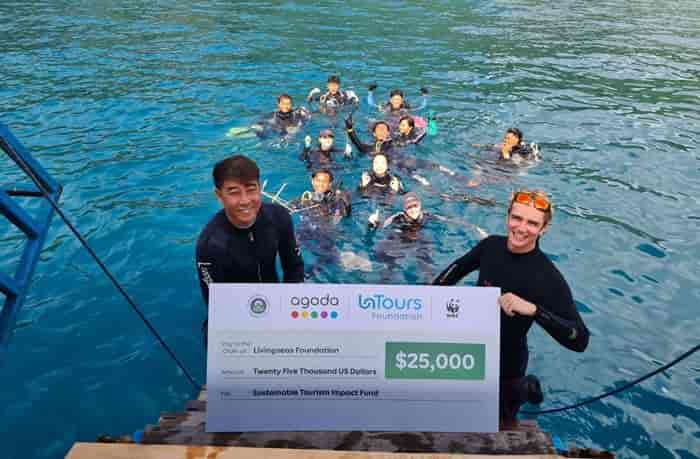
Backed by Agoda, WWF Singapore and the UnTours Foundation, the Fund has rolled out its second round of investments. The sums are modest, USD $25,000 apiece, but the intent is anything but.
If anything, it’s refreshingly old-fashioned: back good people doing good work and let the results speak.
Coral, Community and a Bit of Backbone
In Bali’s Padangbai, Livingseas Asia is proving that tourism doesn’t have to be extractive to be profitable. Divers don’t just look anymore; they help rebuild.
Through the Livingseas Foundation, more than 7,300 square metres of reef have been restored, with over 320,000 coral fragments carefully planted. It’s slow work. It’s meticulous work. And, importantly, it’s work that stays done.
The new funding will go towards something less glamorous but no less essential: housing. Modular accommodation for staff and trainees, right near the restoration site. Because if you want to grow conservation, you first need to house the people doing it.
It’s the sort of practical thinking that tends to get lost in boardrooms.

Bambike Ecotours
Meanwhile, in the Philippines, Bambike Ecotours is taking a different tack on land, not underwater, but no less grounded.
Its model is disarmingly simple: grow bamboo, build bicycles, employ locals, and invite travellers into the story. The next step, Ligtasin Cove in Batangas, will extend that idea into a full-fledged destination, bamboo-built, community-led, and anchored in coastal restoration.
There’ll be eco tours, a bamboo nursery, and most importantly, jobs. The kind that stay local.
Early Signs: Less Talk, More Doing
Six months on from its first investments, the Fund is beginning to show signs of life beyond the press release.
In Thailand, Local Alike has expanded its “Travel With Care” program to 10 destinations, quietly building a network of regenerative tourism experiences that actually involve the communities they claim to support. Sixteen new activities have been launched, alongside partnerships with national parks and tourism authorities. No progress on noise.
Over in the Philippines, Ecohotels has been busy planting 500 mango trees, to be exact, while onboarding 22 farmers into its Bahay Farms initiative. Its menu has shifted towards 50% plant-based offerings, a small but telling indicator of changing priorities.
And then there’s employment. Its Green Warriors program has already placed five trainees into hospitality roles. Not a grand number, perhaps, but a real one.
Indonesia’s Sejiva, for its part, has leaned into cultural heritage walks, coral restoration experiences, and a quietly persistent #travelpositive campaign that’s gaining traction.
None of it is flashy. All of it is necessary.
A Shift in Thinking
“At Agoda, we believe the future of travel depends on the resilience of the destinations we serve,” said Timothy Hughes, Vice President of Corporate Development at Agoda.
It’s the sort of line that could easily drift into corporate speak, but here, it lands differently. Because the money is following the message.
Sarah Payne from the UnTours Foundation puts it more plainly: these are businesses building models that work not just environmentally, but economically.
And that’s the crux of it. Sustainability that doesn’t pay its way rarely lasts.
The Quiet Engine Behind It All
The Fund sits within Agoda’s broader sustainability push, tied closely to its Eco Deals program. Travellers get discounted stays; a portion of those proceeds flows to conservation efforts through WWF, and those funds are then reinvested in enterprises like Livingseas and Bambike.
It’s not revolutionary. It’s just well-structured.
And perhaps that’s the point.
For years, the industry has spoken about “giving back”. What’s emerging here is something a little more grounded, building on the past.
The Road Ahead
Southeast Asia doesn’t lack visitors. What it has lacked, at times, is balance.
Too many feet, not enough foresight.
What this Fund suggests quietly, without fanfare, is that the next chapter of tourism in the region will be written by those who understand that growth and restraint aren’t opposites. They’re partners.
Applications are now open for the next round of funding: https://untoursfoundation.org/sustainable-tourism-impact-fund.
One suspects the queue won’t be short.
And nor should it be.
Because if this is the future of travel, it’s not arriving with a bang but with a steady, deliberate step. The kind that tends to last.