

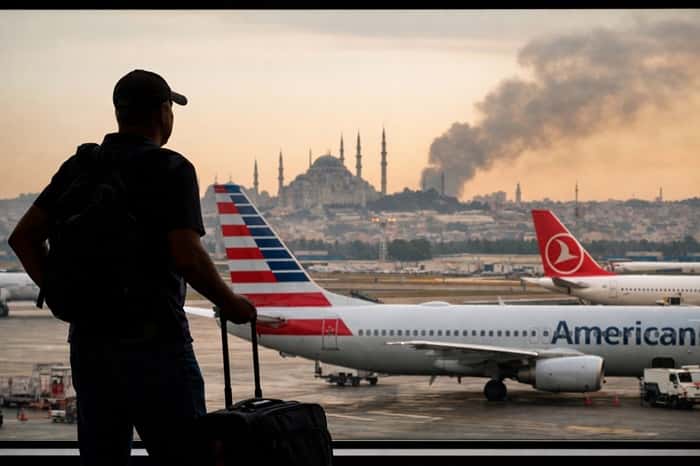
There was a time not all that long ago when international travel was largely a question of budget, time off, and perhaps a decent weather forecast. Today, it’s a more nuanced equation. Safety, perception, and geopolitics now sit squarely at the planning table, and according to fresh data from Global Rescue, American travellers are adjusting accordingly.
A recent SNAP survey of more than 1,000 seasoned global travellers reveals a quiet but meaningful shift: concern about how Americans are perceived overseas has moved firmly into the mainstream. No longer a fringe consideration, it’s now a factor shaping decisions from destination choice to itinerary design.
More than half of respondents, 53 per cent, say they are moderately or highly concerned about being targeted or encountering anti-American sentiment while abroad. Only a modest 12 per cent remain entirely unconcerned. That’s not panic, but it is certainly awareness.
As Dan Richards, CEO of Global Rescue and a member of the US Travel and Tourism Advisory Board, succinctly put it: “Concern about anti-American sentiment is no longer fringe, it’s mainstream. That signals a meaningful shift in how travelers are evaluating personal risk tied to global perception.”
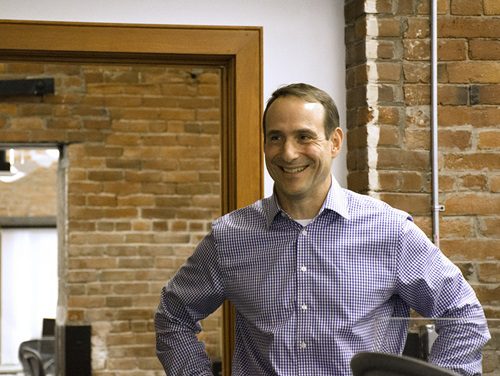
Dan Richards is standing in the operations room.
It’s a sentiment that reflects the broader mood of an increasingly complex world. Ongoing tensions in the Middle East, combined with a steady hum of geopolitical uncertainty elsewhere, have nudged travellers into a more deliberate mindset. Not fearful, but certainly more informed.
And yet, in a reassuring nod to the enduring allure of travel, Americans aren’t abandoning their passports.
In fact, 85 per cent of respondents acknowledge at least some concern about disruptions linked to global conflicts think airspace closures, rerouted flights, and the occasional airport bottleneck. But here’s the twist: nearly two-thirds, or 67 per cent, say they haven’t changed their travel plans at all.
“Travelers aren’t panicking, but they are re-calibrating,” Richards explained. “They remain committed to going abroad, but they’re factoring in risk in a much more deliberate, informed way.”
That recalibration is perhaps best described as a pivot rather than a pullback. Around one-third of travellers have tweaked their plans, 16 per cent postponing trips, 9 per cent switching destinations, and another 9 per cent cancelling altogether.
In other words, the appetite for international travel remains intact; it’s simply being navigated with a steadier hand on the wheel.
“We’re seeing a pivot, not a pullback,” Richards added. “Travelers are navigating around risk, not retreating from travel altogether.”
Of course, geopolitics rarely travels alone; it tends to bring costs along for the ride. Rising airfares, longer routes, and operational disruptions are all beginning to bite. Two-thirds of respondents report noticing at least some increase in travel costs, while more than half say further price hikes could prompt them to rethink future plans.
“Travelers are thinking beyond logistics to perception risk,” Richards said. “With only a small minority saying they’re not concerned at all, most Americans are aware of how they may be perceived abroad and that awareness is shaping where they go and how they travel.”
And yet, for all the caution, the fundamentals remain surprisingly robust. Demand for international travel continues to hold firm, with 41 per cent of travellers expecting no change in their travel frequency over the next six to twelve months. A further 29 per cent anticipate only a slight reduction.
“Resilience in international travel demand remains strong,” Richards noted. “That level of stability underscores a durable appetite for global travel, even in uncertain conditions.”
It’s a delicate balancing act, one that defines the modern traveller. Safety, cost, and perception are now weighed simultaneously, often with a level of sophistication that would have been unthinkable a decade ago.
“The modern traveler is managing risk, not avoiding it,” Richards concluded. “What stands out is that concern levels are high, but behavior changes are measured. Today’s travelers are more sophisticated. They’re weighing disruption, cost and safety simultaneously, and making calculated decisions rather than reactive ones.”
For the travel industry, the message is clear. The world hasn’t grown smaller; it’s grown more complex. And travellers, far from retreating, are simply learning to navigate it better.
For further insights, visit Global Rescue.
by Alison Jenkins – (c) 2026.
Read Time: 3 minutes.
About the Writer.
 Alison Jenkins has lived most of her working life in the slipstream of aviation, where timetables matter, and people matter more. In airline sales, she built a reputation the old-fashioned way: by knowing her clients, her routes, and never missing the human detail.
Quick with a smile, quicker with a solution, she made deals with warmth and kept her edge intact.
Trade shows, FAMILS, airport lounges and hotel lobbies became her second address. And somewhere along the way, notebook in hand, she began writing the journeys rather than selling them. Her reports grew lively, observant, full of the small truths only travellers notice.
That was the moment it dawned on her: she wasn’t simply travelling. She belonged in its stories.











