

The Gulf has never been short of drama. Yet even by its own standards, the current Gulf crisis is moving with unusual speed and consequence. For those of us who have watched this region over decades, sometimes from a safe distance, occasionally from rather closer quarters, the tempo feels different. Faster, sharper, and far less forgiving.
What is unfolding is not a single event but a convergence. Years of tightening tensions, shifting alliances, and the steady erosion of diplomatic guardrails have culminated in a moment when decisions are taken quickly, and consequences arrive even faster.
For the travel industry, which has always had an intimate relationship with geopolitics, whether it likes it or not, this is not abstract. It is operational.
A familiar triangle, unfamiliar dynamics
At the centre of the Gulf crisis sit three familiar actors: Iran, Israel and the United States. The triangle itself is well-worn. The dynamics, however, are not.
Israel has moved with clarity, decisiveness, and calculation, with an eye to drawing Washington further into the equation. The United States, as ever, walks a narrower line. It must reassure allies, project strength, and yet avoid igniting a broader regional war that would prove costly in more ways than one.
Iran, meanwhile, has opted for patience. Not passivity, there is a difference, but patience. Its responses have been measured, leaving room to manoeuvre while allowing pressure to build incrementally across multiple fronts.
It is a strategy that rewards time. Whether time remains available is another matter.

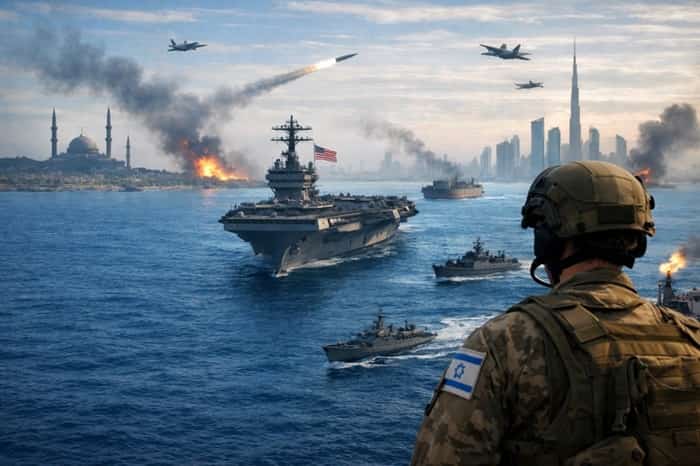
Beyond the immediate actors, the ripple effects are already visible. Created by Andrew Wood with AI
Markets react before diplomats do
If diplomacy operates behind closed doors, markets are far less discreet. Oil prices, as expected, have responded almost instantly to the Gulf crisis, rising not necessarily because of the disruption but because of the anticipation of it.
That distinction matters. The Gulf remains one of the world’s most critical energy corridors, with the Strait of Hormuz acting as a narrow but vital artery. Even the suggestion of instability here sends tremors through global supply chains.
For airlines, already operating on tight margins and tighter schedules, rising fuel costs are not theoretical. They are immediate, measurable and unwelcome.
Long-haul routes become more expensive to operate. Ticket prices inch upwards. Capacity decisions are revisited. None of this happens in isolation.
Aviation feels the strain early
Airspace closures and route diversions have become early indicators of the Gulf crisis deepening. Aircraft now skirt around areas once routinely crossed, adding time, cost and complexity.
It is a familiar pattern. We saw it during previous regional flare-ups, and again more recently in Eastern Europe. Aviation adapts quickly—one of its enduring strengths—but adaptation comes at a price.
Passengers, of course, notice the outcomes rather than the causes. Longer flight times, higher fares, and occasional schedule disruptions are the visible consequences of decisions made far from the departure gate.
Tourism’s fragile confidence
Tourism, perhaps more than any other sector, trades on perception. And perception is rarely subtle.
Images of conflict—no matter how geographically contained—travel instantly. The Gulf crisis, amplified by 24-hour news cycles and social media, has the potential to influence traveller behaviour well beyond the region itself.
Insurance premiums rise. Tour operators reassess itineraries. Travellers pause, reconsider, or quietly change plans.
For destinations perceived as stable, there may be a modest upside. Diversion is a well-established phenomenon in travel. But it is rarely predictable, and never evenly distributed.
For others, particularly those geographically or politically proximate, the impact can be swift and unforgiving.
Asia watches from a distance, but not untouched
From an Asian perspective, the Gulf crisis may appear distant. In practice, its effects are anything but.
Higher fuel costs are directly reflected in airline pricing structures. Long-haul travel, particularly on Europe-bound routes, becomes more expensive. Demand softens at the margins. Confidence, always a delicate commodity, becomes harder to sustain.
Airlines across Asia-Pacific will be watching closely, adjusting capacity where necessary and hedging where possible. None of this is new. But the margin for error is narrowing.
Three paths ahead, none entirely comfortable
Where does this leave us? Broadly speaking, three scenarios present themselves.
The first is containment. Diplomatic channels are often invisible but rarely inactive and gain traction. Tensions stabilise, and the Gulf crisis settles into a tense but manageable equilibrium. Markets would welcome this. So would airlines, insurers and just about everyone else.
The second is controlled escalation. Limited strikes, ongoing tension, and a prolonged period of uncertainty. This is perhaps the most plausible near-term outcome. It keeps oil prices elevated, travel demand cautious, and decision-makers permanently on edge.
The third, and least desirable, is expansion. A miscalculation, a misread signal, or an unintended consequence draws additional actors into the conflict. The ripple effects across energy, aviation and global trade would be immediate and significant.
At present, we sit somewhere between containment and controlled escalation, a rather uncomfortable middle ground.
The real risk: misunderstanding
History has a habit of reminding us that conflicts rarely escalate purely by design. Misinterpretation, rather than intention, is often the more dangerous catalyst.
In a fast-moving environment such as this, signals can be misread. Responses can overshoot. And events can move beyond the control of those who set them in motion.
Understanding the adversary politically, economically, and strategically is therefore not a luxury. It is a necessity.
Interconnected consequences
What distinguishes the current Gulf crisis from many of its predecessors is the degree of interconnectedness.
Energy markets influence aviation. Aviation shapes tourism flows. Tourism impacts broader economic confidence. Each element feeds into the next, creating a system in which disruption in one area quickly propagates to others.
For travel professionals, this is not a time for complacency. Monitoring developments, maintaining flexibility in capacity planning, and communicating clearly with customers will be essential.
The industry has shown resilience before. It will need to draw on that experience again.
Watching the signals
For those looking for early indicators of where this may head, a few markers stand out.
Oil prices remain the clearest barometer. Sustained increases suggest prolonged tension. Sharp spikes may indicate escalation.
Aviation responses to route changes, capacity adjustments and fare movements often provide practical, real-time insights into risk levels.
Financial markets, meanwhile, will continue to oscillate, reflecting uncertainty as much as underlying fundamentals.
And then there is diplomacy. Much of it will occur quietly, away from headlines, but its influence should not be underestimated.
A measured outlook
It is tempting, in moments like this, to search for definitive answers. The Gulf crisis offers few.
What it does provide is a reminder of the delicate balance on which global travel rests. Politics, economics and human behaviour remain tightly interwoven, and shifts in one can quickly unsettle the others.
For now, caution is the prevailing mood. Not panic, but not comfort either.
And perhaps that is the most accurate reflection of where we stand.
by Andrew J Wood and edited by Jill Walsh – (c) 2026.
Read Time: 5 minutes.
About the Writer.
 Andrew J. Wood has lived in Thailand since 1991. He is a former Director of Skål International and a Past President of Skål International Asia, Skål International Thailand, and Skål International Bangkok.
A former hotelier with senior management experience at leading hospitality groups including Shangri-La, Minor International, Landmark and Royal Cliff, he writes regularly for international travel and hospitality publications.
His work focuses on tourism trends across Asia, sustainable tourism development, and the future of travel and hospitality in the Asia-Pacific region.











