

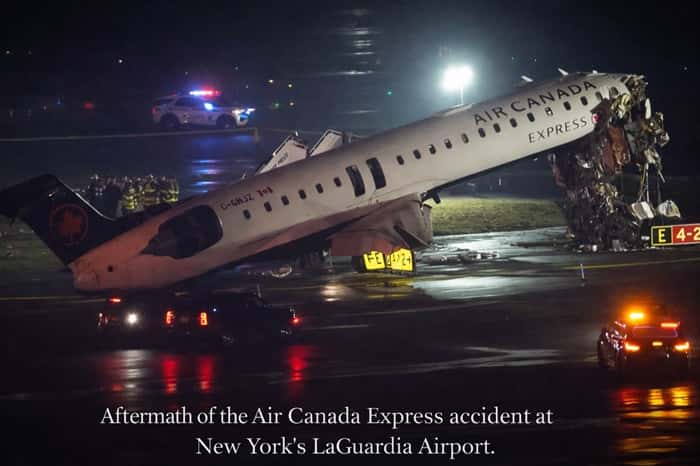
There’s a quiet rule in aviation: when things go right, nobody notices. When they don’t, everyone does.
On Sunday night in New York, the silence broke.
Air Canada Express flight AC8646, a routine hop from Montréal to LaGuardia, ended in tragedy and accident on landing that claimed the lives of both pilots and left passengers shaken, injured, and very suddenly aware that even the most ordinary journey carries risk.
For an industry that trades on reliability, that’s not just a bad night. It’s a moment of reckoning.
A Flight That Should Have Been Forgettable
The aircraft, a Mitsubishi CRJ-900 operated by Jazz Aviation, was doing what hundreds of regional jets do every day: moving people efficiently, quietly, and without fuss.
About 72 passengers. Four crew. A late arrival at LaGuardia at 11:30 pm.
Nothing remarkable. Until it was.
The accident occurred during landing, the phase of flight where precision matters most and margins tighten. It’s also where experience earns its keep and where, occasionally, even that isn’t enough.
Emergency services moved quickly. Passengers were treated on site, and some were transported to nearby hospitals. Details remain fluid, as they always are in the first hours, but the human toll is already clear.
Two pilots didn’t make it home.
The Loss That Lands Hardest
In aviation circles, the loss of flight crew cuts deep.
Pilots are not passengers of fate. They are trained, drilled, and conditioned to manage the improbable. When something overwhelms that system, when two highly trained professionals are lost, it sends a very particular kind of chill through the industry.
There will be no shortage of quiet conversations this week. In crew lounges. On jump seats. Over coffee between sectors.
“What happened?”
Not out of curiosity. Out of necessity.
Air Canada’s Response: Calm, but Heavy
Air Canada’s initial statement struck the expected tone, measured, respectful, and careful not to get ahead of facts.
The airline confirmed the accident, acknowledged the loss of its Jazz Aviation colleagues, and made it clear that details around injuries and passenger outcomes are still being verified.
Behind the wording, though, sits something heavier.
Airlines understand optics. But they also understand responsibility. When your name is on the ticket, even if the aircraft is operated by a regional partner, you own the moment.
And this is one of those moments.
Regional Aviation: Efficient, Complex, Under Pressure
Let’s be candid. Regional aviation is the backbone of global airline networks, but it operates under a different set of commercial realities.
Tighter margins. Higher utilisation. Less room for error.
None of that excuses anything. But it does frame the environment.
Passengers booking an Air Canada flight rarely distinguish between mainline and “Express.” Nor should they. To the traveller, it’s one brand, one promise.
Which is why incidents involving regional operators tend to punch above their weight.
They raise uncomfortable questions about oversight, consistency, and efficiency, as the system sometimes asks a little too much of the margins.
What We Know and What We Don’t
At this stage, the facts are thin. And that’s entirely normal.
Investigators from both the Transportation Safety Board of Canada and the U.S. National Transportation Safety Board are now involved. They will take their time and rightly so.
They’ll look at everything:
- Weather conditions
- Aircraft systems
- Crew performance and fatigue
- Maintenance history
- Operational procedures
Aviation doesn’t deal in guesses. It deals in evidence.
Still, history tells us this much: accidents are rarely caused by a single failure. More often, they are the result of small things lining up in precisely the wrong way.
The Industry Reaction: Quiet, but Intense
There won’t be dramatic headlines inside airline offices this week. No grandstanding.
Instead, there will be a far more telling review.
Safety teams revisiting procedures. Operators checking fleet data. Training departments are reinforcing scenarios that, until Sunday night, felt comfortably theoretical.
That’s how aviation responds. Not loudly, but thoroughly.
And it’s why, despite moments like this, the system continues to improve.
A Reminder the Industry Never Wanted
For passengers, the reaction is simple: concern.
For the industry, it’s more complicated.
Because aviation has spent decades building trust layer by layer, system by system, until flying became almost mundane. Statistically safe. Comfortably predictable.
Events like this disrupt that narrative.
Not because they are common, they are not, but because they are visible.
And in a business built on confidence, visibility matters.
Perspective, Without Complacency
It’s important to say what often gets lost in the noise: commercial aviation remains extraordinarily safe.
Millions of flights operate without incident every year. The systems in place, technical, procedural, and human, are robust and constantly evolving.
But “safe” does not mean immune.
And every accident, no matter how rare, carries a lesson the industry is obliged to learn.
The Human Story Behind the Headlines
Strip away the analysis, and what remains is simple.
Passengers who expected to arrive, not remember.
Families were waiting for news that came far too late.
Colleagues mourn two professionals who did their job until the very end.
It’s easy to talk about systems and safety frameworks. Harder but more important to remember the people inside them.
Final Approach
The investigation into Flight AC8646 will take time. It should.
Answers will come, eventually. Recommendations will follow. Procedures may change in ways passengers will never notice, but benefit from all the same.
That is aviation’s quiet promise: to learn, to adapt, and to move forward without forgetting.
For now, though, the industry pauses briefly and respectfully to take stock.
Because every now and then, the sky reminds us who’s in charge.
by Jason Smith – (c) 2026.
Read Time: 5 minutes.
About the Writer.
 Jason Smith was educated in terminals, taxis and hotel corridors, the sort of schooling no classroom could hope to provide. Half American, half Asian, he grew up inside the quiet machinery of tourism, watching his family send strangers into the world long before he travelled himself.
Bangkok came first, then the Asian Institute of Hospitality & Management, followed by a career stitched together across Singapore, Malaysia and Vietnam. Each city left a mark. Thailand eventually claimed him, along with a corner office, as Director of Sales for one of the country’s leading hotel groups.
Then the world paused. Borders closed, skies emptied, and Jason returned to America carrying time, memory and a lifetime of stories.
Now at Global Travel Media, he writes about the human side of travel check-ins, departures, and everything in between with warmth, clarity, and an instinct for connection.











