

There are cruise seasons.
And then there are statements.
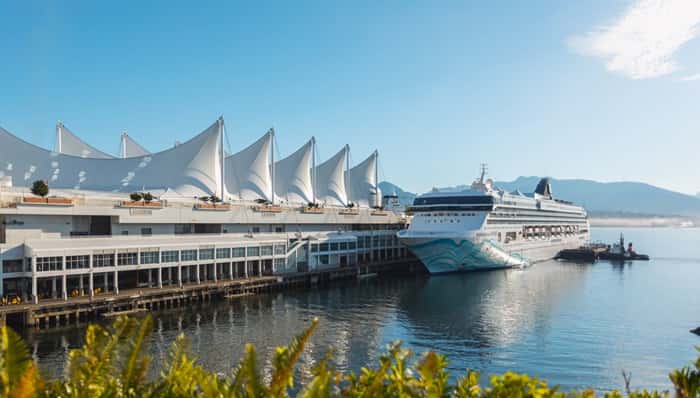
Vancouver’s 2026 cruise program, which begins tomorrow morning when the Disney Wonder eases into berth at Canada Place, is very clearly the latter.
By October, more than 1.4 million passengers will have passed through the Canada Place terminal at the Port of Vancouver. Nearly 360 ships will have called. And more than $1 billion will have flowed through tills, to suppliers, into hotel rooms, and to transport operators across Canada.
For a city that has long understood the rhythm of the Alaska cruise market, this isn’t just recovery. It’s acceleration.
The Numbers That Matter
Let’s deal in facts.
This year’s projected passenger volume is five per cent higher than the previous record set in 2024. It is 19 per cent higher than last year’s 1.2 million passenger visits from 300 ship calls.
That is not marginal growth. That is compound confidence.
Cruise operations linked to Vancouver sustain more than 17,000 jobs nationally. On average, each ship call delivers roughly $3 million in local economic activity through provisioning, shore excursions, retail, food and accommodation.
When industry people talk about “economic impact”, this is what they mean: butchers supplying beef, florists restocking arrangements, drivers moving luggage, laundry services running through the night.
It is a supply chain that hums.
Cliff Stewart, Vice President of Operations and Supply Chain at the Vancouver Fraser Port Authority, puts it without embellishment:
“The Vancouver cruise sector and Canada Place cruise terminal continue to provide a powerful economic boost, as passengers visit shops, restaurants and local attractions, and cruise lines re-stock ships using Canadian suppliers.”
There is no marketing gloss required. The scale speaks for itself.
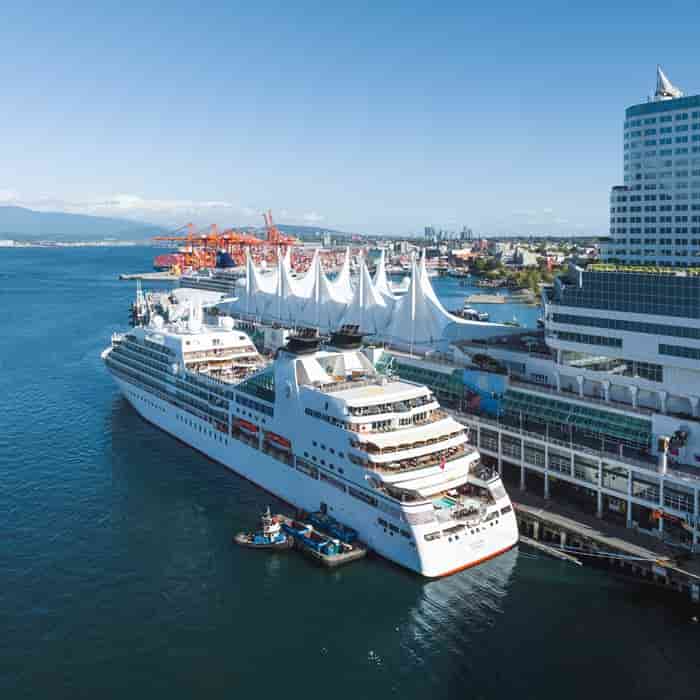
Vancouver Cruise Terminal
Alaska Still Reigns
Make no mistake, this surge is anchored in Alaska.
Vancouver remains one of the most important homeports for Inside Passage cruising. Ships embark, disembark, refuel, restock and turn around here. That homeport status is what differentiates Vancouver from a simple transit port.
Passengers don’t simply wave from the deck.
They stay. They dine. They overnight. They explore.
And this year, the product mix deepens.
Disney Cruise Line will homeport two vessels, Disney Wonder and, for the first time in Vancouver, Disney Magic. Two new operators, Virgin Voyages and Ritz-Carlton Yacht Collection, enter the market. Five ships will make inaugural visits.
That is diversification at the premium end of the market a segment that spends.
Jose Fernandez, Vice President of Port Strategy, Development and Operations at Disney Cruise Line, is clear about the appeal:
“Our Alaskan cruises have long been a favorite among guests seeking adventure and unforgettable experiences. We’re excited to continue working with the Port of Vancouver, and we look forward to welcoming more families to discover Alaska’s breathtaking landscapes this season aboard the Disney Wonder and, for the first time, the Disney Magic.”
Alaska remains a bucket-list product. Vancouver remains the front door.
Throughput Without Chaos
Handling 1.4 million passengers requires more than optimism.
Facial biometric processing introduced in 2024 has dramatically reduced clearance times for U.S. border formalities. The reduction, up to 94 per cent, takes average transaction times from minutes to seconds.
In peak season, that matters. Long lines erode satisfaction. Smooth processing reinforces the premium experience cruise lines sell.
Efficiency, in this context, is not glamour. It is discipline.
Growing Without Burning
There is another story running parallel to the volume surge, and it is environmental.
Canada Place was among the first cruise terminals globally to introduce shore power back in 2009. Since then, more than 50,000 tonnes of greenhouse gas emissions have been prevented.
Now expansion is underway.
The port authority, with federal backing through Transport Canada’s Green Shipping Corridors Program, will increase shore power capacity so more vessels can plug into British Columbia’s hydro-powered grid while at berth.
The projected additional reduction: 3,300 tonnes of greenhouse gases per cruise season, equivalent to removing roughly 770 petrol vehicles from the road annually.
In 2025, more than 80 per cent of cruise calls will be shore power-enabled.
The Honourable Steven MacKinnon, Minister of Transport, frames it in national terms:
“Vancouver’s cruise sector is a powerful engine for tourism and trade, supporting thousands of jobs and generating significant economic activity across Canada. As another strong cruise season begins at the Port of Vancouver, our government is investing through Transport Canada’s Green Shipping Corridors Program to expand shore power at Canada Place reducing emissions while enabling continued growth.”
Translation for the trade: growth and environmental compliance are no longer competing priorities. They are now commercially intertwined.
Cruise lines know this. So do ports.
Participation in the port authority’s ECHO Program, coordinating voluntary vessel slowdowns to protect at-risk whales in the Salish Sea, reached almost 90 per cent last year, with cruise operators leading uptake.
Sustainability is no longer optional optics. It is a licence to operate.
The Perfect Storm
If 1.4 million cruise passengers were not enough, Vancouver will also host seven matches of the FIFA World Cup 2026 this summer.
The overlap is not subtle.
Royce Chwin, President and CEO of Destination Vancouver, does not sugarcoat it:
“Vancouver will experience something of a perfect storm this summer when it comes to accommodation, with the height of a very busy cruise season overlapping with the city hosting FIFA World Cup 2026™ matches.”
Accommodation demand will be fierce. Rates will respond accordingly.
For agents and wholesalers, this is not a footnote; it is a planning imperative. Early bookings will matter. Inventory will tighten.
Cities rarely experience simultaneous global sporting and peak cruise events. Vancouver will.
Reputation Reinforced
Canada Place continues to collect recognition, recently named North America’s Leading Cruise Port 2025 at the World Travel Awards and shortlisted in Europe’s Premios Cruceroadicto awards.
Awards are not trophies for the mantelpiece. They are signals to cruise executives weighing deployment decisions.
Vancouver’s message to the market is simple: capacity, competence, compliance.
Final Word
The season opens on February 26 with Disney Wonder at 7 am. It closes on October 13 with Norwegian Encore.
Between those dates lies one of the most commercially significant cruise programs the city has ever delivered.
More ships. More passengers. More environmental safeguards. More economic impact.
Vancouver is not chasing volume for its own sake.
It is managing scale with precision and, in doing so, reinforcing its place as one of North America’s most strategically important cruise homeports.
That is not hype.
That is the trajectory.
by Susan Ng – (c) 2026.
Read Time: 9 minutes.
About the Writer.
 With the polish of an international hotel professional and the instincts of a born storyteller, Susan Ng learned hospitality where it truly lives behind reception desks, in banquet halls, beside linen carts. She understands that excellence isn’t announced; it’s felt, in the small, quiet gestures that linger long after checkout.
Away from the bustle, her curiosity found a new front desk: the blank page. Her blog, candid and gently wry, drew readers who recognised truth when they saw it. She wrote about grace and imperfection with the steady eye of someone who had lived both.
Today, at Global Travel Media, Susan brings that same warmth and insight to her stories. Expect writing that is polished, generous, and reassuring, like the perfect welcome after a long journey.











