

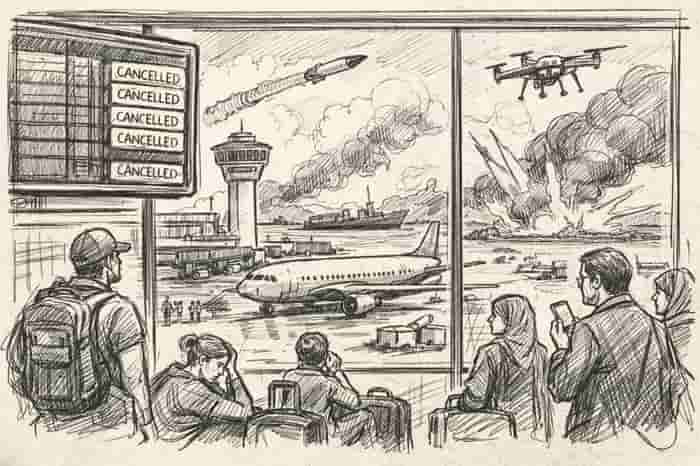
There are a few things that can bring the finely tuned machinery of global aviation to a grinding halt. War, unfortunately, remains one of them.
Across the Middle East this week, airspace closures triggered by escalating hostilities between Israel, the United States and Iran have left thousands of travellers stranded, airlines scrambling to reroute aircraft, and travel planners quietly recalculating itineraries that only days ago looked perfectly routine.
For an industry built on predictability and carefully choreographed connections, the disruption has arrived swiftly and with very little warning.
Security and crisis response firm Global Rescue is now urging travellers to postpone non-essential journeys to the region, warning that the operating environment has become both unstable and highly unpredictable.
“Travel to or through the Middle East right now carries elevated and unpredictable risk,” said Kent Webber, senior manager of Intelligence Services at Global Rescue and a former Senior Intelligence Operations Officer at the United States Pentagon.
“We are advising travellers to postpone non-essential travel to the region and to carefully evaluate whether their presence is mission-critical. The operating environment is fluid, and conditions can deteriorate with little or no warning.”
A Region’s Airspace Suddenly Goes Quiet
Airports that normally hum with round-the-clock activity have fallen silent or are operating on severely reduced schedules.
Among the facilities currently affected are Bahrain International Airport, Tehran’s Imam Khomeini International Airport, Baghdad International Airport, Erbil International Airport, Tel Aviv’s Ben Gurion Airport and Doha’s Hamad International Airport.
Elsewhere, some of the Middle East’s busiest aviation gateways, Dubai International Airport, Abu Dhabi’s Zayed International Airport, Beirut Rafic Hariri International Airport, Muscat International Airport and Amman’s Queen Alia International Airport, remain open but are operating under irregular schedules and rapidly shifting operational constraints.
Kuwait International Airport, meanwhile, continues to experience rolling delays as regional security conditions evolve.
For airlines, the problem is not simply where to land, but where they can safely fly.
“These closures and limitations create a cascading disruption across global aviation networks, not just within the Middle East,” Webber said.
“Travellers transiting the region for Europe, Asia or Africa should anticipate rerouting, extended delays and potential cancellations.”
And therein lies the wider challenge.
Over the past two decades, Middle Eastern hubs have become the connective tissue of long-haul travel. Airports such as Dubai, Doha and Abu Dhabi effectively knit together routes between Europe, Asia, Africa and Australia.
When those links falter, the ripple travels far.
Flights between Asia and Europe are already being rerouted around closed airspace, adding hours to journey times and creating logistical headaches for airlines attempting to keep aircraft and crews where they need to be.
Travellers Face Uncertain Plans
For travellers who had planned to pass through the region this week, many en route between continents, the disruption has translated into missed connections, overnight delays and uncertain travel plans.
Global Rescue says anyone considering travel to the Middle East should think carefully before proceeding.
“Travellers must weigh the essential nature of their trip against the real possibility of being stranded due to airspace closures, airport shutdowns, or cascading flight cancellations,” Webber said.
“Even where airports remain technically open, flight schedules are severely disrupted, and onward connections may not be reliable.”
In other words, the journey might begin smoothly enough, but finishing it could prove considerably more complicated.
Advice for Those Already in the Region
For travellers currently in affected countries, the advice is straightforward and familiar to anyone who has spent time in uncertain environments: stay informed and avoid unnecessary movement.
Global Rescue is urging travellers to follow instructions issued by embassies and local authorities and to remain prepared should evacuation opportunities arise.
“Members and clients currently in affected countries should heed official instructions to shelter in place, maintain a low profile, and avoid unnecessary movement,” Webber said.
“While belligerents are not expected to deliberately target civilians, the risk of collateral damage from missile, drone and air defence activity is significant.”
Preparedness matters.
“Travellers should ensure they have access to secure shelter, sufficient food, water, medications and valid travel documents in the event of a sudden departure window,” he added.
“When commercial options become available, those who can safely depart should consider doing so without delay.”
A Conflict Spreading Across Domains
The current crisis is not confined to the skies.
Recent developments include missile and drone interceptions in Bahrain, Kuwait, Qatar, Saudi Arabia and the United Arab Emirates, alongside missile strikes in Israel and renewed air activity around Tehran.
Elsewhere, strikes targeting Hezbollah positions have been reported in Lebanon, while damage to Saudi Aramco’s Ras Tanura refinery has added a further economic dimension to the unfolding situation.
Maritime security has also deteriorated sharply.
Several global shipping companies have suspended commercial operations through the Strait of Hormuz amid heightened risk, underscoring how rapidly geopolitical tensions can disrupt critical global transport routes.
“This is a multi-domain conflict environment involving air, missile, drone and maritime threats,” Webber said.
“The breadth of activity increases the probability of unintended escalation and incidental exposure to risk for travellers.”
The Travel Industry Watches Carefully
For airlines, travel companies and tour operators, the situation is being monitored closely.
The travel industry has long experience navigating geopolitical turbulence, but events such as these serve as a reminder that global mobility depends heavily on political stability.
When airspace closes, routes vanish overnight.
For now, the advice to travellers is refreshingly simple: keep a close eye on airline updates, follow official travel guidance and allow more flexibility than usual when planning journeys that pass through the Middle East.
Because at the moment, the region’s skies, normally one of the busiest corridors in international aviation, are a good deal quieter than anyone would like.
Meanwhile, the uncertainty shows little sign of easing for airlines operating through the Gulf. Qatar Airways confirmed that its scheduled flight operations remain temporarily suspended following the closure of Qatari airspace. The airline said services will only resume once the Qatar Civil Aviation Authority declares the skies safe to reopen. For the moment, passengers and travel planners alike remain in a holding pattern, with the carrier advising that a further operational update will be issued on 06 March at 0900 Doha time (0600 UTC). In aviation terms, it’s a polite way of saying everyone is waiting for the green light, and until that happens, the world’s most connected hub remains firmly paused.
Further updates are available via https://www.globalrescue.com.
by Michelle Warner – (c) 2026.
Read Time: 5 minutes.
About the Writer.
 Michelle Warner has always carried stories the way others carry passports lightly, faithfully, and with purpose. She learned her craft in newsrooms, shaping sentences with care, before swapping deadlines for departures as a flight attendant with some of the world’s great airlines. Years aloft sharpened her eye for character and deepened her fondness for the small, dignified rituals of travel, the quiet kindness of strangers, the poetry of arrival, the patience learned between time zones.
Now grounded by choice, Michelle has come home to writing with the same calm authority she once brought to turbulent cabins. Her prose blends an editor’s discipline with a traveller’s wonder, tinged with humour and reverence for the golden age of travel. Each piece feels like a handwritten boarding pass gracious, observant, and unmistakably alive.
====================================











