

For Australians, Indonesia has long been the neighbour that needs very little introduction. Bali, in particular, is almost part of the national holiday vocabulary: sunshine, surf, a short flight and the perennial temptation to add “just one more night”.
But Indonesia’s tourism authorities are now asking Australian travellers to look beyond the familiar not necessarily beyond Bali, but beyond its well-worn version.
Under its Quality Tourism strategy, the Ministry of Tourism of the Republic of Indonesia is placing greater emphasis on experiences that deliver more value to travellers, destinations and local communities. The focus is increasingly on marine tourism, gastronomy, wellness, culture, luxury experiences and the arts, rather than simply chasing visitor numbers. Indonesia’s Ministry of Tourism says its 2026 priorities include higher-quality, sustainable tourism that generates stronger economic benefits for communities.
It is a subtle but important shift. Indonesia is not turning its back on popular tourism; it is trying to persuade travellers to stay longer, explore further and spend more thoughtfully. That means discovering the country through its people, food, landscapes, traditions and heritage rather than treating each destination as another pin on a map.
The idea sits neatly behind Indonesia’s “Go Beyond Ordinary” campaign, which encourages visitors to seek richer and more meaningful journeys. The campaign highlights gastronomy, wellness, and marine experiences as key pillars, as Indonesia positions quality and sustainability more prominently in its international tourism pitch.
For Australian travellers, Bali remains the obvious starting point, although perhaps not the finishing point.
Beyond the beach clubs and busy resort strips lies an island of rice terraces, temple ceremonies, traditional villages, regional cooking and a well-established wellness culture. The point is not that Australians have been visiting the “wrong” Bali. Rather, many repeat visitors never reach the Bali beyond the usual circuit.
Across the Lombok Strait, Lombok offers a different rhythm. Sasak culture gives the island its own identity, while the Gili Islands provide access to tropical marine experiences. Inland, Mount Rinjani delivers a decidedly more energetic proposition for travellers keen on trekking and nature-based adventure.
Nobody has ever accused Rinjani of being a spa treatment.
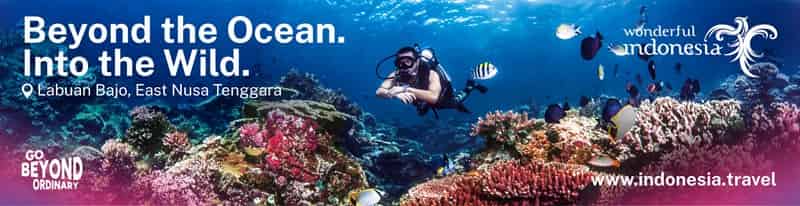
Further east, Labuan Bajo has emerged as the gateway to one of Indonesia’s most extraordinary marine environments. The Indonesian Government continues to develop the destination with an emphasis on quality, competitiveness and sustainability.
Nearby Komodo National Park is recognised by UNESCO for both its dramatic terrestrial landscapes and rich marine ecosystems. Its coral reefs support exceptional biodiversity, while its surrounding waters include sea turtles, dolphins, dugongs and other marine species.
This is where Indonesia’s quality-tourism ambition makes particular sense. A destination as environmentally valuable as Komodo does not benefit from tourism measured only by volume. A more compelling model protects the natural asset while ensuring tourism creates lasting economic value for local communities.
Then there is Borobudur in Central Java, where the journey moves from reef to relief quite literally.
The UNESCO World Heritage-listed Borobudur Temple Compounds date from the 8th and 9th centuries. The monument rises through a sequence of terraces and circular platforms crowned by a monumental stupa, with 72 openwork stupas surrounding the upper platforms.
It is not simply an impressive historical attraction. Its architecture reflects Buddhist cosmology and gives travellers an altogether different encounter with Indonesia’s cultural depth.
Minister of Tourism of the Republic of Indonesia Widiyanti Putri Wardhana said the strategy was designed to strengthen visitors’ connection to the places they experience.
“Quality Tourism is about creating a stronger connection between travellers, destinations and the communities that shape them. It means encouraging journeys that go beyond seeing a place, towards understanding its character, experiencing it more deeply and creating lasting value for the destinations visited. In that spirit, we invite Australian travellers to explore further and discover more meaningful experiences across Indonesia.”
The quotation appears in the Ministry-sourced Australian release published on 2 October 2026 and has been retained verbatim.
Technology is also being enlisted in the effort. The Ministry has introduced MaiA – Meticulous Artificial Intelligence of Indonesia, an AI-powered travel assistant developed under Indonesia’s Tourism 5.0 programme. Travellers can access MaiA through the official tourism website at www.indonesia.travel, where it can assist with personalised trip planning, destination discovery and itinerary inspiration.
Powered by Google Gemini, the virtual travel assistant can help visitors build personalised itineraries and shape trips around destinations and individual interests. The Ministry describes MaiA as a smart travel planner and companion designed to assist travellers from inspiration through to trip planning.
That may sound strikingly modern beside an ancient temple such as Borobudur, but the combination neatly illustrates Indonesia’s broader tourism proposition: use new technology to help travellers discover old cultures, living traditions and natural wonders more intelligently.
For the Australian market, the opportunity is substantial. Indonesia is already close, familiar and accessible. The next challenge is not simply persuading Australians to go.
It is persuading them to look again.
Bali can still supply the sunset. Lombok can add adventure. Labuan Bajo can deliver the sea, and Borobudur can provide a few centuries of perspective.
Indonesia’s latest tourism message is therefore refreshingly straightforward: come back, certainly, but this time, go deeper.
By: Octavia Koo – © 2026.
Read Time: 3 minutes.
Author Bio:
 Octavia Koo arrived in Australia in the early eighties with little fuss and a good eye. Sydney suited her. At UNSW, she studied Arts, then found her footing in graphic design before drifting, quite naturally, into the digital side of things, building websites and shaping words that made people want to stay.
Singapore followed, and with it, the fast pace of tourism platforms and ITB Asia. Long before SEO became a buzzword, Octavia understood how stories travelled online. That’s where she met Stephen, and the seed for something more was planted.
A few years later, she joined Stephen’s EGT Media.
Today, Octavia works with quiet assurance, blending art, instinct and experience to produce stories that don’t shout; they simply work and linger.











