

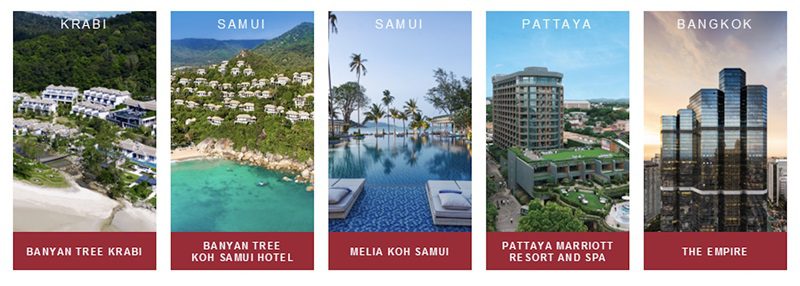
Thailand’s property and tourism sectors are being handed a sizeable new investment vehicle, with Asset World Corp Public Company Limited unveiling a proposed real estate investment trust built around five prominent freehold assets and an initial investment value of up to THB51.388 billion.
The new AWC Lifestyle Property Real Estate Investment Trust, or AWR, is designed to marry two things investors traditionally like: income today and the possibility of more value tomorrow.
In AWC’s case, that means combining Bangkok commercial property with internationally branded resorts in Koh Samui, Krabi and Pattaya while creating a pipeline through which mature AWC developments may eventually migrate into the REIT.
It is an ambitious structure, and certainly not a small one.
AWC describes the strategy as an Integrated Sustainable Growth Platform, under which the listed property group effectively becomes the development engine while AWR concentrates on owning completed, income-producing assets.
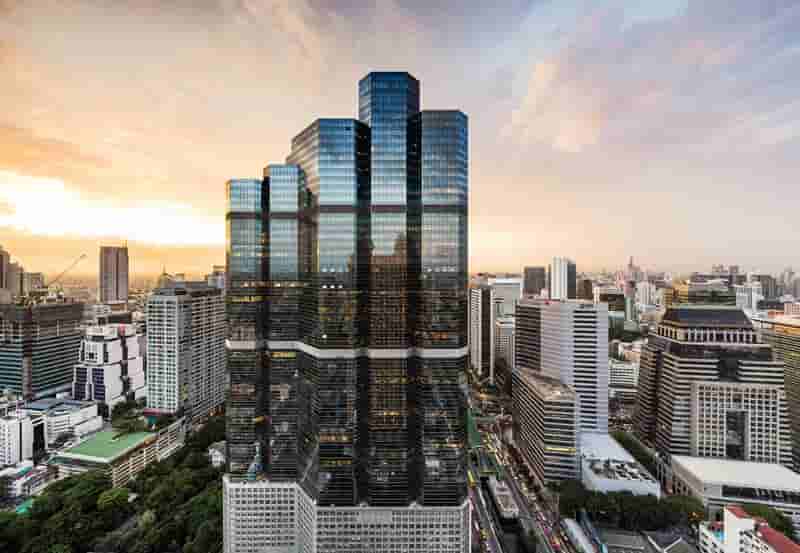
The Empire is a 58-storey landmark in the heart of Sathorn and one of the largest integrated business and lifestyle destinations in Bangkok’s Central Business District (CBD).
The theory is reasonably straightforward. AWC develops, improves and positions properties until they reach operating maturity. AWR can then consider acquiring qualifying assets, potentially providing AWC with capital to recycle into further development while giving REIT investors exposure to established real estate.
Property companies have been finding increasingly inventive names for capital recycling since somebody first discovered that bricks, beds and balance sheets could coexist happily. What matters here, however, is the scale of the pipeline behind the proposal.
According to AWC, its portfolio has expanded to 62 projects, while gross asset value has risen from THB96.46 billion when the company listed on the Stock Exchange of Thailand in 2019 to THB224.1 billion as at 30 June 2026.
That gives AWR considerably more to contemplate than its opening five properties.
Five assets form AWR’s opening hand
The proposed initial portfolio comprises The Empire in Bangkok, Banyan Tree Koh Samui, Banyan Tree Krabi, Meliá Koh Samui and Pattaya Marriott Resort and Spa.
AWR’s website confirms all five properties as its proposed opening portfolio and describes the trust as a freehold, best-in-class, sustainability-focused REIT.
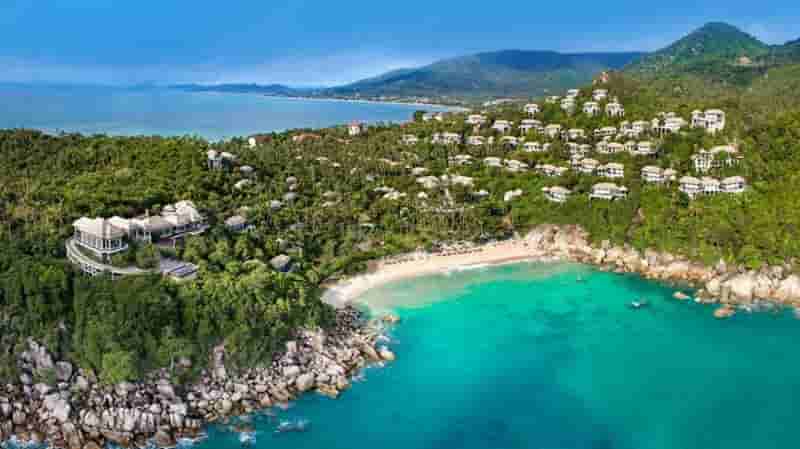
Banyan Tree Koh Samui
That mix is important.
Instead of placing all its chips on either offices or hotels, AWR would combine Bangkok commercial rental income with resort earnings from three of Thailand’s strongest leisure markets.
It gives the proposed REIT exposure to two major engines of the Thai economy: corporate activity and tourism, although investors should remember that diversification does not remove risk. Offices, resorts, financing markets and international travel demand can all have very different ideas about what constitutes a quiet year.
AWC says EBITDA across the five assets has increased by approximately 20 per cent over the past two years. That figure is a company-reported performance measure and should be considered alongside the detailed assumptions, forecasts and risks contained in the REIT documentation.
Asset World Corp REIT Co., Ltd. submitted the registration statement and draft prospectus to Thailand’s Securities and Exchange Commission on 29 September 2026, according to AWC.
AWR’s website directs investors to that SEC documentation for further information on the proposed trust structure.
The Empire gives the portfolio a Bangkok anchor
The heavyweight commercial asset is The Empire, AWC’s landmark development in Sathorn, Bangkok’s central business district.
AWC describes the property as one of Bangkok’s largest integrated business and lifestyle destinations. Its company material notes the building’s 158,021 square metres of net leasable area, more than 200 tenants, and an approximately 99 per cent tenant-retention rate.
The property combines Grade A office accommodation with restaurants, wellness facilities and lifestyle space, reflecting a broader industry shift away from the traditional office tower as little more than desks, lifts and somewhere to complain about the air-conditioning.
The Empire has also accumulated several internationally recognised building credentials.
AWC confirms LEED Gold, WELL Core Platinum and Fitwel 2-Star certification, while the property has also received WiredScore Platinum and SmartScore Gold recognition.
Those credentials matter beyond the increasingly crowded collection of plaques in the foyer.
Energy efficiency, wellness standards and building performance can affect operating costs, tenant retention, leasing competitiveness and ultimately the economics of a commercial property.
For a REIT promising sustainable long-term growth, those are practical considerations rather than decorative ESG language.
Resorts bring Thailand’s tourism machine into the portfolio
The remaining four assets shift the emphasis squarely towards tourism.
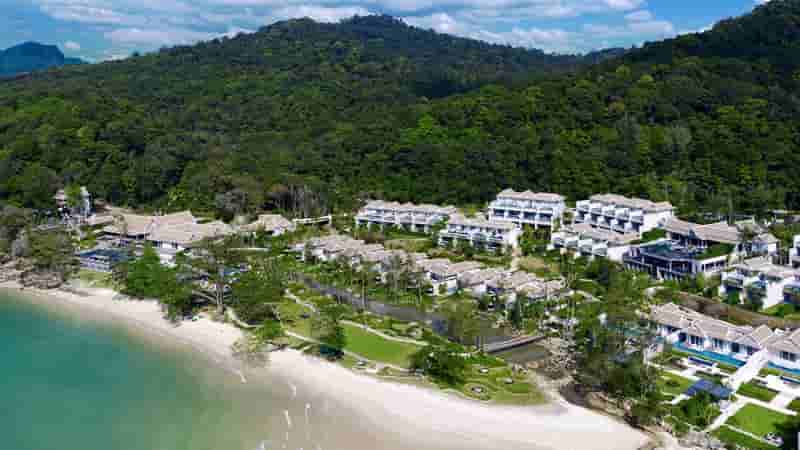
Banyan Tree Krabi
Banyan Tree Koh Samui comprises 88 private-pool villas on Koh Samui, while Banyan Tree Krabi offers 72 suites and villas on Tubkaek Beach.
AWC reports strong historical revenue-per-available-room and EBITDA growth rates for both properties. Those performance figures originate from the sponsor and should be read as part of the broader investment case rather than treated as guarantees of future performance.
What can be independently confirmed is that both Banyan Tree properties retain significant international recognition.
The 2026 MICHELIN Guide’s Thailand hotel selection includes Banyan Tree Samui and Banyan Tree Krabi among the country’s Two MICHELIN Key hotels.
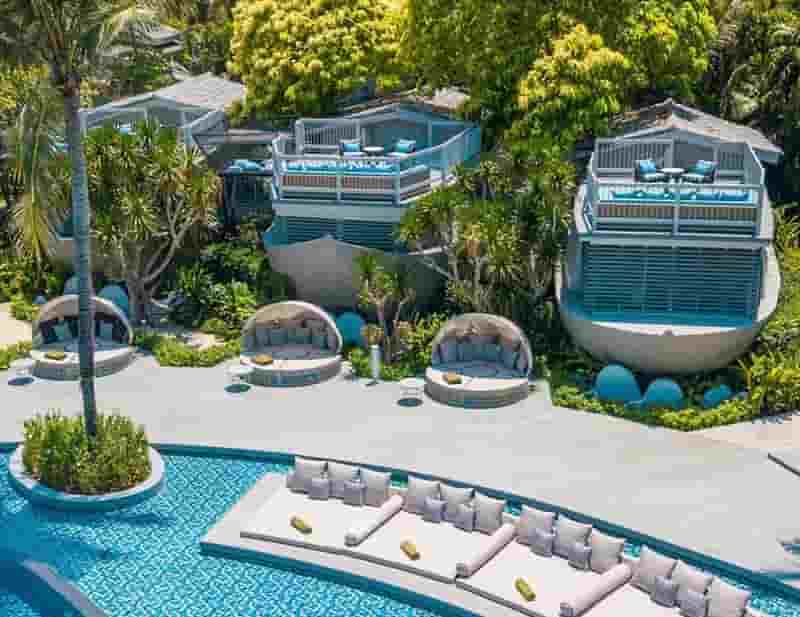
Melia Koh Samui
That is valuable positioning at the luxury end of Thailand’s resort market, particularly as destinations compete not merely for more visitors but for travellers with greater discretionary spending.
Then there is Meliá Koh Samui, the 200-room beachfront resort at Choeng Mon Beach.
MICHELIN’s own hotel listing confirms its 200 rooms and distinctive Boat Suites, which draw on traditional Thai vessels, together with the large lagoon-style pool running through the resort.
AWC likewise confirms the property’s Choeng Mon Beach location, 200-room inventory and nautical design elements.
The fourth hospitality asset, Pattaya Marriott Resort and Spa, gives AWR exposure to another of Thailand’s best-known leisure destinations and to Marriott’s enormous international loyalty ecosystem.
AWC says the Pattaya property has 287 rooms and recorded substantial RevPAR growth during its first year of operation.
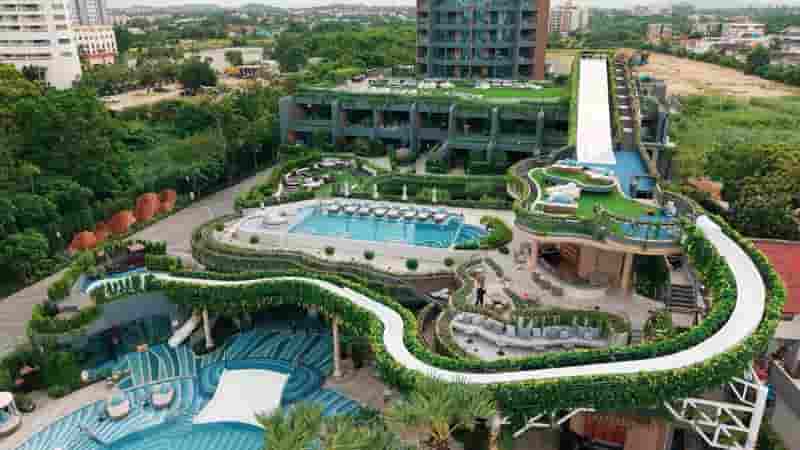
Pattaya Marriott Resort & Spa
As with other sponsor-supplied operating figures, investors should examine the underlying comparison period and financial disclosures rather than falling in love with a percentage at first sight. Hospitality numbers can occasionally look spectacular when a newly opened hotel is being measured against a very low starting base.
Three growth engines
AWC has organised the AWR investment thesis around three forms of value creation.
The first is Performance Growth, increasing earnings generated by the operating assets.
The second is Appreciation Growth, based on ownership of freehold real estate in prime locations where land is limited, and replacement is difficult.
The third, and potentially the most consequential, is Acquisition Growth.
AWR would initially have access to nine assets selected by AWC for investment consideration, while a Right of First Refusal arrangement is intended to provide opportunities involving a further 48 projects in AWC’s current portfolio and future developments, subject to the relevant terms and approvals.
That pipeline is what could ultimately determine whether AWR remains an attractive collection of five prestigious properties or develops into a substantially larger listed real estate platform.
AWC Chief Executive Officer and President Wallapa Traisorat said the model was intended to separate development from long-term income ownership while supporting growth across both sides of the structure.
“AWC established AWR to create AWC’s Integrated Sustainable Growth Platform for the real estate business. AWC is the Development Engine, developing and creating destinations with consideration for the location, communities, the real estate industry and tourism, to serve quality customer segments, realize the full potential value of each location and generate total returns including development gains. AWR, meanwhile, holds income-generating assets for stable, continuous, accelerated and sustainable growth. We believe this model will help strengthen Thailand’s real estate industry.”
She said AWR would allow investors to participate in properties AWC had developed over many years while creating a structure through which both AWC shareholders and AWR unitholders could potentially benefit.
The concept is not revolutionary in global property markets, but its application across Thailand’s hotel, office and destination sectors is strategically notable.
Governance will be closely watched
AWR will be managed by Asset World Corp REIT Co., Ltd., headed by chief executive Dr Paitoon Wongsasutthikul, previously AWC’s chief investment officer.
According to AWC, at least 72 per cent of trust units will be allocated to investors, while AWC may hold up to 28 per cent.
The sponsor says the retained stake is intended to align the interests of AWC and AWR unitholders.
The proposed governance structure includes a board comprising 60 per cent independent directors, with independent appointments made in conjunction with trustee approval.
Dr Paitoon said the initial portfolio was selected for quality, location, income resilience, and market positioning.
“AWR’s portfolio will begin with 5 landmark freehold assets in prime locations, connecting 2 key sectors of the Thai economy: commercial business in Bangkok and tourism in 3 of the country’s leading destinations.”
He added that the manager would seek further investments only where returns were considered appropriate for unitholders and said management fees had been structured to align with growth in distributable income per unit.
That discipline will matter.
A large acquisition pipeline may look splendid in a PowerPoint presentation, but REIT investors generally prefer accretive acquisitions to empire building. More property is not automatically better property.
Tourism gives AWR an intriguing growth story
For the travel sector, AWR’s significance extends beyond another capital-market transaction.
Thailand’s tourism economy has increasingly attracted institutional capital into upscale resorts, wellness projects, branded residences, mixed-use precincts and destination-scale developments.
A vehicle that can recycle capital from mature tourism assets into new developments could increase the financial flexibility available for further expansion.
That could mean more hotels, larger mixed-use precincts and further investment in Thailand’s established and emerging visitor destinations.
It also underscores the increasing convergence between hospitality and institutional real estate.
The modern resort is not simply somewhere to sleep. It is a financial asset, an operating business, a global brand platform, a loyalty ecosystem and, increasingly, a component within much larger investment structures.
AWR brings all of those ingredients together.
For investors, however, the proposition should still be approached as an investment, not a tourism brochure.
Interest rates, property valuations, hotel demand, occupancy, average room rates, capital expenditure, refinancing conditions, related-party transactions and acquisition pricing can all influence long-term returns.
The registration statement and draft prospectus therefore deserve considerably more attention than the infinity pools.
A sizeable bet on Thailand
What AWC has assembled is, nevertheless, an unusually interesting intersection of Thai tourism, commercial property and capital markets.
Five prominent freehold properties provide the opening portfolio. AWC’s development pipeline offers expansion potential. International hotel brands provide distribution and loyalty reach. Bangkok commercial property offers recurring rental income, while Thailand’s resort markets provide the growth component.
It is an elegant proposition on paper.
Execution will determine whether elegance becomes earnings.
If AWR delivers the disciplined acquisition strategy, governance safeguards and operating growth its sponsor is promising, it could become an important new conduit between global investment capital and Thailand’s tourism real estate.
And with an initial investment of up to THB51.388 billion, this is hardly a cautious toe dip into the hotel pool.
AWC is jumping in at the deep end.
Investor information: AWR’s official website provides information on the proposed trust and access to the relevant Thai SEC filing: https://www.assetworldcorpreit.com
Thai SEC filing supplied by AWC:
https://market.sec.or.th/public/ipos/IPOSEQ01.aspx?TransID=817258&lang=en
Asset World Corp: https://www.assetworldcorp-th.com
By: May Marclay – © 2026.
Read Time: 8 minutes.
Author Bio:
 May Marclay’s career hasn’t followed a straight line, and she’s better for it. She began in real estate, then moved into hospitality, finding her rhythm with Centara in the Maldives. There, she worked the Asian markets the old-fashioned way: building trust, closing deals, and turning conversations into lasting business.
The UAE sharpened its focus. At IHG, supporting an Area General Manager, she saw the machinery of a major travel hub from the inside, no gloss, just how things actually get done.
Now, with her sights set on healthcare, May brings a broader lens than most. She speaks three languages, reads widely, travels with intent, and writes with the calm assurance of someone who understands both the detail and the bigger picture without needing to say so too loudly.











