
Thailand’s hotel sector has never been shy of a construction crane.
For the better part of five decades, new hotels have appeared across the country with admirable regularity. Investors have long regarded the kingdom as one of Asia’s most dependable tourism engines, and for good reason. Visitor arrivals rise, airlines add routes, and the hotel industry obligingly builds more rooms.
But the latest numbers suggest that Thailand’s hotel pipeline may finally be reaching a point where growth and competition are beginning to travel uncomfortably close together.
Not a crisis, certainly. But perhaps a gentle reality check.
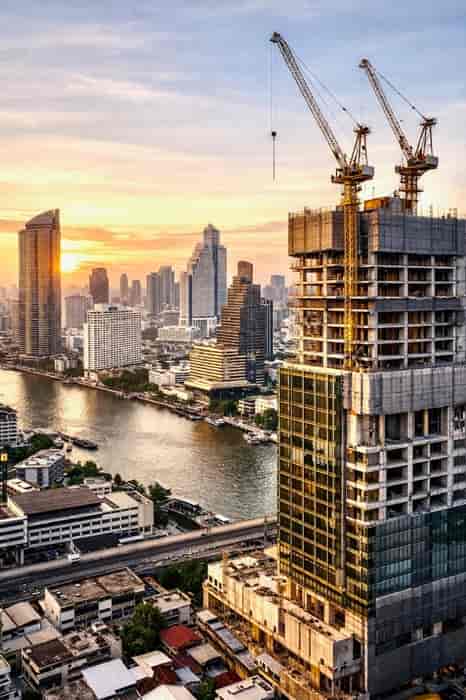
Bangkok’s famous Chao Phraya River is a magnet for new developments. – Image supplied by Andrew Wood
A Pipeline That Keeps Growing
According to the latest Asia Pacific hotel pipeline data, development activity across the region continues to gather pace.
By the end of the fourth quarter of 2025, there were 2,323 hotel projects representing 433,241 rooms under construction or in advanced planning stages across the Asia Pacific (excluding China).
Thailand alone accounted for 167 projects with 43,067 rooms, firmly anchoring the country among the region’s most active development markets.
If there were any doubts about Bangkok’s enduring magnetism for hotel investors, the capital quickly dispels them. Bangkok currently leads the region with 68 hotel projects adding 16,641 rooms.
Phuket follows with 41 projects and 9,583 rooms in the development pipeline.
Both destinations are well-established tourism heavyweights. Neither could be accused of lacking accommodation.
Which makes the steady addition of new inventory rather interesting.
What the Numbers Actually Suggest
On the surface, construction pipelines tend to signal optimism. Developers rarely build hotels unless they believe guests will eventually appear.
Yet taken together with performance data from industry analysts such as STR, a more measured interpretation emerges.
While visitor numbers are steadily recovering, room supply in several mature Thai markets is growing faster than demand during non-peak periods.
This does not immediately spell trouble. Thailand’s tourism engine remains strong and remarkably resilient.
But it does mean that competition is becoming noticeably sharper.
For hotel operators, the practical effects are already familiar.
Outside high season, occupancy becomes harder to defend. Average daily rates show less upward momentum. Marketing costs rise as hotels compete more vigorously for online visibility.
Put bluntly, the same number of travellers now have more rooms to choose from.
Competition Is Quietly Intensifying
This dynamic is particularly visible in the midscale and upscale segments, where hotels often offer broadly similar facilities and rely heavily on pricing and promotion to attract guests.
In such environments, the arrival of a handful of new competitors can quickly reshape the local market.
This pattern is becoming increasingly visible in Pattaya, where a new development cycle is gathering pace.
Industry projections suggest the city’s hotel inventory could grow by roughly 2.2 percent annually, with over 5,700 additional rooms expected by 2027 or 2028.
While this may sound modest in percentage terms, the absolute number of rooms is significant, particularly for a destination already well supplied with accommodation.
Pattaya’s Next Wave of Hotels
Much of Pattaya’s upcoming inventory will come from large mixed-use developments aimed at repositioning the resort city for higher-spending travellers.
Among the most ambitious is the Aquatique Pattaya project led by Asset World Corp (AWC).
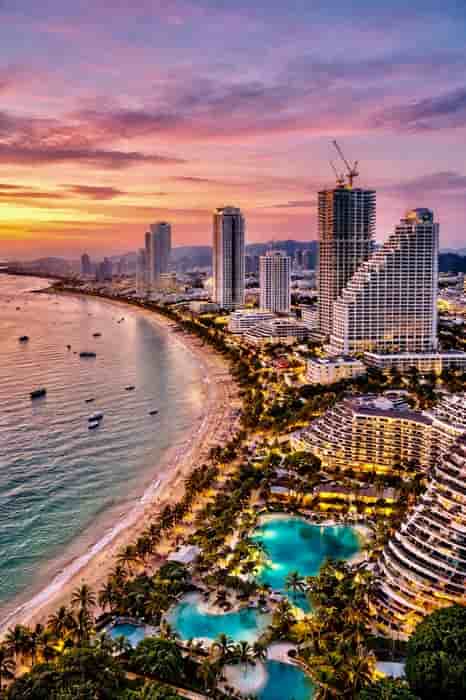
Pattaya’s ever-changing profile – Image supplied by Andrew Wood
The company is investing around THB100 billion into a landmark development on Beach Road in central Pattaya. The project will introduce several international brands that were previously absent from the city.
The lineup is impressive:
• Ritz-Carlton Pattaya
• JW Marriott Pattaya with 398 rooms
• Pattaya Marriott Marquis with approximately 900 rooms
• Autograph Collection Pattaya offering 306 rooms
Together, these properties will bring a sizeable injection of luxury inventory to the market.
For Pattaya’s tourism profile, that is broadly positive news. For existing hotels, however, it means the competitive landscape is about to become rather more crowded.
Oversupply? Not Quite But Worth Watching
Industry observers are generally careful with the word “oversupply”. Thailand’s tourism sector has a long history of absorbing new hotel capacity with surprising ease.
However, in certain locations, the relationship between supply and demand is beginning to tilt.
When room supply expands faster than demand, hotels typically maintain occupancy through tactical promotions, bundled packages, or higher commission distribution channels.
Over time, those measures can erode rate integrity and compress margins.
None of this suggests a looming downturn. It simply means that operating a hotel in Thailand is becoming more of a strategic endeavour than it once was.
Why New Hotels Still Matter
To be fair, continued development also brings considerable benefits.
New hotels raise overall accommodation standards and introduce globally recognised brands that strengthen Thailand’s international reputation.
Modern inventory also helps support the country’s ambitions in MICE tourism, luxury travel and large-scale events.
Across the Asia Pacific region, new supply continues to arrive at a steady pace. During 2025 alone, 334 hotels opened across the region, adding 50,002 rooms.
The pipeline suggests the trend will continue:
• 338 hotels and 67,317 rooms are expected to open in 2026
• 349 hotels representing 64,491 rooms are projected for 2027–28
Thailand is likely to capture a meaningful portion of that expansion.
Provided, of course, that airlines continue restoring long-haul connectivity and global travel demand remains cooperative.
The Market Is Maturing
Perhaps the most accurate description of Thailand’s hotel sector today is not oversupplied, but maturing.
The industry has evolved considerably since the landmark 1987 “Visit Thailand Year” campaign, which helped launch the country onto the global tourism stage.
Back then, simply building a hotel in a popular location was often enough to guarantee steady occupancy.
Today’s environment is rather more nuanced.
Hotels must differentiate themselves more clearly, manage revenue more precisely and cultivate loyal customer bases if they want to remain competitive.
In other words, growth continues, but it rewards sharper operators.
Which, one suspects, is exactly how a mature tourism market should behave.