

There was a time not that long ago when corporate travel policies resembled the sort of document you might file under important but rarely opened.
Long, wordy and written in language that felt suspiciously like legal fine print, they were often printed, filed and quietly forgotten somewhere between the finance department and the travel manager’s desk.
But according to new research from the Global Business Travel Association (GBTA) and global travel management company ALTOUR, the corporate travel rulebook is undergoing a rather welcome makeover.
And this time, technology, particularly artificial intelligence, is playing a starring role.
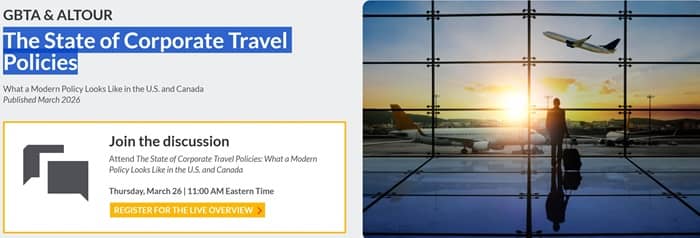
The new report, The State of Corporate Travel Policies: U.S. and Canada 2025, suggests companies are not only tightening their travel policies but also making them smarter, clearer and far easier for employees to follow.
Which, in the world of corporate travel, may prove revolutionary.
A Quiet Shift Toward Stronger Rules
One of the study’s most striking findings is that travel policies are becoming more structured and, in many cases, more stringent.
Almost one in three travel managers (32%) say their organisation’s policy is stricter today than it was three years ago. Only a modest five per cent report that policies have become more relaxed.
In practical terms, this reflects a growing desire for control and consistency as business travel continues to rebound globally.
Companies want better oversight. Travel managers want clearer rules. And finance teams, understandably, want fewer surprises when the expense reports land.
Yet despite the tightening of rules, many policies still suffer from an old problem: they are simply too long.
More than half of corporate travel policies now exceed 10 pages, and almost a quarter exceed 20 pages.
That might explain why the most common reason travellers break the rules is refreshingly straightforward.
They haven’t read them.
According to the research, 32 per cent of travel buyers say policy breaches happen because employees simply aren’t familiar with the rules.
In other words, travellers aren’t always rebelling; they’re just confused.
Enter Artificial Intelligence
This is where artificial intelligence begins to change the conversation.
Rather than expecting travellers to wade through lengthy policy manuals, companies are exploring smarter ways to communicate the essentials.
One idea gaining traction is the use of AI-generated video explainers that summarise travel policy in simple, digestible language.
Think of it as the travel policy equivalent of a three-minute safety briefing rather than a 20-page instruction manual.
And travel managers are keen.
The study found that 64 per cent are interested in using AI-powered tools to deliver policy guidance, particularly if they help employees understand the rules before they book.
As Suzanne Neufang, CEO of GBTA, explains, travel policy is evolving alongside the workplace itself.
“Travel policies are evolving in a way that reflects today’s realities and responsible travel decisions. This research shows organizations are evolving through technology and reassessing their policies through a more inclusive lens, along with strengthening the traveler experience.”
At the same time, she notes the report highlights areas where improvement remains possible.
“The gaps identified in the research give our industry a roadmap for continued improvement.”
Simpler Policies, Happier Travellers
From the perspective of travel management companies, the message is clear: simpler communication equals better compliance.
Gabe Rizzi, President of ALTOUR, believes technology could finally solve a long-standing industry frustration.
“Travelers want clarity, flexibility and a support system that helps them stay in policy and companies want visibility and consistency,” Rizzi said.
“Travel policies have been too complex for too long. There is a clear opportunity for AI to distill key details and improve compliance.”
Put simply, when policies are easier to understand, travellers are far more likely to follow them.
The Booking Problem That Won’t Go Away
Even so, corporate travel managers still face one stubborn challenge: travellers booking outside official channels.
According to the study, 35 per cent of travel managers say off-channel bookings remain their biggest compliance headache.
When employees bypass the company’s booking systems to book flights or hotels independently, it creates several complications.
Companies lose visibility. Negotiated rates may not apply. And duty-of-care tracking becomes harder.
Hotel bookings present a similar challenge.
Around 28 per cent of respondents say travellers staying in non-preferred hotels is another significant policy breach.
It is a reminder that even the most carefully crafted policy still depends on traveller behaviour.
Inclusion Still Needs Work
While policies are becoming more structured, research suggests many organisations still have work to do on inclusion.
Only 13 per cent of travel managers say their policies strongly address accessibility requirements, while just 19 per cent provide clear guidance for diverse traveller groups, including LGBTQ+ employees or women travelling to destinations where safety concerns may arise.
Given the growing emphasis on traveller wellbeing and corporate duty of care, it is likely to become a priority area in the years ahead.
The Guest Traveller Dilemma
Corporate travel policies also tend to focus on employees, yet business travel frequently involves people who are not technically on staff.
Candidates attending job interviews, visiting consultants, interns and even clients may all travel at a company’s expense.
Yet the research shows 26 per cent of companies still manage this “guest travel” informally, handling each trip on a case-by-case basis.
That can create administrative headaches and inconsistent decisions.
Encouragingly, the study suggests companies are increasingly introducing clearer processes to manage this type of travel more effectively.
What Companies Actually Allow
The research also offers a revealing snapshot of what corporate travel policies permit today.
Air Travel:
Premium Economy has become a common compromise between comfort and cost, with 64 per cent of companies allowing it at least occasionally.
Basic Economy, however, remains unpopular. 58 per cent of companies never permit it, largely due to its inflexible rules.
Business Class is typically reserved for longer flights, with 64 per cent of for-profit organisations allowing it on journeys of five to six hours or more.
Hotels:
Accommodation policies remain surprisingly flexible.
While 53 per cent of companies prohibit homesharing platforms such as Airbnb or Vrbo, many policies avoid strict price caps.
In fact, 46 per cent simply instruct employees to book “reasonably priced” hotels, which, as any seasoned traveller knows, can be interpreted in more than one way.
Meals:
Expense control still matters. Three-quarters of companies set meal spending limits or per diems, with fixed limits more common.
Ground Transport:
Mobility trends are shifting, too. While 51 per cent of companies allow rental cars, around a third now encourage rideshares, taxis or public transport, particularly in large cities.
A Travel Policy Reset
The research draws on an online survey of 168 corporate travel managers across the United States and Canada, conducted between 19 November and 10 December 2025.
Taken together, the findings suggest corporate travel policies are entering a new phase, one defined by clarity, technology and practicality.
The days of dense policy manuals may not disappear overnight.
But if artificial intelligence can turn those lengthy documents into clear guidance that travellers actually understand, the humble travel policy might finally become what it was always meant to be.
Not a document travellers avoid.
But one they actually use.
by Prae Lee – (c) 2026.
Read Time: 6 minutes.
About the Writer.
 You can tell a great deal about a person by how they meet a Bangkok morning. Prae Lee doesn’t charge into it; she glides, unhurried, as if time itself has agreed to behave. There is a calm assurance about her, the sort earned by knowing both your roots and your destination.
A graduate of Chulalongkorn University, she earned her business degree with quiet pride, then further polished it in Singapore and Australia. Travel didn’t change her. It refined what was already there: curiosity, discipline, grace.
Back in Bangkok, she slipped modern life into the family business, mastering social media with an instinct for listening and selling with Thai gentleness.
Prae never seeks attention, yet everything she touches grows brighter.
Now with Global Travel Media, she writes with authenticity, drawing on culture, travel and a rare, steady confidence.











