

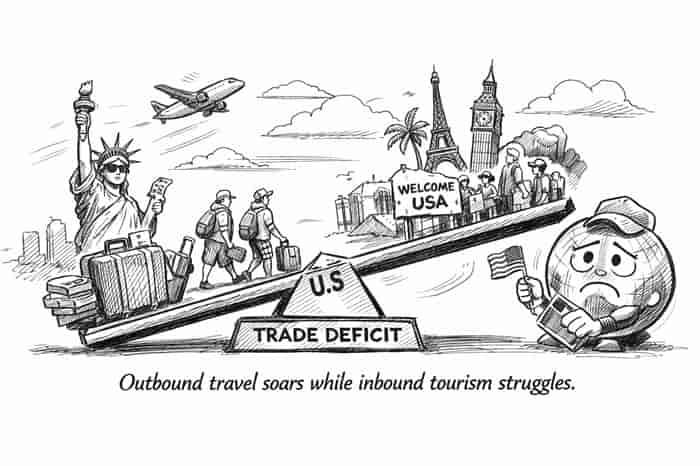
If travel recovery were a long-haul flight, the United States might be cruising, but the fuel gauges tell a more complicated story.
New figures from the National Travel and Tourism Office (NTTO) show the tourism economy is still regaining altitude, albeit unevenly. November 2025 data paints a familiar tale for anyone watching global travel flows: inbound demand softening just as outbound wanderlust surges.
International visitors spent nearly US$20.7 billion on travel and tourism activities across the United States during November. That’s respectable by most measures, but still down 4 per cent compared with November 2024, a reminder that recovery, while real, remains fragile.
Meanwhile, Americans showed little hesitation about heading offshore. Outbound travel topped US$22.5 billion for the month, leaving the US with a tourism trade deficit of roughly US$1.8 billion.
In plain English: more money leaving than arriving.
For an industry that once relied heavily on inbound visitor spend, that imbalance matters.
A year of resilience with cracks showing
Year-to-date numbers offer both reassurance and warning. International travellers have pumped almost US$228.9 billion into the US economy so far, down only marginally by about 0.4 per cent compared with the same period last year.
That still translates to an average daily injection of US$685 million. Not insignificant, even in a US economy measured in trillions.
Yet the stagnation underscores a broader reality: the recovery has plateaued. Markets that once drove inbound demand, particularly Asia and parts of Europe, have not fully rebounded, while American outbound demand has roared back faster than expected.
Where the money is really coming from
A closer look at November’s spending composition reveals how inbound travel dollars are distributed.
Travel spending itself, covering everything from hotels and meals to entertainment and local transport, accounted for US$11.6 billion. That’s down from US$12.1 billion a year earlier and remains the backbone of tourism exports, accounting for 56 per cent of the total.
Airlines captured a smaller slice. Passenger fare receipts from international visitors reached nearly US$3.1 billion, slipping just under 2 per cent year-on-year. Those receipts made up about 15 per cent of tourism exports.
The remaining share came from less visible but significant segments: education, healthcare, travel and short-term worker expenditure. Combined, these categories delivered US$6 billion in November down 4 per cent but still accounting for nearly a third of inbound tourism revenue.
In other words, the US tourism mix remains diversified, but no category is immune to softening demand.
Aviation recovery: back to normal… almost
Fast-forward to January 2026, and the aviation picture becomes clearer.
International air passenger traffic between the US and the rest of the world totalled 21.4 million enplanements for the month. That’s a slight dip down 0.5 per cent year-on-year but still 107.6 per cent of pre-pandemic January 2019 levels.
On paper, that suggests recovery is complete. In reality, the detail tells another story.
Non-US citizen arrivals dropped 4.8 per cent to 4.6 million passengers, reaching just 87.4 per cent of pre-pandemic levels. Overseas visitor arrivals tracked even lower, falling 4.2 per cent year-on-year and sitting at 83.5 per cent of 2019 volume.
For inbound tourism operators, those figures matter more than headline traffic numbers.
The NTTO’s January I-94 arrivals data available via the official advance release (https://www.trade.gov/i-94-arrivals-program) confirms the trend: inbound recovery is lagging.
Americans keep travelling and spending
If inbound travel looks patchy, outbound demand is anything but.
US citizen departures rose 1.4 per cent in January 2026, with five million Americans heading overseas. More tellingly, outbound travel exceeded January 2019 levels by nearly 27 per cent.
That divergence, inbound lagging, outbound surging, explains the widening tourism trade gap.
It also reflects a structural shift. US travellers have re-emerged as one of the world’s most powerful outbound forces, while inbound markets remain constrained by currency dynamics, visa friction and slower Asia-Pacific recovery.
Regional travel patterns reveal shifting alliances
Looking at where people are actually flying provides further insight.
Mexico remains the dominant international partner, with 3.8 million passengers moving between the two countries in January, broadly flat year-on-year. Canada followed with 2.2 million travellers, though volumes fell sharply, down nearly 12 per cent.
Across the Atlantic, the United Kingdom recorded 1.3 million travellers, while leisure-driven routes shone elsewhere. The Dominican Republic saw traffic jump 6.8 per cent, and Japan surged nearly 9 per cent year-on-year, a sign Asia’s comeback, while slow, is underway.
Regionally, Europe remained stable, with 4.4 million passengers essentially flat compared with last year and only marginally below 2019 levels.
The Americas told a more upbeat story. Travel between the US and South/Central America and the Caribbean hit 6.2 million passengers, up 1.2 per cent year-on-year and almost 20 per cent above pre-pandemic levels.
Asia, however, remains the laggard. Traffic climbed slightly year-on-year but still sits nearly 17 per cent below 2019 volumes.
The gateways shaping global travel
Major hubs continue to dominate the flow of international travellers.
New York’s JFK retained top billing, handling 2.5 million passengers in January, followed closely by Miami and Los Angeles. San Francisco and Atlanta rounded out the top five US gateways.
On the international side, London Heathrow remains the premier overseas connector to the US, followed by Cancun, Toronto, Mexico City and Seoul’s Incheon Airport.
These routes are more than statistics; they shape airline strategy, airport investment and tourism marketing priorities.
What it all means for global travel
For travel professionals, the takeaway is clear: recovery is no longer a single narrative.
Yes, aviation volumes have largely returned. Yes, Americans are travelling with renewed confidence. But inbound tourism, the lifeblood of many destinations, is still uneven.
That imbalance has real consequences. Tourism trade deficits affect everything from airline yields to hotel occupancy, destination marketing budgets and even national economic positioning.
For the United States, the challenge now isn’t recovery, it’s recalibration.
Rebuilding inbound demand will likely hinge on easing travel friction, rebuilding Asia-Pacific connectivity and maintaining competitive pricing against a strengthening outbound dollar.
Until then, the world’s largest travel market remains an intriguing paradox: bustling airports, confident consumers and a tourism ledger still waiting to rebalance.
by Maysa Punchanit – (c) 2026.
Read time: 5 minutes.
About the Writer.
 Maysa Punchanit has never waited for life to become easy. She’s far too practical for that. Instead, she’s built her path the way many strong women do, step by step, job by job, learning something useful everywhere she’s been.
Her working life has taken her through hospitality, sales, beauty therapy and the fast-moving world of social media, where she partnered with some of Thailand’s best-known companies. Along the way, she discovered a steady voice for blogging, warm, direct and grounded in real experience rather than marketing spin.
Being a single mother sharpened her resolve rather than slowing her stride. If anything, it gave her purpose.
Now with Destination Thailand News and Global Travel Media, Maysa arrives not as a newcomer, but as someone quietly battle-tested resilient, capable and ready for the next chapter.











