


There are easy years in aviation, and then there are years like 2025.
For Asia Aviation PLC (AAV), the majority shareholder of Thai AirAsia, the past 12 months were a textbook lesson in resilience. The numbers, at first glance, tell a story of pressure: softer yields, shrinking Chinese arrivals, and cautious international demand. But read a little deeper and a more nuanced narrative emerges, one built on cost discipline, domestic dominance and a bit of currency luck.
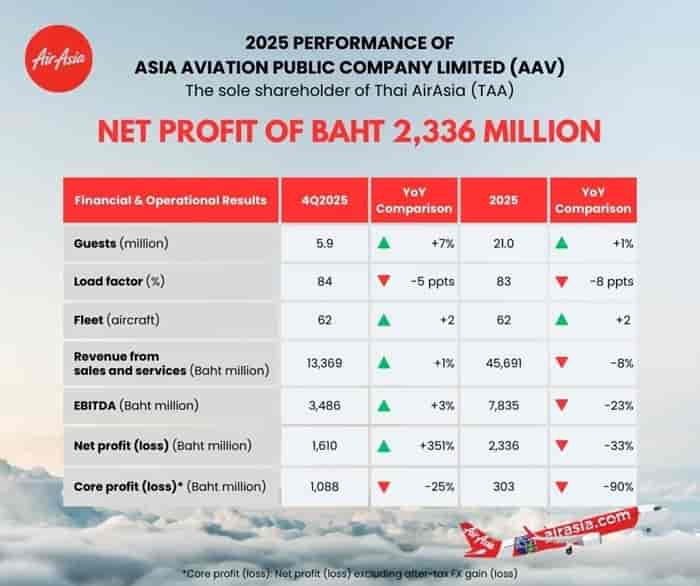
The Bangkok-listed group reported total sales and service revenue of Baht 45.7 billion for the year, down eight per cent year-on-year. Average fares slipped nine per cent as the Chinese inbound machine, once the backbone of Thai tourism, continued to splutter.
Yet aviation has always rewarded operators who can pivot quickly. AAV did exactly that.
A sharp drop in global oil prices delivered a welcome tailwind, helping drive fuel costs down by roughly 10 per cent. That, combined with tight operational control, trimmed cost per available seat kilometre (CASK) to Baht 1.76, a five per cent improvement.
The result? EBITDA of Baht 7.8 billion and a reported net profit of Baht 2.34 billion.
Strip out a sizeable foreign exchange gain of Baht 2.54 billion, thanks to a strengthening Thai baht, and the core profit lands at a more modest Baht 302.7 million. Still, in a year defined by uneven demand and fragile regional confidence, finishing in the black is no small feat.
Domestic dominance leads the charge
Where AAV truly flexed its muscle was at home.
Thai AirAsia carried 21 million passengers across 2025, nudging volumes up by one per cent despite global turbulence. More telling was its grip on the domestic market, where the airline captured a record 41 per cent share, moving 14.3 million passengers within Thailand.
In an era where international recovery remains patchy across Asia, that domestic stronghold looks less like a fallback and more like a strategic moat.
Load factors held steady at 83 per cent across 25.2 million seats, while the fleet stood at 62 aircraft at year’s end, with 59 actively flying, a reminder that scale still matters in the low-cost game.
A strong finish to a complicated year
If the full-year numbers reflect endurance, the fourth quarter hinted at momentum.
Revenue climbed six per cent to Baht 14.26 billion, while net profit surged 351 per cent to Baht 1.61 billion. Core profit dipped 25 per cent, but the broader trajectory pointed upward, helped by stabilising Chinese routes, where load factors rebounded to 85 per cent.
Route development also played its part. New domestic services from Suvarnabhumi to Nakhon Si Thammarat and Chiang Rai broadened network depth, while regional links like Chiang Mai–Udon Thani added connectivity where demand remains sticky.
Seasonal restarts, including services from Phuket to Khon Kaen and Udon Thani, underscored a familiar AirAsia strength: tactical route agility.
China slows, India steps forward
AAV and Thai AirAsia CEO Phairat Pornpathananangoon was candid about the year’s headwinds.
“2025 was an extremely challenging year due to external factors, particularly the slowdown in the overall Chinese market,” he said.
Rather than chase a slow rebound, the airline recalibrated.
Domestic leadership became the anchor strategy, while South Asia emerged as a growth lever. India, in particular, delivered standout gains, with passenger numbers hitting a record 1.2 million, up 22 per cent.
There was also a deliberate pivot toward higher-yield travellers. Expanding operations at Suvarnabhumi Airport allowed the airline to tap long-haul connections from Europe and North America, feeding its short-haul network with higher-spending passengers.
Elsewhere, capacity discipline defined the international playbook. Seat supply was trimmed five per cent to match demand realities, yet certain corridors still delivered. CLMV markets Cambodia, Laos, Myanmar and Vietnam remained solid, as did so-called Fifth Freedom routes like Don Mueang–Taipei–Okinawa and Don Mueang–Luang Prabang–Hanoi.
Eyes firmly on recovery
If 2025 was about survival with style, 2026 looks set to be about measured growth.
AAV is targeting high single-digit revenue expansion and passenger volumes of around 23.5 million. Fleet expansion is already pencilled in, with five additional aircraft expected in the second half.
Tourism tailwinds may also strengthen. Thailand’s Tourism Authority is leaning heavily into stimulus campaigns, including the “Feel All the Feelings” initiative, fronted by global pop icon Lisa, a reminder that destination marketing in Asia now travels at the speed of fandom.
Sustainability credentials are also climbing the agenda. The company recently secured the top-tier ‘AAA’ rating in the 2025 SET ESG Ratings from the Stock Exchange of Thailand, signalling growing investor scrutiny around governance and environmental performance.
A familiar aviation lesson
Aviation history is littered with carriers that chased growth blindly and paid the price. The smarter ones, the survivors, are those that adapt, consolidate and quietly build strength while others wait for blue skies.
AAV’s 2025 performance sits firmly in that latter category.
It wasn’t a blockbuster year. But it was disciplined, deliberate and ultimately profitable and in aviation, that still counts as a win.
With domestic dominance intact, India rising and China showing early signs of life, the runway into 2026 looks clearer than it has in some time.
And after a year like the last one, clarity alone might be the industry’s most valuable currency.
by Karuna Johnson – (c) 2026.
Read Time: 4 minutes.
About the Writer.
 Karuna Johnson’s career only makes sense if you know she truly loves travel. Born Thai, with dual citizenship, she moves easily between worlds, equally at home sharing street food in Bangkok or sitting quietly through a Sydney boardroom meeting.
Educated in both Thailand and Australia, she speaks several languages and has applied them across destination management companies and hotels, spanning sales and administration. She’s the sort who keeps things running smoothly while others are still waking up.
Her journeys have taken her across Asia, Europe, and the United States, but it’s the smaller details that stay with her: people, customs, and the stories beneath every trip.
Worldly without being showy, Karuna brings a steady, thoughtful voice to Global Travel Media, exactly the kind of travel needs.











