

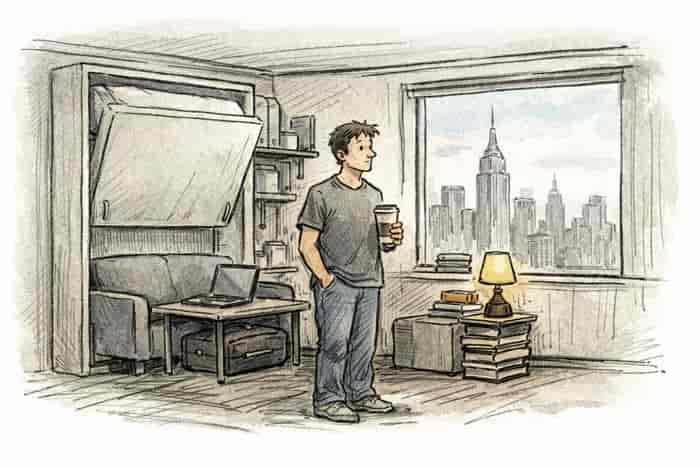
There was a time when a cramped flat was something you tolerated in your twenties, a rite of passage before eventually upgrading to something with a hallway and, if luck allowed, a second window.
These days, that upgrade is looking increasingly mythical.
Across America’s biggest cities, renters are quietly adjusting expectations. Not lowering them, exactly, just folding them neatly into smaller and smaller spaces. The rise of the micro apartment isn’t new, but what’s changed is how normal it now feels.
Fresh data from SolPlace, a furniture company that specialises in making small spaces behave like larger ones, paints a pretty stark picture. Looking at rental listings across the 102 biggest US cities, the company found that apartments under 500 square feet aren’t fringe anymore. They’re firmly in the mainstream.
And while several cities are feeling the pinch, one continues to wear the crown with almost stubborn consistency: New York.
New York: Still Setting the Pace
If you’ve ever stayed in Manhattan and wondered whether the wardrobe was actually the bedroom, you weren’t imagining it.
According to the numbers, more than two-thirds of studio and one-bedroom rentals in New York now fall under 500 square feet. Out of 7,500-plus listings analysed, just over 5,000 landed firmly in micro territory.
Even more telling is what’s happening to one-bedroom apartments. Traditionally, the upgrade option was a sign you were moving up in the world; they’re shrinking, too. More than 60 per cent now come in at under 500 square feet.
Which means the “separate bedroom” dream hasn’t disappeared. It’s just been scaled down.
There’s something oddly fitting about that. New York has always been a city of trade-offs. The skyline gives, the square footage takes away.
The West Coast Quietly Tightens
While New York remains the headline act, the real shift may be happening further west.
Seven of the top 10 cities for micro-apartment density now sit along the West Coast. It’s a line-up that reads like a tech conference guest list: San Francisco, Seattle, Los Angeles, Oakland, Long Beach, Tacoma and Portland.
San Francisco, unsurprisingly, is deep into the small-space era, with more than 80 per cent of studios under 500 square feet. Seattle isn’t far behind, buoyed by tech growth and housing that never quite caught up.
Los Angeles is perhaps the most interesting inclusion. A city once defined by sprawl and driveways is now seeing nearly 40 per cent of its studios and one-bedroom rentals fall into micro territory. The land of the endless suburb is learning to live a little closer together.
Boston Joins the Club
On the other side of the country, Boston is following a similar trajectory.
Nearly half of its studios and one-bedroom rentals now sit below the 500-square-foot line. It’s another example of how knowledge-economy cities full of universities, finance firms and start-ups are quietly redefining what “normal” housing looks like.
In these places, the equation tends to be the same: opportunity rises, space shrinks.
Not a Trend, a Reset
What makes this shift interesting isn’t the novelty. It’s the permanence.
Micro apartments were once framed as clever design experiments, minimalist living with a Scandinavian marketing gloss. Now they feel less like lifestyle choices and more like economic realities.
SolPlace founder Sean Yap puts it plainly: “The data shows that micro-apartments are no longer just a design preference, but a reflection of an economic shift.”
“As the cost of living continues to rise, and urban spaces become more scarce, square footage becomes the compromise many renters are making,” he says.
It’s a neat summary of a complicated story. People aren’t necessarily choosing smaller homes because they want less space. They’re choosing access to jobs, networks, culture and accepting the spatial consequences.
Living Smaller, Thinking Smarter
One of the more interesting knock-on effects is how people are adapting.
“When your living room is also your bedroom and workspace, every piece of furniture has to work harder,” Yap says. “People are no longer buying furniture just for looks, but need these pieces to solve spatial problems.”
It’s a quiet design revolution happening behind closed doors. Sofa beds are smarter. Tables fold. Storage hides in unlikely places. Entire rooms shape-shift depending on the time of day.
It’s also oddly reminiscent of older urban living patterns long before open-plan living and oversized couches became the default.
A Glimpse of the Future
While the data focuses on the US, it’s hard not to see the broader signal.
Cities everywhere are grappling with the same pressures: population growth, affordability constraints and the simple reality that land doesn’t expand just because demand does.
In that sense, micro apartments feel less like an American quirk and more like a preview. A signpost pointing toward denser, tighter urban living, not necessarily worse, just different.
For some renters, the trade-off works. Walkability, energy and opportunity wrapped into a compact footprint.
For others, it’s a reminder that the definition of “making it” keeps evolving.
Either way, one thing is clear: in the world’s most ambitious cities, space is no longer a given. It’s a luxury and increasingly, a negotiable one.
by Prae Lee – (c) 2026.
Read Time: 5 minutes.
About the Writer.
 You can tell a great deal about a person by how they meet a Bangkok morning. Prae Lee doesn’t charge into it; she glides, unhurried, as if time itself has agreed to behave. There is a calm assurance about her, the sort earned by knowing both your roots and your destination.
A graduate of Chulalongkorn University, she earned her business degree with quiet pride, then further polished it in Singapore and Australia. Travel didn’t change her. It refined what was already there: curiosity, discipline, grace.
Back in Bangkok, she slipped modern life into the family business, mastering social media with an instinct for listening and selling with Thai gentleness.
Prae never seeks attention, yet everything she touches grows brighter.
Now with Global Travel Media, she writes with authenticity, drawing on culture, travel and a rare, steady confidence.











