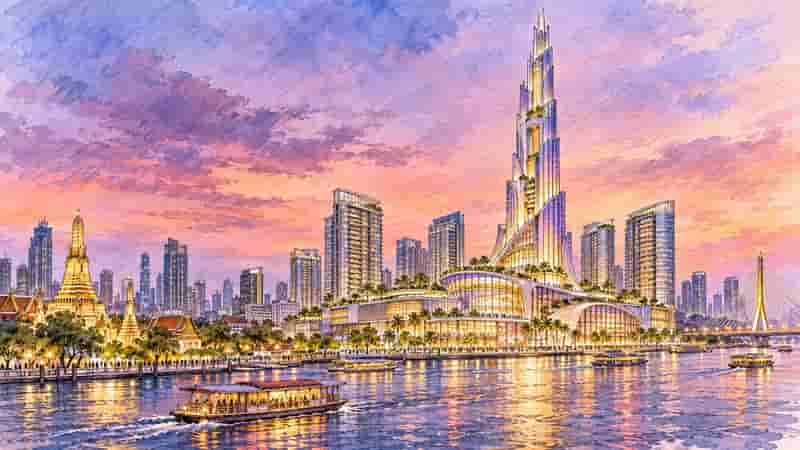
Bangkok rarely lacks big ideas. Its shopping centres are enormous, and its traffic can turn a short journey into a long-term commitment. Now the man behind the world’s tallest building has his eye on Bangkok’s skyline.
Mohamed Alabbar, founder of Dubai-based Emaar Properties and private developer Eagle Hills, is pursuing a proposed US$5 billion (approximately A$7.3 billion) mixed-use project in Thailand’s capital. In interviews published by Bangkok Biz News and The Standard on 12 November 2026, Alabbar raised the possibility of a tower that could challenge Dubai’s Burj Khalifa.
There is one important qualification. The investment remains under negotiation. No site, final tower height, approved design or construction start date has been announced. For now, this is an ambitious proposal, not a building taking shape above Bangkok.
Dubai’s ambitions meet Bangkok’s attractions
Alabbar knows tall buildings. Emaar developed the 828-metre Burj Khalifa, which opened in 2010. The tower was designed by Skidmore, Owings & Merrill, led by architect Adrian Smith. It has become both a symbol of Dubai and an attraction in its own right.
The Bangkok venture would initially fall under Eagle Hills, a separate company founded by Alabbar. Emaar might later become involved in retail or hospitality components, but that prospect is not a confirmed partnership.
The proposed complex would bring together residences, offices, shops and hotels. Alabbar has been exploring Thai investment opportunities for about four years, while discussions concerning this particular deal have reportedly continued for around 18 months.
The developer anticipates greater clarity within one or two weeks. That is an expectation, not an announced signing date. Nor does the US$5 billion estimate establish that financing has been secured.
Where would the $5bn development go?
For neighbours, landowners and travel advisers, the most pressing question has a surprisingly simple answer: nobody has publicly identified the address.
The proposed site covers approximately 20–30 rai, equivalent to 3.2–4.8 hectares, or 32,000–48,000 square metres. Bangkok Biz News reports that the developer is still considering which district would suit the project.
There is no confirmed neighbourhood, street address or plot. Claiming it will rise in Sukhumvit, Sathorn, Silom or beside the Chao Phraya River would be guesswork.
Alabbar has expressed an interest in joint ventures with Thai landowners rather than automatically buying land outright. The reporting also refers to leased land. Neither point establishes that a specific parcel has already been secured.
A separate suggestion involving possible future redevelopment of Khlong Toei Port should not be confused with the skyscraper proposal. It is another area of interest, not a confirmed location for this project.
The tallest tower or something more useful?
The prospect of overtaking the Burj Khalifa understandably attracts attention. After all, height records make magnificent headlines, even if they cannot check guests into hotel rooms.
Yet Alabbar has indicated that creating a recognisable landmark matters more than securing a world record. Any exceptionally tall building would depend on Thai planning requirements and official approval.
No proposed height has been disclosed, and there is no basis for claiming Bangkok is certain to inherit the world’s tallest building.
One intriguing detail is his stated preference for a Thai architect to design the tower, provided the project goes ahead. That could give the development a Thai identity rather than transplant Dubai’s architectural playbook.
What could tourism gain?
For the travel industry, the commercial opportunity lies below the clouds.
New luxury hotel capacity, high-end shopping, dining and business accommodation could give visitors another integrated destination. A distinctive observation experience might also attract tourists who would otherwise admire the skyline from an existing rooftop bar.
Bangkok benefits from international flight links, a mature hospitality sector and leisure appeal. Another landmark could strengthen its marketing position, particularly among premium travellers and visitors from the Middle East.
Those are potential outcomes, not published forecasts. No confirmed hotel brands, room numbers, opening dates, employment projections or visitor estimates have been released.
Australian travel advisers therefore have reason to watch the proposal, but nothing new to sell just yet. As every experienced adviser knows, a glossy artist’s impression is not the same as a confirmed reservation.
Beyond the capital
Alabbar’s interests in Thailand may extend further. The Standard reports that he is also considering coastal resort projects requiring roughly 3,000–4,000 rai of land (approximately 480–640 hectares), separate from the Bangkok investment.
He has also indicated interest in waterfront and port regeneration if suitable opportunities emerge. These ideas remain exploratory and should not be treated as approved projects.
Eagle Hills sees Thailand as a potential first investment destination in ASEAN, with Indonesia another market under consideration.
A timetable written in pencil
Alabbar has suggested a development period of three to five years, with design and approvals coming first and construction beginning about 18 months into the process. No opening year has been confirmed.
Before a tower can rise, the developer must settle the site, negotiate commercial arrangements, finalise plans and obtain relevant approvals. The height question may be the least complicated part of the discussion.
Bangkok needs little help attracting visitors. What this project might offer is a new reason to stay longer, spend more and perhaps look upwards.
For the moment, however, Thailand’s prospective skyline sensation remains an investment ambition rather than a concrete landmark. In a city famous for moving quickly and slowly at the same time, that distinction is worth keeping firmly in view.
By: Supaporn Pholrach – © 2026.
Read Time: 5 minutes.
Author Bio:
 Supaporn Pholrach came up in advertising when deals were sealed with a handshake, and deadlines lived on scraps of paper, not dashboards. She learned early that people mattered more than process, and it stuck. Armed with solid training and a stubborn work ethic, she built a reputation for getting results without turning hard or hollow.
Fifteen years at Bangkok Shuho would test anyone’s stamina. Supaporn stayed the distance. These days, as Sales Manager at Global Travel Media, she helps tourism brands cut through the noise with common sense, good humour and genuine warmth.
She doesn’t chase quick wins. She earns trust, builds loyalty and keeps her word. In an industry that rarely slows down, Supaporn is someone you’re quietly glad to have on your side.