Thailand’s tourist arrivals have been heading one way. The profits at one of its largest hotel and property groups have been heading the other way.
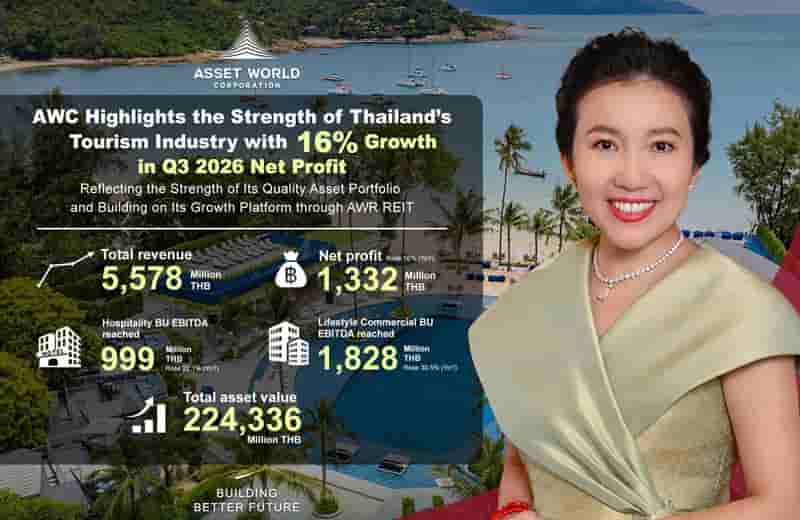
Asset World Corporation (AWC) has reported a 16 per cent rise in third-quarter net profit to THB1.332 billion, despite a softer national tourism market. Its results suggest that well-positioned luxury hotels, corporate events, and newly opened properties can prosper even when overall visitor numbers fail to oblige.
The Bangkok-listed developer, part of the TCC Group, said in its 12 November results that its headline third-quarter revenue reached THB5.578 billion, up 7.4 per cent from a year earlier. Earnings before interest, tax, depreciation and amortisation (EBITDA), on the company’s measure, increased 7.4 per cent to THB2.695 billion.
Chief executive Wallapa Traisorat framed the strategy as “creating benefits for communities, providing stable returns and growth for shareholders”. The promise is broad. The figures offer a first test.
There is more to the story than a handsome profit figure. AWC is also preparing a major real estate investment trust, bringing together four high-end resorts and a Bangkok office landmark in a deal that could reshape how it funds future hospitality developments.
Strong hotels, uneven tourism
AWC’s hospitality division generated THB3.312 billion in revenue, up 16.5 per cent, while divisional EBITDA rose 22.1 per cent to THB999 million. Revenue per available room, or RevPAR, climbed 25.4 per cent to THB4,014. That measures hotel-room income across rooms available to sell, not simply the highest room rate on a booking website.
The gains were spread across several markets. Not all had the same cause. Pattaya recorded a 94 per cent rise in portfolio RevPAR, helped by two hotels that opened in the previous year. Chiang Mai advanced 40 per cent, with AWC pointing to renewed short-haul demand, especially from China. Koh Samui gained 24 per cent and Krabi 18 per cent; Hua Hin managed a more modest 3 per cent.
Bangkok benefited from convention business and the August opening of Fairmont Bangkok Sukhumvit. AWC said RevPAR in its meetings, incentives, conferences and exhibitions segment grew 23.2 per cent. For travel organisers, those figures reinforce an old industry lesson: a full conference programme can be every bit as valuable as a crowded beach.
Yet this is not evidence that all of Thailand’s tourism has returned to growth. Tourism figures reported in early November put international arrivals for January to October at 25.46 million, down 4.59 per cent year on year. Visitor spending fell 2.85 per cent. China’s arrivals improved, but declines elsewhere weighed on the national total.
AWC’s performance therefore tells a more precise story: selected hotels have benefited from pricing, improved demand, and new room supply, even as the wider market remains under pressure. A hotel group is not a national tourism census.
Restaurants and attractions add another course
Guests have been doing more than sleeping. AWC’s food and beverage business earned THB1.013 billion, up 9.5 per cent, accounting for roughly 30 per cent of hospitality revenue. Food and beverage income at Pattaya Marriott Resort & Spa rose 135 per cent, with InterContinental Chiang Mai The Mae Ping recording 38.7 per cent growth.
The commercial side was also busy. AWC reported lifestyle commercial revenue of THB2.184 billion, up 23.1 per cent, and EBITDA of THB1.828 billion, up 30.5 per cent. At Bangkok’s Asiatique The Riverfront, new attractions including Jurassic World: The Experience and SkyFlyers: Wings of Garudapterus helped draw visitors.
Over the first nine months of 2026, Asiatique visitor numbers rose 38 per cent and rental revenue increased 9.2 per cent. The distinction matters. Crowds are welcome, but they must spend money. Tenants must also pay rent. Otherwise, a busy riverfront is just that: busy.
At The Empire office complex, occupancy reached 74 per cent at the end of September. AWC is seeking more income from dining, furnished offices and a planned wellness club. Its ambition is to make a building work beyond the hours when office staff are at their desks.
The bigger wager: a landmark REIT
The bigger move may be AWR, the proposed AWC Lifestyle Property Real Estate Investment Trust. AWC has identified five freehold properties for its opening portfolio: Banyan Tree Krabi, Banyan Tree Samui, Meliá Koh Samui, Pattaya Marriott Resort & Spa and The Empire in Bangkok.
The group has outlined an initial investment value of up to THB51.388 billion. It says the five assets delivered combined EBITDA growth of about 22 per cent in the third quarter. Unlike a leasehold structure, freehold ownership avoids a fixed land-lease expiry, although it does nothing to abolish operating, financing or property-market risk.
AWC’s plan is straightforward in principle. Develop hotels and commercial destinations, build their earnings, then place mature properties in the trust. That could free up capital for the next round of projects while giving investors exposure to income-producing assets. Eleven financial institutions, including BofA Securities, Morgan Stanley and leading Thai banks, are involved in supporting the proposed offering.
AWC filed the application with Thailand’s Securities and Exchange Commission on 29 September. The IPO has not been completed, and its size, timing and projected returns remain subject to regulatory processes and market conditions. Calling it Thailand’s largest REIT offering today would turn an ambition into an accomplished fact.
A promising quarter, with a necessary asterisk
There is a financial detail worth keeping in view. The Stock Exchange of Thailand’s financial statements show roughly THB1.09 billion in third-quarter gains from changes in property values. Statutory revenue for the quarter was about THB4.49 billion before those gains. Such paper gains can lift profit without bringing in cash from room stays or rent. AWC’s THB5.578 billion headline revenue measure should not be read as income from day-to-day trading alone.
That does not erase stronger hotel trading. It does mean investors should examine operating cash flow, earnings excluding valuation movements and the formal prospectus alongside the press-release headline.
AWC expects further activity from its attractions and the opening phases of EA Wellness Club through 2027. Pattaya also has Tomorrowland Thailand booked for 11–13 December 2026. Bangkok’s IMF and World Bank annual meetings, however, were held in October. They are not a forthcoming December event.
For Australian travel advisers and hotel partners, the signs are worth watching. But they are not a guide to every market. Premium leisure, meetings and experiences remain areas of opportunity, but demand varies sharply by destination and customer segment. Selling Thailand well still requires knowing which Thailand a traveller wants.
AWC has delivered a stronger quarter and laid out an ambitious funding strategy. The next test will be how much of that growth comes from repeat guests and reliable cash earnings, rather than new openings and changes in property values. In hospitality, as in property, the view is pleasant. The foundations matter more.
By: May Marclay – © 2026.
Read Time: 5 minutes.
Author Bio:
 May Marclay’s career hasn’t followed a straight line, and she’s better for it. She began in real estate, then moved into hospitality, finding her rhythm with Centara in the Maldives. There, she worked the Asian markets the old-fashioned way: building trust, closing deals, and turning conversations into lasting business.
The UAE sharpened its focus. At IHG, supporting an Area General Manager, she saw the machinery of a major travel hub from the inside, no gloss, just how things actually get done.
Now, with her sights set on healthcare, May brings a broader lens than most. She speaks three languages, reads widely, travels with intent, and writes with the calm assurance of someone who understands both the detail and the bigger picture without needing to say so too loudly.