

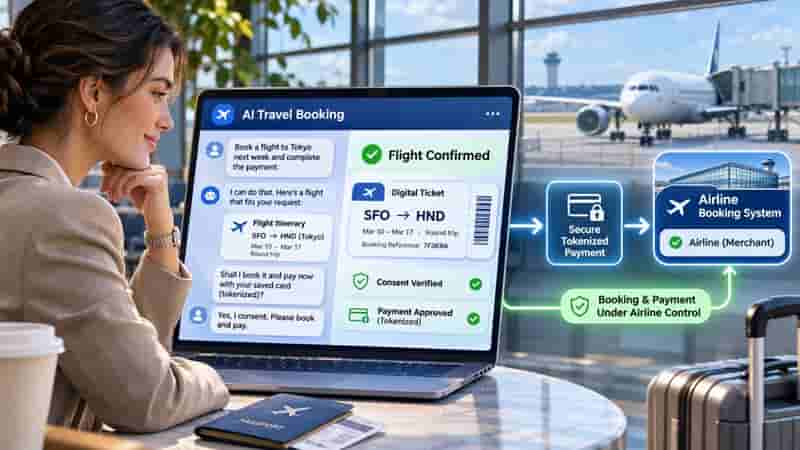
An AI agent has completed a live airline booking and payment, with Melbourne’s Booked AI playing a key role. Yet a very different announcement from United Airlines exposes the battle ahead over control of the customer, the sale and the money.
In the airline business, controlling who sells the seat can be almost as important as filling it. That old argument has acquired a new participant: an artificial intelligence agent capable of completing the sale before the traveller ever reaches a conventional booking screen.
Travelport, Mastercard, Basis Theory and Melbourne-based Booked AI announced on 12 November that they had completed a live flight purchase, from finding an airline offer to issuing a ticket, entirely within a conversational AI service. The customer approved the itinerary and price; the software handled the transaction.
It is a notable technical achievement, assuming the companies’ account of the exercise. But the real significance is not that a chatbot managed to buy a ticket. The airline remained the merchant, the customer’s card number stayed out of the AI agent’s hands, and the sale travelled over established airline distribution and payment infrastructure.
For an industry protective of both its customers and its margins, those details are more than fine print.
A Melbourne connection to a global experiment
Booked AI, founded by Mennan Yelkenci and headquartered in Melbourne, supplied the conversational agent. It obtained a live airline offer through Travelport TripServices using New Distribution Capability (NDC), the industry-backed standard intended to give travel sellers access to airline offers and services.
Once the customer approved the choice, Mastercard Agent Pay initiated payment with a tokenised credential. Basis Theory held the underlying card details in its payment vault. Travelport and the airline’s existing systems then completed the booking and issued the ticket.
No improvised checkout. No card number handed to the conversational agent. And, critically, no third party replacing the airline as the merchant for the transaction.
That distinction goes to the centre of airline distribution. Airlines have spent years seeking greater control over their offers, ancillary products, payment arrangements and customer relationships. They are unlikely to welcome a new digital intermediary simply because it has an impressive vocabulary.
Travelport chief technology officer Andrew Jordan said airlines “shouldn’t have to give up control of the sale or the payment”. This demonstration was designed to show that an AI interface need not require them to do so.
Yet the announcement leaves some commercially important questions unanswered. The participating airline was not identified. Neither were the route, fare or timing of a broader service launch. The companies did not publish independent performance results or evidence that the process has been tested at high booking volumes.
A successful live transaction is evidence of feasibility, not an industry-wide deployment.
The United Airlines contradiction, or is it?
The timing was especially sharp. On 11 November, the day before the Travelport announcement, United Airlines said it was restricting unauthorised third-party personal AI agents from accessing its channels, directly or through agencies and aggregators.
United cited risks ranging from exposed account credentials and unintended purchases to changes involving loyalty balances. It also pointed to regulatory requirements that demand a passenger’s personal acknowledgement, such as declarations about prohibited items in baggage.
At first glance, one company appears to be opening the door to agentic commerce while another is closing it. In reality, they are drawing much the same boundary.
Travelport’s example depends on a controlled connection to the airline’s systems, an agreed price, recorded customer consent and a secure payment credential. United’s restrictions target unauthorised agents acting through channels where the airline says it cannot accept the same risks.
There is no evidence the unnamed airline in the Travelport transaction was United, or that United was responding to this particular project. The two announcements simply expose the central negotiation now facing AI travel distribution: being technically able to complete a booking is not the same as being commercially authorised to do so.
The payment is only half the story
Mastercard’s Verifiable Intent technology linked the authorised flight and amount to the payment request. According to the participating companies, a mismatch would have stopped the purchase until fresh consent was obtained.
That is a useful safeguard. It is not, by itself, a guarantee that an AI-selected itinerary is suitable, that every fare condition has been understood or that a traveller can obtain prompt help when the journey unravels.
Flight changes, refunds, cancellations, schedule disruptions and disputes over what was promised are the hard, unglamorous parts of travel retailing. An excellent checkout experience will be remembered rather less fondly if nobody can resolve an involuntary rerouting at midnight.
Basis Theory technology chief James Armstead acknowledged the limits of the broader ambition: “We’re expecting too much from general-purpose agents right now.”
His point was that tightly designed processes, with defined permissions and secure payment, offer a more credible near-term path than giving an all-purpose digital assistant unrestricted access to a passenger’s travel accounts.
What Australian travel advisers should ask
For Australian agencies and travel management companies, the story is not an obituary. It is an early warning that the booking interface, the commercial relationship and the service obligation may increasingly sit in different places.
If a customer tells an AI assistant to find the best itinerary, whose inventory does it search? How are preferred suppliers, agency agreements and corporate travel policies honoured? Who explains a fare restriction, handles a refund or answers the telephone when an automated recommendation proves expensive?
Those are commercial and professional questions, not objections to technology. The ability to produce a ticket is valuable. The ability to stand behind it is what makes a travel business.
Travelport has demonstrated a plausible way to connect conversational selling to established airline systems. Its partners deserve attention for tackling payment and consent problems rather than pretending they don’t exist. Melbourne’s Booked AI also gives Australian travel technology a genuine place in this development.
But there is no evidence yet that the approach can manage the full complexity of everyday travel at scale.
The airlines have not surrendered their shopfronts, and travel advisers have not lost their purpose. What has changed is the shape of the next negotiation.
The machine may be ready to sell the seat. The industry is still deciding who is responsible when something goes wrong.
By: Kanda Limw – © 2026.
Read Time: 6 minutes.
Author Bio:
 Kanda Limw is one of those rare people every office quietly depends on. She doesn’t fuss or fanfare her way through the day; she simply notices what needs doing and gets on with it, often before anyone else has drawn breath.
Years behind the scenes have taught her that good administration isn’t about control; it’s about care. Diaries align, tensions soften, loose ends disappear. When the day threatens to tilt, Kanda steadies it without drama.
There’s something reassuringly old-fashioned about her reliability. She listens properly, remembers the small things, and does what she says she will.
Kanda has no appetite for the spotlight. Yet ask anyone who works alongside her, and they’ll tell you that when she’s there, everything runs just a little smoother.













