

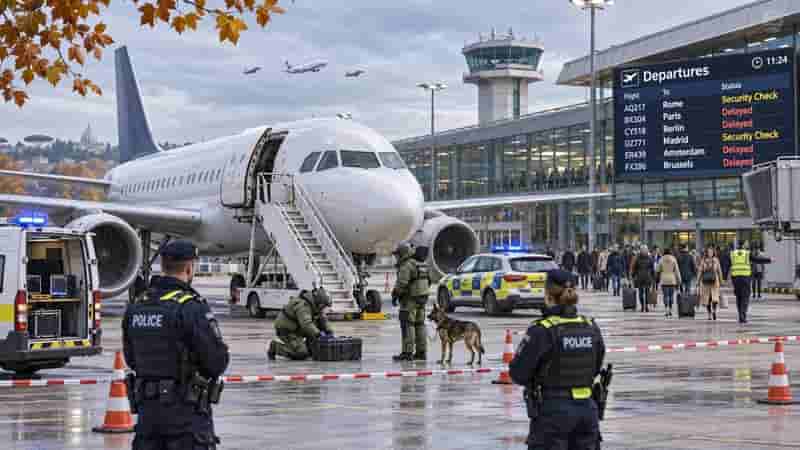
At least seven aircraft face false bomb warnings across Europe as airports respond, fighter jets deploy, and investigators search for those responsible.
Europe’s airlines spent Tuesday dealing with a security nightmare that required neither an explosive device nor an actual attack to bring flights under scrutiny. At least seven passenger aircraft received bomb threats on 3 November, prompting diversions, searches, temporary airport restrictions and an Italian fighter-jet escort.
All seven identified aircraft landed safely. Searches found no explosives and authorities reported no injuries. But passengers faced inspections and disruption across Poland, Italy, Spain and Bulgaria, while investigators were left with the question that matters most: who was sending the warnings?
The incidents did not ground flights across Europe. They disrupted specific services and facilities, an important distinction when alarm travels faster than reliable information.
Warsaw: Two Flights, Two Airports
Poland’s capital faced separate threats involving LOT Polish Airlines and Scandinavian Airlines (SAS).
A LOT Boeing 737 MAX from London Heathrow, with 181 people aboard, was diverted from Warsaw Chopin Airport to Warsaw Modlin. Modlin reported a threat alert at 9.54am local time, and the aircraft arrived at 10.01 am. The airport temporarily suspended operations while specialists searched the aircraft. Nothing was found, and operations resumed. LOT arranged road transport to Warsaw for affected passengers.
An SAS service from Copenhagen landed at Chopin as scheduled, despite another warning. Security checks briefly closed one runway, but the airport remained operational. SAS said it referred the incident to Polish police.
Neither aircraft was found to contain an explosive device. The alerts were separate, not evidence of a coordinated attack.
Italian Fighters Escort Ryanair Flight
Rome’s Fiumicino Airport received Ryanair services from Lisbon and Dublin after bomb warnings were reported against both.
Italy’s air force scrambled two Eurofighter jets to intercept and escort the Dublin flight towards Rome. It landed safely; specialist teams checked the aircraft, passengers, crew and baggage. The Lisbon aircraft also underwent security inspections. Neither search uncovered explosives, and airport operator sources said other services at Fiumicino continued normally.
A military escort makes for extraordinary images. It does not establish that a bomb existed.
Spain and Bulgaria: Checks, Not Explosions
In Murcia, southeastern Spain, emergency services assembled after a threat against a Ryanair flight from Manchester. Airport operator Aena said the aircraft landed on schedule, not in an emergency landing. The 114 passengers and seven crew members disembarked for checks while bomb-disposal officers inspected the aircraft. No explosives were found, and operations resumed as normal.
In Sofia, Bulgarian authorities searched two more aircraft: a Wizz Air service from Milan Bergamo with 176 passengers and a Ryanair flight from Dublin with about 185 passengers, according to differing published accounts. Both landed at their intended destination, and neither search uncovered a device.
Early reports suggested an Israeli flight had been threatened in Sofia. Bulgaria’s transport ministry subsequently corrected that account, identifying the Bergamo and Dublin services instead. The correction is worth recording: in a security scare, the first version is not always the right one.
Alerts Had Started on Monday
The previous day, 2 November, a Wizz Air flight from London Luton to Sofia diverted to Budapest after receiving an in-flight bomb threat. Hungarian Gripen fighter aircraft escorted it to a safe landing. Checks found no threat aboard.
On Tuesday, London’s Metropolitan Police said it had also been alerted to threats involving four aircraft due to arrive at or depart from Heathrow, as well as a warning concerning a Manchester flight. Checks identified no security issues. Officials did not publish enough identifying details to establish how those warnings overlap with the seven flights documented elsewhere, so simply adding them together would risk double-counting.
The confirmed figure remains at least seven flights on Tuesday, with further warnings reported. As of 4 November, the total number of distinct threatened aircraft had not been conclusively established.
Greece: A Cruise Ship Search
The disruption also reached the sea. The Crown Iris, carrying 940 passengers and 597 crew members, was searched on the Greek island of Syros after a warning that an explosive device was attached to its hull. A more extensive inspection found nothing suspicious, and passengers were permitted to reboard. Authorities had not established any connection with the flight threats.
Who Benefits From a False Alarm?
Rhys Jones, an aviation risk specialist at Osprey Flight Solutions, told Reuters that seven such threats against flights in one day was exceptional. The variety of airlines, destinations and routes suggested that broad operational disruption could be the objective, he said.
That remains analysis, not a police conclusion. Copycat threats, a single perpetrator or unrelated incidents are also possible. No organisation had claimed responsibility, and investigators had not identified those responsible or demonstrated a coordinated campaign.
The European Commission was monitoring developments with affected countries and the European Union Aviation Safety Agency, according to the Financial Times.
The bill for a false warning can nevertheless be substantial: airport emergency teams, aircraft inspections, rebookings, crew schedules and missed connections all cost time and money. Security procedures did their job. They also showed how little it takes to unsettle a complicated transport network.
What Australian Travellers Should Do
Anyone flying through Europe should check airline alerts and connection times, particularly on separately booked tickets. If a flight is disrupted, speak to the airline and contact your travel advisor first before purchasing alternative transport. Retain delay notices, accommodation invoices and other receipts.
Under European Union rules, eligible passengers may have rights to care, reimbursement or rerouting when flights are cancelled or significantly delayed. Security risks can count as extraordinary circumstances, affecting standard cash compensation, but that does not automatically extinguish assistance obligations. Entitlements depend on the route and circumstances; check the EU’s official air passenger rights guidance.
Travel insurance is another matter. As specialist publication ITIJ notes, disruption cover and exclusions vary; travellers should not assume a bomb hoax guarantees reimbursement. Australians can also consult Smartraveller before departure.
The reassuring news is that the aircraft landed safely and the searches found nothing. The unresolved news is why so many warnings arrived within hours. For Europe’s aviation industry, that question is best answered by investigators, not by speculation at the departure gate.
By: Jill Walsh – © 2026.
Read Time: 5 minutes.
Author Bio:
 Jill Walsh has always kept a pen close and a suitcase closer. She started in media releases, then learned the trade by escorting press trips around the world, discovering which stories travel well and which need a sharper edit.
Before long, she wasn’t just promoting destinations; she was representing them, translating civic ambition and local pride into words people actually wanted to read. These days, semi-retired and happily so, Jill has traded departure boards for deadlines, joining old friend and colleague Stephen at EGT Media on a casual basis.
Her patch is the business end of wanderlust: balance sheets, route maps, tender wins and the numbers that quietly decide where travellers go. She writes with dry humour, clean prose and an old-school respect for facts a steady voice when the market starts shouting.











