

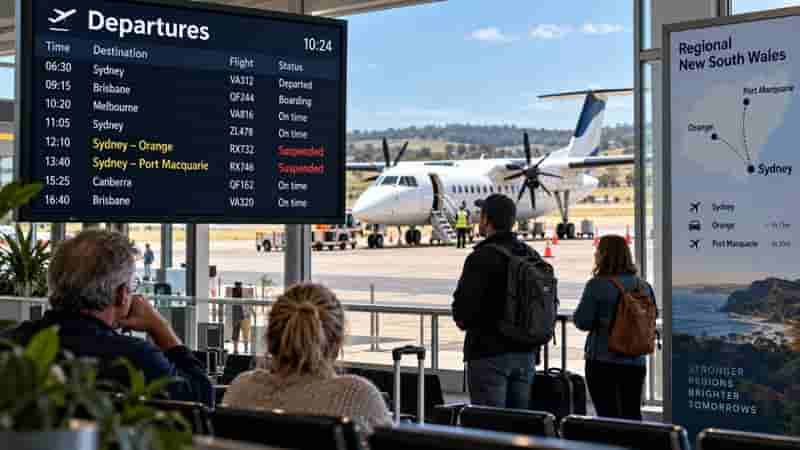
Rex’s Orange and Port Macquarie flights will stop from 25 October. The fuel-price shock is real, but the loss of competition raises harder questions about fares, regional tourism and taxpayer-backed aviation.
Australia’s regional aviation network has suffered another blow, and this time two important New South Wales links to Sydney are casualties.
Regional Express (Rex) will suspend flights on the Sydney-Orange and Sydney-Port Macquarie routes from Sunday, 25 October 2026. The airline blames high jet fuel prices and insufficient demand, and says it may restart services when conditions improve. No resumption date has been announced.
For residents, businesses and travel advisers, the immediate consequence is not that the runway lights will go out. Instead, QantasLink will become the only scheduled airline offering nonstop passenger flights between Sydney and each of the two regional centres.
That leaves a familiar question hanging over regional Australia: when one airline goes, does affordable choice follow it out of the departure gate?
Two routes suspended, not an entire Sydney network
Precision matters here. Rex is not withdrawing from Sydney altogether. It is suspending these two services, while other routes within its regional network continue to operate.
In its announcement, Rex said high fuel prices linked to the Middle East conflict and weak demand made the routes no longer commercially viable. The airline said it would keep assessing market conditions and reconsider the suspensions if fuel costs fell enough.
That makes this an indefinite suspension, rather than a confirmed permanent closure. For passengers needing to travel in November, December or beyond, however, the distinction provides little comfort. A possible return at an unspecified date is not a bookable seat.
Orange Regional Airport continues to have QantasLink and Link Airways services. Port Macquarie Airport also has flights operated by QantasLink and Eastern Air Services. Those additional airlines do not provide competing scheduled nonstop services to Sydney on the two affected routes.
The sting comes from reduced direct competition, not a complete loss of air access.
Jet fuel is taking a bigger bite
Rex’s explanation cannot be dismissed as an airline reaching for a convenient excuse. Australia’s competition regulator has documented the fuel shock.
The Australian Competition and Consumer Commission reported on 15 September that jet fuel prices in late August were nearly 50 per cent higher than in February 2026. The Middle East conflict has disrupted fuel markets and increased costs across domestic aviation.
The pressures are not evenly shared. In its June domestic airline competition report, the ACCC noted that Qantas Group and Virgin Australia had arrangements to lock in some fuel costs in advance. Rex, being smaller, reported that it did not hedge against jet fuel prices.
In other words, the industry’s giants have more room to absorb sudden price shocks. A regional carrier operating smaller aircraft on routes with limited passenger numbers has far less room.
Fuel is only half the equation. If too few passengers buy seats, the math turns sour quickly. An aircraft still needs its crew, maintenance and ground handling, whether the cabin is full or passengers have taken to the highway instead.
Airline economics can be remarkably unforgiving. Unfortunately, so can the consequences for a town that loses a competitor.
Will regional airfares rise?
Higher fares are a legitimate concern, not a proven outcome.
QantasLink has not announced a route-specific increase attributable to Rex’s withdrawal. Nor is there yet a before-and-after fare comparison that could establish what effect the suspensions have had. The suspensions take effect on 25 October.
The competitive landscape changes immediately. With one fewer nonstop carrier, passengers may have less choice over departure times and prices, particularly when travelling at short notice for medical treatment, family emergencies or urgent business.
The national picture provides context. The ACCC’s September assessment found average domestic airfares were 3.5 per cent higher in May and 4 per cent higher in June than a year earlier, before moderating in July. Those national movements must not be presented as evidence of a fare increase on Orange-Sydney or Port Macquarie-Sydney.
It is also worth remembering that the cheapest flight is of little use if its timetable cannot get a passenger to a specialist appointment or a connecting international departure.
For travel advisers, fewer departures can mean longer stopovers, altered itineraries and more difficult conversations with clients. For regional tourism operators, accessible air services are part of the visitor experience before anyone reaches the hotel reception desk.
Port Macquarie fears the knock-on effect
Federal Nationals MP for Lyne, Alison Penfold, has been forthright about the implications for the Mid North Coast.
“Regional communities depend on reliable and affordable air travel,” she said in a statement issued on 14 October.
Penfold said air links were essential for medical appointments, family commitments, tourism and business. She has written to QantasLink seeking assurances that the carrier will not raise prices simply because it faces no scheduled nonstop competitor on the Sydney route.
Her intervention expresses concern about what might happen. It does not establish that QantasLink has acted improperly or intends to exploit its position.
Port Macquarie Mayor Adam Roberts has also warned of wider consequences. Speaking to ABC News, he pointed to the region’s roughly $700 million annual visitor economy and the potential flow-on effects of losing the service.
Hotels, restaurants, event organisers and local businesses do not need an airline to account for every visitor. They do, however, need visitors to reach them with confidence.
Orange asks whether Rex will come back
In the Central West, the announcement has struck a similarly raw nerve.
Independent federal MP Andrew Gee described the decision as a shock in comments reported by the ABC. Orange Mayor Tony Mileto questioned whether the carrier would reverse course and said the council would seek discussions with other airlines about retaining their services.
The city is a regional business centre and an established food-and-wine destination. Its Sydney connection matters to tourism, professional services, healthcare and families as much as it does to occasional holidaymakers.
QantasLink’s continued presence is important. But losing Rex still reduces choice on a route where flexibility can mean the difference between a useful day trip and an expensive overnight stay.
Neither community is arguing that an airline should fly empty aircraft forever. The question is whether Australia’s regional transport policy can offer a more durable answer than leaving every thin route to fend for itself.
Rex’s rescue raises a public-interest question
The suspensions are especially sensitive because Rex’s survival involved substantial Commonwealth intervention.
After entering voluntary administration in July 2024, the airline continued operating regional services while administrators sought a buyer. US aviation business Air T completed its acquisition in December 2025.
The financial arrangements were complex, and the distinctions matter. According to a Commonwealth statement dated 4 February 2026, the government restructured approximately $108 million in existing debt and provided a new commercial loan facility of up to $60 million. Air T separately arranged an investor-backed credit facility of A$50 million.
These amounts are not interchangeable, and they should not be added together and described as cash grants. The Commonwealth facility was described by Air T at the time of acquisition as an undrawn loan available for aircraft overhauls and general operations.
As part of the government-supported sale, Air T agreed to commitments intended to maintain essential regional links, bring more aircraft into service and increase frequencies on profitable routes.
So how do two additional suspensions fit with that undertaking?
The office of federal Transport Minister Catherine King has acknowledged the disappointment and says government officials remain in contact with Rex. In a statement reported by ABC News on 14 October, a spokesperson said the government was continuing to monitor Rex’s compliance with its regional commitments.
That provides an important accountability measure. It is not evidence that Rex has breached its agreement. Available public reporting has not established the precise contractual requirements, exceptions, or how they apply to these particular routes.
Taxpayer-backed support was intended to preserve connectivity. A commercially viable regional airline is also essential. Holding both ideas together is the difficult work of aviation policy, not a task solved by a press release.
Sydney Airport slot protection: an unanswered question
One date deserves careful scrutiny.
In February 2025, the Australian Government announced that Rex’s regional flight slots at Sydney Airport would be protected from the normal ‘use it or lose it’ test until 24 October 2026.
Rex’s newly announced suspensions are due to begin the following day, 25 October 2026.
The proximity is striking, but it proves nothing about why these services are being suspended. Rex has cited fuel prices and demand. No one has independently confirmed the latest position on the slot exemption, or whether any replacement or extension applies.
It would be premature to claim that airport slot rules prompted the decision. However, it is entirely fair to ask Rex and the relevant authorities to explain the current arrangements and whether they affect the suspended flights.
In a sector where runway access is scarce, clarity is preferable to conjecture.
What passengers and travel advisers should do?
Rex says affected customers booked to travel on or after 25 October will be contacted directly and offered a full refund or the option of rebooking on an alternative Rex service at no additional charge, subject to availability.
That does not mean Rex has promised to transfer every passenger to QantasLink or cover every extra expense arising from a revised itinerary.
Travellers should check their booking details, review any onward flights, accommodation or tour arrangements, and ask their travel adviser or booking provider about the options relevant to their fare and circumstances. Anyone travelling for time-sensitive medical appointments, cruises or international connections should plan around the published schedule rather than a possible future reinstatement.
For current details, consult Rex Airlines and Qantas.
A national test, played out on regional runways
Rex says it remains committed to regional and remote Australia. The federal government says it continues to watch compliance with the airline’s service commitments. QantasLink is expected to maintain nonstop Sydney connections to both Orange and Port Macquarie.
Those are significant facts, but they do not settle the larger argument.
Aviation is a business, not a charity, and airlines must operate routes that can sustain them. Yet regional access is also an economic and social lifeline. It connects tourism businesses to visitors, patients to specialists and regional employers to the markets they serve.
The challenge is to protect that lifeline without pretending that fuel bills, passenger numbers or commercial risk can be wished away.
For the moment, the two NSW communities are not losing their Sydney connection. They are losing a choice. In Australian regional aviation, choice is most valuable just after it disappears.
By: Octavia Koo – © 2026.
Read Time: 10 minutes.
Author Bio:
 Octavia Koo arrived in Australia in the early eighties with little fuss and a good eye. Sydney suited her. At UNSW, she studied Arts, then found her footing in graphic design before drifting, quite naturally, into the digital side of things, building websites and shaping words that made people want to stay.
Singapore followed, and with it, the fast pace of tourism platforms and ITB Asia. Long before SEO became a buzzword, Octavia understood how stories travelled online. That’s where she met Stephen, and the seed for something more was planted.
A few years later, she joined Stephen’s EGT Media.
Today, Octavia works with quiet assurance, blending art, instinct and experience to produce stories that don’t shout; they simply work and linger.











