

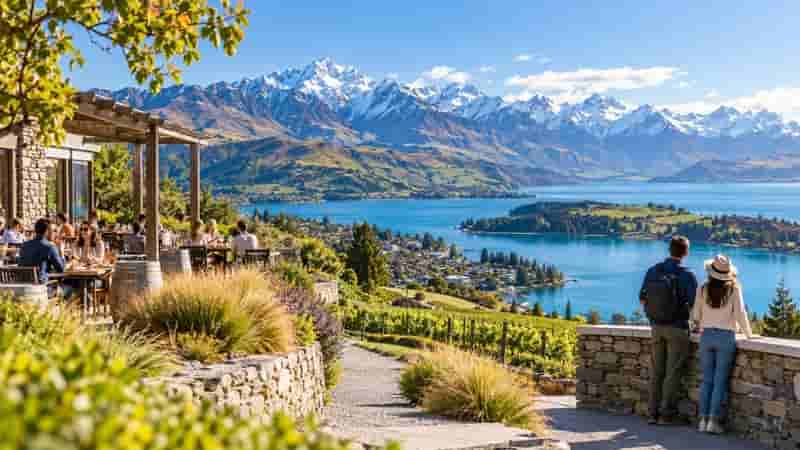
Fresh arrival records and NZ$14.3 billion in annual visitor spending have put New Zealand tourism back in the spotlight. The challenge now is to spread the benefits beyond its busiest gateways.
New Zealand’s tourism industry has found its stride again. Visitors are returning, Australians are leading the charge, and the spending figures are enough to put a spring in even the most cautious hotel accountant’s step.
However, there is a catch. The country’s next great tourism achievement will not be measured by the length of an arrivals queue at Auckland Airport. It will depend on whether the recovery reaches the cafés, guides, accommodation providers and communities beyond the obvious holiday stops.
Fresh figures released by Stats NZ on 14 October put overseas visitor arrivals at 3.71 million for the year ending August 2026, up 307,000 on the previous 12 months. That is stronger than the 3.67 million recorded for the year ending June, the figure behind Tourism New Zealand’s celebrated 3.7 million milestone.
Separately, the International Visitor Survey recorded NZ$14.3 billion in visitor spending for the year ending June 2026, up 20 per cent in nominal terms.
The two headline figures cover different reporting periods, but together they tell an encouraging story: tourism demand and visitor spending are moving in the right direction.
July breaks through, August keeps the momentum
A particularly telling detail appears in the latest arrivals figures.
New Zealand welcomed 256,600 overseas visitors in July, 100.4 per cent of July 2019. It was the first month since the border reopened in which arrivals exceeded the equivalent pre-pandemic month.
August brought a further 248,700 overseas visitors, up 18,400 on August 2025. That was about 99 per cent of the August 2019 result.
In other words, July cleared the old benchmark, while August came very close. One strong month doesn’t mean every season has fully recovered, but the direction is hard to miss.
Australia provided a remarkable share of that performance.
August saw 125,600 Australian visitor arrivals, a record for the month. From January to August, the Australian market reached 1.60 million arrivals, while US arrivals reached 389,000. Both were record annual totals for their respective markets, according to Stats NZ.
That matters to airlines and tour operators, of course. It also matters to a motel owner in the regions who would rather have visitors stay for three nights than race past the front door in search of the next famous lake.
A recovery, not a victory lap
The broader picture still needs perspective.
In the year ending June 2026, the 3.67 million visitor arrivals represented about 94 per cent of the 3.89 million arrivals recorded in the equivalent period in 2019.
The Ministry of Business, Innovation and Employment (MBIE) reports that inflation-adjusted international visitor spending for the June 2026 year had recovered to about 98 per cent of its comparable pre-pandemic level.
Those figures are not contradictory. One measures people; the other measures spending after accounting for changing prices.
Tourism New Zealand chief executive René de Monchy summed up the achievement in an August statement:
“Achieving 3.7 million arrivals gives New Zealand strong momentum as we look ahead.”
He has reason to be pleased.
In the year to June, overall international arrivals grew 8.9 per cent, holiday arrivals rose 15.3 per cent, and conference arrivals increased 16.7 per cent.
Leisure travellers are returning, and business events are contributing to the recovery.
But strong national growth does not guarantee full hotels in every town, profitable restaurants on every main street or comfortable margins for every small operator.
Tourism, like farming, is better judged by the harvest than by the weather forecast.
Australia remains the heavyweight across the ditch
Australia is New Zealand’s largest international visitor market.
Holiday arrivals from Australia rose 16 per cent in the year ending June 2026, and Australians spent NZ$4.4 billion during that period, a 25 per cent annual increase.
The United States contributed NZ$2.2 billion in spending, up 20 per cent, while China contributed NZ$1.5 billion, up 26 per cent. Holiday arrivals from China grew 40 per cent.
Arrival and spending growth rates measure different things and shouldn’t be confused, but both point to stronger international demand.
For Australian travel advisers, the opportunity is considerable.
The familiar favourites still have their place. Auckland makes an easy city break, Rotorua retains its geothermal magic, and Queenstown is unlikely to run out of mountains worth photographing.
Yet the more interesting sale may be a journey that doesn’t end at the usual highlights.
Think of a wine-and-food itinerary through Martinborough and Hawke’s Bay, a coastal stay in Kaikōura, or a South Island trip that allows time for the small towns between the postcard views.
The point is not simply to send more people. It is to build trips that reward travellers and leave more money with local businesses.
A longer stay and an extra experience can matter more to a community than a hundred hurried stops for photographs.
Six regional campaigns put money behind the pitch
New Zealand’s Government has moved from talking about regional dispersal to funding specific campaigns.
On 7 September, Tourism and Hospitality Minister Louise Upston announced six successful Regional Tourism Boost initiatives, backed by a combined NZ$5 million.
The projects target visitors from Australia, North America and China, with an emphasis on travel beyond the main gateways and outside the busiest periods.
They include a food and outdoor-experiences campaign across the top of the South Island, led by Visit Hurunui, and a Classic New Zealand Wine and Food Trail campaign led by WellingtonNZ.
Other funded initiatives aim to attract Chinese visitors to the North Island and Christchurch, encourage North Americans to explore more of the country, and create interest in new food trails.
The funding supports marketing campaigns; it is not evidence that the forecast economic benefits have already been delivered.
“We want more visitors arriving in the quieter months and travelling beyond our main gateways to experience the regions that make New Zealand unique,” Upston said in the government announcement.
Tourism New Zealand says international visitor spending increased across 27 of the 31 regions measured in MBIE’s Monthly Regional Tourism Estimates.
That is promising, but these are regional estimates, not proof that every business enjoyed higher profits.
Food, hospitality and the case for staying longer
The numbers clearly invite restaurants, wineries and experience providers.
International visitors spent NZ$2.07 billion on dining in the year ending June 2026, according to Tourism New Zealand, while its audience research found that 84 per cent of potential visitors wanted to try local cuisine.
Tourism New Zealand has chosen food and beverage, active escapes and wellness as three marketing themes.
The logic is hard to dispute.
A traveller can admire a mountain without leaving much money behind. Add a locally guided walk, a winery visit, a cooking experience or a small-town restaurant, and the economic contribution becomes more tangible.
It also gives operators a chance to work together.
A boutique hotel can recommend an independently run tour. A restaurant can introduce guests to a nearby cellar door. A cruise shore excursion can take passengers beyond the port, if transport and timing allow.
None of this requires turning every quiet town into a tourism theme park.
It requires good service, clear booking options, fair pricing and experiences that reflect the place rather than a generic brochure.
Visitors should leave with memories, not the suspicion that the same souvenir shop has followed them around the country.
A campaign built on friends and family
Tourism New Zealand’s Don’t be a Stranger campaign offers another approach to visitor growth.
Launched in September, it encourages people in Australia, Britain and Canada who have friends or family in New Zealand to stop promising a visit “one day” and make the journey.
Visiting friends and relatives accounts for around 30 per cent of international arrivals and contributes about NZ$2.6 billion annually, according to Tourism New Zealand.
The campaign aims to generate more than 5,000 additional visits by December 2026, with an estimated economic contribution of NZ$16.4 million.
Those figures are targets, not completed results.
Still, the thinking is sensible.
Someone staying in a relative’s spare room may not appear on a hotel’s guest list, but can still pay for meals, tours, transport and attractions.
Even family hospitality has its limits. Eventually, someone will suggest getting out of the house.
Air seats are only the beginning
Air connections will help determine whether demand can become bookings.
In September, Tourism New Zealand referred to projected airline capacity growth of 5 per cent over the following six months.
That is a projection, not proof that every new seat will be filled.
Costs, schedules, international uncertainty and the ease of onward connections remain important.
Tour operators and hotels cannot bank a marketing impression as revenue, however attractive the campaign artwork may be.
Tourism New Zealand also estimates that 183 million people worldwide are considering a New Zealand trip.
It is an audience research figure, not a booking count.
Converting curiosity into travel is the difficult and commercially important part.
Evidence suggests visitors like what they find.
In the latest International Visitor Survey, 91.3 per cent reported that New Zealand met or exceeded their expectations.
It is a welcome endorsement of the operators who deliver the experience, but no excuse to take that standard for granted.
The infrastructure bill cannot be ignored
More visitors bring pressure as well as prosperity.
Roads, public toilets, conservation areas, walking tracks and waterfront facilities all need to cope with the crowds.
Regional communities should not be expected to pick up every bill for a national economic success.
In July, the Government announced NZ$3.8 million for public toilet improvements in the Mackenzie and Queenstown Lakes districts.
August brought NZ$500,000 to expand the Tiaki – Care for New Zealand programme, which promotes responsible visitor behaviour.
In September, the government announced an NZ$835,000 investment in Kaikōura visitor infrastructure and public spaces, including improvements linked to cruise arrivals.
These may lack the glamour of a luxury-lodge opening, but they are essential to a sustainable visitor economy.
Tourists remember majestic scenery. They also remember dirty public facilities and missed connections.
The next target, and the real test
Tourism New Zealand’s more recent campaign material sets a goal of 3.9 million annual international arrivals by the end of December 2026, along with NZ$14.4 billion in international visitor spending by June 2027.
Earlier statements linked the arrival goal to June 2027, so the difference in target dates matters.
Neither target is a confirmed outcome.
The question now is whether New Zealand can turn a convincing recovery into lasting gains.
Will smaller destinations welcome more visitors in quieter months? Will Australian advisers find more ways to sell regional travel? Will hospitality businesses enjoy steady demand rather than a brief seasonal rush?
And will people in the most popular places see enough benefit to stay enthusiastic hosts?
New Zealand has no shortage of scenery, character or compelling reasons to visit.
Its latest statistics suggest the world is rediscovering all three.
The next success story will not be about how many people arrive. It will be about how much value they leave behind and how widely they share it.
By: Michelle Warner – © 2026.
Read Time: 10 minutes.
Author Bio:
 Michelle Warner has always carried stories the way others carry passports lightly, faithfully, and with purpose. She learned her craft in newsrooms, shaping sentences with care, before swapping deadlines for departures as a flight attendant with some of the world’s great airlines. Years aloft sharpened her eye for character and deepened her fondness for travel’s small, dignified rituals: the quiet kindness of strangers, the poetry of arrival, the patience learned between time zones.
Now grounded by choice, Michelle has come home to writing with the same calm authority she once brought to turbulent cabins. Her prose blends an editor’s discipline with a traveller’s wonder, tinged with humour and reverence for the golden age of travel. Each piece feels like a handwritten boarding pass, gracious, observant, and unmistakably alive.











