

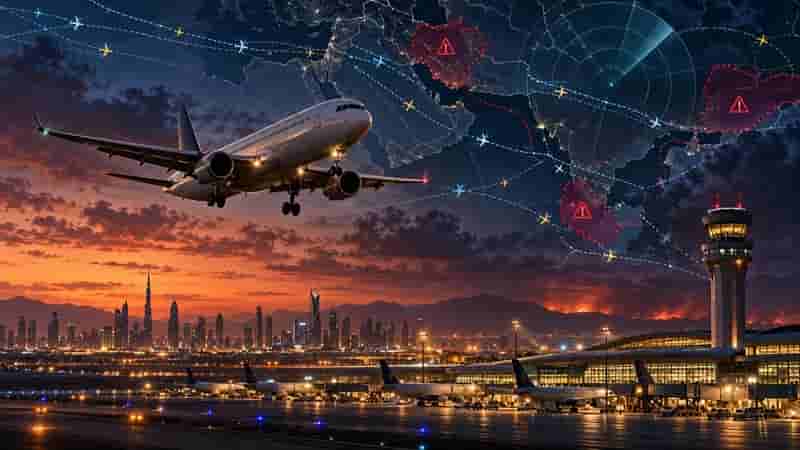
Missiles rain down on Riyadh, airlines scramble to avoid troubled skies, and international passengers are discovering that the greatest uncertainty in flying is no longer whether their luggage will arrive. With deadly attacks bringing war dangerously close to civilian aviation, just how safe is that next flight through the Middle East?
Not so long ago, the greatest hazard of flying through the Middle East was discovering that the passenger reclining into your knees intended to stay there for the next 14 hours.
Or perhaps finding that your suitcase had decided to spend an unscheduled holiday in Dubai while you continued to London.
Both irritating, certainly. Neither particularly life-threatening.
How innocent those little inconveniences now seem.
Today, the skies above one of the world’s busiest aviation crossroads are troubled by something considerably more sinister than misplaced baggage.
Missiles. Military drones. Airspace closures. Threats that can materialise in minutes and turn a perfectly ordinary international journey into a test of nerves, judgement and survival.
And following Saturday’s deadly attack on Riyadh’s King Khalid International Airport, travellers have every reason to ask the question that airline executives would undoubtedly prefer never appeared above a newspaper column.
Are international flights through the Middle East still safe?
It deserves far more than the soothing corporate assurance that passenger safety remains an airline’s highest priority.
We have heard that one before.
Travellers want to know whether the aircraft carrying them, their families, and their hopes of a long-awaited holiday might find itself sharing airspace with weapons designed for an altogether different purpose.
And they deserve an answer without the customary diplomatic fog.
Riyadh: When the unthinkable becomes horribly real
There is something profoundly disturbing about an attack on a civilian airport.
Airports are places of arrivals and departures, tearful farewells and joyful reunions. Grandparents await grandchildren there, families begin holidays, and business travellers hurry to another meeting that might, with considerable good fortune, finish on time.
They are not supposed to be battlefields.
Yet on Saturday, 10 October, King Khalid International Airport in the Saudi capital became the scene of appalling destruction.
According to Saudi Arabia’s General Authority of Civil Aviation, the attack killed 12 people and injured 309.
Four of the dead were Saudi nationals. Eight were citizens of other countries.
Behind those statistics are twelve lives that will never be lived to their conclusion, grieving families and hundreds of injured people whose lives may never be quite the same.
The Saudi-led coalition blamed Yemen’s Iran-aligned Houthi movement, although responsibility for this particular strike had not been independently established in the initial international reporting.
It followed earlier attacks on the airport during the same week, including strikes that caused additional deaths and damage to an aircraft.
Airport operations were temporarily suspended. Flights were diverted or cancelled. Passengers faced uncertainty as authorities responded to the immediate danger.
The airport was no longer simply a transport hub. It had become a vivid demonstration of how quickly civilian aviation can be caught in the consequences of armed conflict.
For the airlines, they had aircraft to reposition, passengers to accommodate, and schedules to rebuild.
For the families of the dead, there would be no such easy return to normality.
That is the distinction worth remembering whenever aviation disasters become reduced to numbers in a news bulletin.
That is why the industry cannot afford to treat attacks on civilian infrastructure as merely another operational inconvenience.
A warning from Europe that deserves attention
The attack did not arrive entirely without warning signs.
On 9 October, the European Union Aviation Safety Agency, better known as EASA, expanded its existing Saudi Arabian conflict-zone advisory to include an additional area in the country’s northwest.
The agency’s concerns centred on the dangers posed by military operations, including missiles and drones capable of threatening civilian aircraft and airports.
Not every threat involves deliberately targeting an aircraft.
An air defence system can intercept a missile and scatter dangerous debris. Military radar systems may misidentify an aircraft. Weapons launched towards distant targets can pass through airspace used by commercial services.
The potential for a catastrophic misunderstanding is hardly reassuring.
Nor is the growing ability of military technology to reach targets far beyond a conventional battlefield.
Airlines have responded with precautionary measures.
Reuters reported that several international carriers, including Lufthansa Group airlines and others, had suspended or adjusted some Saudi Arabian services amid the worsening security situation.
Those decisions are not necessarily permanent, nor do they prove that every flight through the region is unsafe.
They do, however, show that operators with considerable commercial interests at stake are taking the warnings seriously.
Cancelling a flight is expensive.
Losing passengers, aircraft and public confidence in an avoidable catastrophe would be beyond calculation.
Sometimes the most impressive demonstration of an airline’s professionalism is the decision not to fly.
When an airline ticket becomes an exercise in faith
Most passengers know remarkably little about what happens between buying a ticket and watching their aircraft leave the runway.
And perhaps that is just as well.
Commercial aviation is an extraordinarily sophisticated operation, involving thousands of decisions that passengers rarely see and generally have no reason to question.
Aircraft routing isn’t about drawing a straight line across a map, adding enough fuel, and hoping the weather behaves itself.
Airlines consider air traffic restrictions, weather systems, aircraft performance, fuel requirements, diversion airports and security threats.
In conflict-affected areas, additional risk assessments become essential.
The International Civil Aviation Organisation (ICAO), the United Nations agency responsible for international civil aviation standards, publishes guidance for operations over or near conflict zones.
Its Risk Assessment Manual for Civil Aircraft Operations Over or Near Conflict Zones provides a framework for assessing threats and deciding how to manage them.
Airlines, national authorities and air traffic organisations all have responsibilities within this system.
Flight operations specialists, security analysts, and intelligence providers have professional lives that revolve around identifying dangers long before passengers become aware that anything might be wrong.
Fortunately, they are generally rather better qualified to judge these matters than the enthusiastic amateur who has just spent 20 minutes consulting a flight-tracking application.
But there is a problem.
Even the finest intelligence cannot guarantee that a missile will not be launched unexpectedly.
Nor can the most experienced pilot promise that military circumstances will remain unchanged throughout a long flight.
A journey from Sydney to Europe may involve many hours in the air.
During that time, a region previously assessed as acceptable could suddenly escalate militarily.
An airline’s safety assessment must therefore remain a living document, not something filed away after the aircraft departs.
Passengers should remember one uncomfortable truth.
An airline continuing to sell tickets is not proof that every route through a troubled region is free from danger.
Dubai, Doha and Abu Dhabi: Australia’s indispensable connections
For Australians, this is not some distant diplomatic argument of interest only to foreign affairs departments.
It strikes directly at the heart of international travel.
Dubai, Doha and Abu Dhabi have transformed the way Australians reach Europe, Africa and much of the Middle East.
These extraordinary aviation hubs have brought cities once separated by awkward connections within comparatively easy reach.
They have also generated fierce airline competition, expanded destination choices and helped turn international travel from an occasional luxury into a regular part of Australian life.
For travel advisors, the connections are invaluable.
For passengers, they have become almost routine.
A family leaving Brisbane can connect through Dubai for London. A couple from Melbourne might change aircraft in Doha on their way to Rome. Corporate travellers use Abu Dhabi to reach business centres throughout Europe.
The arrangements are familiar.
But familiarity can become dangerous when it encourages complacency.
On 8 October, the Australian Government lowered its overall travel advice for Qatar and the United Arab Emirates to exercise a high degree of caution.
That was encouraging news.
It was not an announcement that every threat had conveniently packed its bags and departed.
Australia’s Smartraveller service continues to warn of regional instability, possible military escalation and sudden airspace restrictions.
Qatari airspace could close with little notice, potentially affecting flights through Hamad International Airport.
The UAE also faces risks associated with wider military developments and possible interruptions to aviation operations.
Saudi Arabia remains subject to advice to reconsider your need to travel overall, while Iran carries the much stronger do not travel warning.
These differences are important.
The Middle East is not one enormous geographical danger zone where every airport and aircraft faces identical risks.
Security circumstances vary by country, destination, and individual flight path.
Nevertheless, a major incident in one location can send disruption rippling through airline networks far beyond the immediate danger.
And a traveller enjoying a perfectly pleasant coffee in an Australian departure lounge may be completely unaware that events thousands of kilometres away are already changing the journey ahead.
The price of taking the long way around
There was a time when airlines competed enthusiastically over who could fly a particular route fastest.
Today, some are being forced to rediscover the virtues of taking the scenic route.
Unfortunately, the scenery is often invisible from 11,000 metres, and the extra fuel bill is less attractive.
When airspace becomes unsafe or unavailable, airlines may need to divert around it.
That can involve flying hundreds of additional kilometres, obtaining new air traffic clearances and carrying more fuel.
Longer journeys can affect crew duty limits and scheduled connections.
Aircraft can arrive late, miss their next departures, and throw carefully organised airline networks into disarray.
What begins as a security decision concerning one flight may end with passengers scattered across terminals on several continents.
For airlines, those disruptions mean extra costs.
For travel agencies, they mean demanding hours finding alternatives.
For passengers, they can mean missed connections, unexpected accommodation bills and holidays that begin several days later than intended.
And the financial consequences do not necessarily stop there.
Prolonged airspace restrictions may increase operating costs, reduce capacity on particular routes or influence future ticket prices.
None of this is welcome.
But there is little point in celebrating a wonderfully cheap ticket if the routing carries unacceptable security risks.
Airlines must make these decisions on professional safety grounds, not simply because a diversion interferes with the accountant’s preferred figures.
Missiles are not the only danger in troubled skies
Modern aviation confronts threats that passengers may never see or fully appreciate.
One of the more unsettling is interference with satellite navigation.
Aircraft use sophisticated navigation systems that help determine their position and maintain accurate flight paths.
In regions affected by armed conflict, these systems may encounter deliberate interference.
Jamming can block or degrade the signals satellite-navigation receivers use.
Spoofing is even more deceptive, introducing misleading signals that may cause equipment to calculate an incorrect position.
It sounds rather like someone deliberately moving all the road signs while a motorist attempts to navigate an unfamiliar city.
Except the motorist is commanding an aircraft carrying hundreds of people.
Fortunately, modern airliners have multiple navigation capabilities, and crews are trained to manage equipment failures and unreliable information.
Satellite interference does not mean an aircraft will suddenly become uncontrollable.
But it can create additional work for pilots and air traffic controllers, especially in already demanding operational conditions.
ICAO and other aviation safety authorities have identified such interference as a significant international concern.
Another issue receives considerably less publicity.
The people who operate aircraft are human.
Pilots become tired. Controllers experience stress. Cabin crews may worry about their families while working through difficult situations.
In April 2026, ICAO highlighted the psychological strain that military conflict can place on aviation personnel.
Fatigue, anxiety and prolonged pressure can affect performance in occupations where errors may have serious consequences.
We spend a great deal of time admiring aviation technology.
Quite rightly.
But no amount of sophisticated equipment can replace the judgement of a well-trained, alert and professionally supported human being.
Two terrible lessons written in innocent lives
International aviation history contains tragedies that should never be forgotten.
On 17 July 2014, Malaysia Airlines flight MH17 was destroyed over eastern Ukraine by a Buk surface-to-air missile.
All 298 people aboard died.
On 8 January 2020, Ukraine International Airlines flight PS752 was shot down shortly after departing Tehran.
All 176 passengers and crew lost their lives after Iranian air defence forces fired missiles at the aircraft.
Different circumstances. Different countries. Different failures.
But a dreadful common consequence.
Innocent people boarded civilian aircraft expecting to reach their destinations.
They never arrived.
Their families were left with an emptiness that no investigation, official apology or compensation payment could fully repair.
These disasters do not mean that every aircraft passing near a conflict zone is destined for catastrophe.
They show why we cannot dismiss the risks merely because an airline has operated the route successfully before.
What went well yesterday is not an adequate safety assessment for tomorrow.
Aviation has learned that lesson at a heartbreaking price.
Now the obligation is to ensure it is never forgotten.
What should Australian travellers actually do?
Panic is not a travel strategy.
Neither, regrettably, is blind optimism.
Australians planning journeys through the Middle East should take several sensible precautions before departing.
Start with Smartraveller. Check the official Australian Government advice for your destination and every country through which you intend to transit. A short airport connection does not make a security warning irrelevant.
Check your airline’s latest information. Flight schedules may change without much notice. Confirm your departure, connection and arrival arrangements directly with the airline.
Discuss alternative routings. Experienced travel advisors can investigate different connections where these are practical and available. Remember that alternative routes have their own safety, cost and operational considerations.
Examine your insurance. Some policies exclude war-related incidents, military activity, or circumstances known when you purchased the policy. Coverage varies, so read the conditions and ask your insurer for clarification.
Keep essential items accessible. Medication, travel documents, emergency contact details, and access to funds become especially important during delays or diversions.
Follow local authorities. During a security incident, official instructions should take precedence over speculation circulating through social media.
Australians requiring urgent consular assistance can telephone the Australian Government’s 24-hour Consular Emergency Centre on 1300 555 135 within Australia or +61 2 6261 3305 from overseas.
Useful official resources include Smartraveller, ICAO and EASA.
The best travel preparation is not necessarily the most elaborate.
Sometimes it is simply knowing whom to call when everything goes wrong.
Suddenly, the travel advisor is worth their weight in gold
An irony in all this should not escape the Australian travel industry.
For years, travellers have been encouraged to believe that booking an international journey requires little more than an internet connection, a credit card and sufficient enthusiasm to click the word ‘Confirm’.
And when everything works perfectly, that may be true.
But introduce a missile strike, an airspace closure, three cancelled connections and an airline call centre experiencing the electronic equivalent of nervous exhaustion, and the picture changes considerably.
Suddenly, the experienced travel advisor looks less like an optional expense and more like a sensible investment.
A good advisor can investigate alternative routes, explain ticket conditions, contact suppliers, and help clients work through the practical difficulties disruption creates.
They cannot guarantee replacement seats or overturn government security restrictions.
Nor can they command the world’s armed forces to behave themselves, although one suspects a few experienced Australian agents would be delighted to try.
They can provide professional judgement, knowledge, and assistance when passengers need it most.
The value of that service should never be underestimated.
For travel agencies and corporate travel management companies, the present crisis provides a powerful reminder that their business is not merely selling seats.
It is looking after people.
And looking after people has never been more important.
Airlines must stop talking like public relations departments
One final matter deserves attention.
Communication.
Every airline tells passengers that safety is its highest priority.
We would be considerably more alarmed if one announced that punctuality, catering revenue or executive bonuses came first.
But passengers need more than familiar corporate declarations when security conditions deteriorate.
They need clear information.
Is the flight operating?
Has the route changed?
What happens if they miss the connection?
Are passengers entitled to alternative arrangements, and under what conditions?
Can they obtain a refund?
Airlines cannot reasonably disclose confidential security intelligence, nor should anyone expect them to.
But they can communicate promptly, explain practical options and treat passengers as people rather than booking reference numbers.
A particular kind of frustration comes from being stranded in an airport while an airline’s automated system repeatedly assures you how important your call is.
After the fourth repetition, enthusiasm tends to diminish.
When families are anxious about their safety, carefully polished corporate language offers little comfort.
Honesty and practical help matter more.
So, is it still safe to fly through the Middle East?
Here is the essential distinction.
International commercial aviation remains supported by rigorous regulation, advanced aircraft technology, professional training and sophisticated operational safeguards.
Those protections are substantial.
Airlines can avoid dangerous airspace, change routes, reassess threats, and suspend operations when necessary.
Many flights can continue to operate with appropriate precautions.
But flights near armed conflict face additional risks that reassuring statements or sophisticated engineering alone cannot eliminate.
The attacks on Riyadh demonstrate that civilian aviation infrastructure can be exposed to military violence with devastating consequences.
They do not establish that every flight through Dubai, Doha, Abu Dhabi or elsewhere in the region is unsafe.
Equally, the continued operation of a particular service does not guarantee that every possible route through the Middle East is safe.
Security assessments must be specific, current and responsive to rapidly changing circumstances.
For passengers, that means making informed decisions.
For airlines, it means having the courage to cancel a profitable service when the risk becomes unacceptable.
For governments, it means sharing accurate information and providing clear warnings.
And for the aviation industry as a whole, it means resisting the temptation to confuse commercial confidence with actual security.
The final word: There is no prize for arriving on time at any cost
Something magnificent about international aviation.
Think about it.
A family can leave Australia in the evening and, after crossing continents and oceans, find themselves embracing relatives on the other side of the world.
Business relationships flourish. Tourism communities prosper. Young people discover different cultures. Old friends are reunited.
The Middle East’s extraordinary airlines and airports have played an enormous part in making those journeys possible.
That achievement deserves recognition.
But aviation’s greatest accomplishment is not speed, comfort or the astonishing distances modern aircraft can cover.
It is the safety culture painstakingly developed over generations.
A culture built through engineering excellence, professional discipline, international cooperation and, tragically, lessons learned from lives lost.
Protecting that legacy requires the willingness to make unpopular decisions.
A delayed flight is inconvenient.
A cancelled holiday is disappointing.
A longer journey may test even the most seasoned traveller’s patience.
And nobody particularly enjoys spending an unexpected night in an airport hotel, however enthusiastically its website describes the breakfast buffet.
But those inconveniences pale in comparison to the consequences of an avoidable tragedy.
Passengers boarding international flights place enormous trust in the people responsible for taking them safely across the world.
Airlines can’t buy that trust with advertising campaigns, loyalty points, or a particularly comfortable business-class seat.
It must be earned on every flight.
In every decision.
Every day.
An airline’s business is to get people from one place to another. Its solemn responsibility is to make certain they arrive alive.
And in the troubled skies above the Middle East, that responsibility has never carried greater weight.
By: Jason Smith – © 2026.
Read Time: 16 minutes.
Author Bio:
 Jason Smith didn’t learn travel from textbooks. He learned it in airports, taxis and hotel lobbies, watching the business unfold long before he played his own part. Half American, half Asian, he grew up around the quiet workings of tourism, where people come and go, and stories rarely stand still.
Bangkok came first, then formal study, then a career that carried him through Singapore, Malaysia and Vietnam. Each place left something behind. In the end, Thailand felt like home, along with a senior role in hotel sales.
Then everything stopped. Borders shut, planes grounded, and Jason found himself back in America with time to reflect.
Now, at Stephen’s EGT Media, he writes travel as it really is, not polished or perfect, but human, and all the better for it.











