

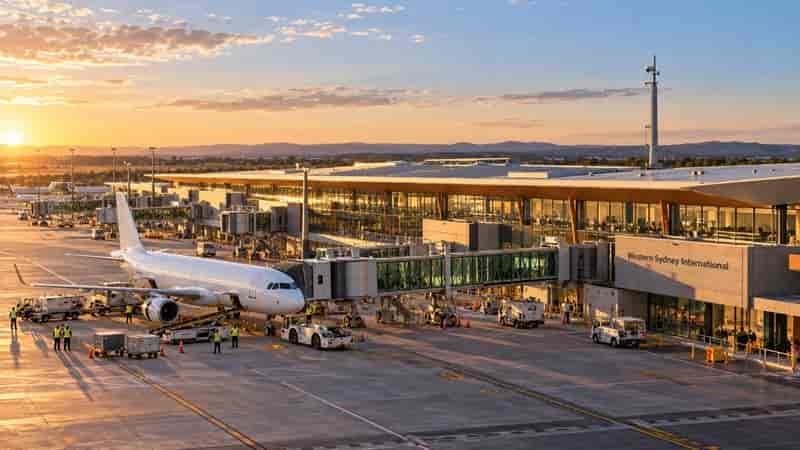
For decades, Sydney’s second airport seemed to belong in that special Australian category of infrastructure projects everyone discussed, governments studied, committees reviewed and generations of travellers assumed they might never actually use.
That changes on Sunday, 25 October 2026.
Western Sydney International (Nancy-Bird Walton) Airport (WSI) will begin commercial passenger operations, giving Greater Sydney a second major airport and Australian aviation something it has not seen for more than half a century: a new major greenfield international gateway.
The opening is much more than a ribbon-cutting exercise at Badgerys Creek. WSI is a 24-hour, curfew-free airport designed for domestic, international and freight operations, initially capable of handling up to 10 million passengers a year. Its approved long-term airport layout provides for growth to a nominal capacity of 82 million passengers annually.
In other words, this airport isn’t being built merely for next summer’s holiday rush. It is infrastructure designed to influence how Sydney travels, trades and grows for decades.
And after years of debate, Sydney’s newest airport is finally about to gain the one feature every airport ultimately requires: passengers.
Jetstar makes aviation history
Jetstar will make the first commercial passenger departure from WSI, with JQ362 scheduled to leave for the Gold Coast at 11 am on 25 October.
The airline will initially operate up to 14 flights a week between WSI and Melbourne, four weekly services to the Gold Coast and three weekly flights to Brisbane. All will use Airbus A320 aircraft.
That gives the airport an immediate domestic network linking Western Sydney with three of Australia’s busiest leisure and business markets.
The symbolism of that first flight should not be underestimated. Australia has built terminals, extended runways and redeveloped airports many times over. Starting scheduled passenger services from an entirely new major airport is a considerably rarer event.
Jetstar has also been involved in WSI’s operational-readiness program ahead of the passenger opening. That testing matters because launching an airport involves far more than ensuring an aircraft can land.
Check-in, baggage systems, security, gate operations, passenger flows, ground handling and dozens of less glamorous systems all need to work together.
Airports, like orchestras, are impressive when everybody comes in at the right moment.
They are rather less appealing when the baggage section decides to perform a solo.
Air New Zealand takes WSI international
International services begin almost immediately.
Air New Zealand is scheduled to become WSI’s first international passenger airline on 26 October, one day after domestic passenger operations commence.
The carrier plans three return services each week between Auckland and Western Sydney on Mondays, Wednesdays and Fridays, using Airbus A320 and A321 aircraft.
For the travel trade, that route carries significance beyond New Zealand itself.
It establishes WSI as an international gateway from its opening week and gives travellers in Western Sydney another trans-Tasman option without automatically sending them across metropolitan Sydney to Kingsford Smith.
Then comes a particularly powerful name.
Singapore Airlines is scheduled to launch daily non-stop services between Singapore and WSI on 23 November 2026, subject to regulatory approvals.
The airline plans to operate the route with a 303-seat Airbus A350-900, configured with 40 Business Class and 263 Economy Class seats.
Singapore is not merely another dot on an airport route map.
Changi is one of the world’s great connecting hubs, giving passengers access to Singapore Airlines’ broader network across Asia, Europe and beyond.
For a brand-new international airport, attracting Singapore Airlines before the first passenger has even boarded a flight is quite a calling card.
Vietnam and Fiji join the departure board
WSI’s international network is already extending beyond Auckland and Singapore.
Vietjet has announced twice-weekly return services between Ho Chi Minh City and Western Sydney from 9 January 2027. The route will provide another direct link between Australia and Vietnam, an increasingly important tourism, trade and visiting-friends-and-relatives market.
Fiji Airways will follow on 19 March 2027 with three weekly services between WSI and Nadi, operating on Mondays, Fridays and Sundays using Boeing 737 MAX 8 aircraft.
The aircraft will offer up to 170 seats, comprising 162 Economy Class seats and eight Business Class seats.
The scheduling is also worth noting.
Fiji Airways’ WSI departures are planned for 11.55pm, illustrating immediately why a curfew-free airport can be commercially valuable.
Overnight flying can create useful aircraft rotations and connection opportunities that are much harder to accommodate at an airport constrained by nighttime operating restrictions.
Qantas arrives in March
Qantas passenger operations are scheduled to begin at WSI on 28 March 2027.
The airline plans four weekly services to Melbourne and four to Brisbane using QantasLink Embraer E190 aircraft.
Qantas and Jetstar have reached a five-year agreement covering domestic passenger flying and airport freight, giving the Qantas Group scope to expand its Western Sydney operation as demand develops.
That phrase as demand develops matters.
New airports do not become aviation powerhouses by declaration. Airlines add capacity when passengers fill seats and route economics work.
WSI’s early network should therefore be viewed as a foundation, not a finished route map.
Bali: promising, but not yet a confirmed WSI route
One potential route requires more careful treatment.
On 2 October 2026, Qantas applied to the International Air Services Commission for an allocation of 4,539 seats per week in each direction on the Indonesia route.
Qantas, Jetstar, or another wholly owned Qantas Group carrier could use the requested capacity for additional Australia-Indonesia flights from December 2026, including new routes and increased frequencies.
However, as of 7 October 2026, the application remains ongoing, and the IASC has invited competing applications until 19 October 2026.
That makes further Indonesia flying an important development to watch, but it would be premature to present a Western Sydney–Bali service as a formally confirmed route.
For publishers and travel sellers alike, the distinction is simple but important: proposed capacity is not the same thing as a confirmed, ticketed route.
Should Bali eventually join WSI’s schedule, the leisure-market logic would be obvious.
Until then, however, the departure board should remain ahead of the headline, not the other way around.
The real competitive weapon: 24-hour operations
WSI’s most consequential advantage may not be its architecture or even its location.
It is time.
The airport will operate without a curfew, allowing aircraft movements around the clock.
Sydney Kingsford Smith Airport, by contrast, is governed by a legislated curfew that generally restricts aircraft operations between 11 pm and 6 am, subject to limited exemptions.
That difference matters commercially.
Airlines spend fortunes acquiring aircraft and generally prefer them to earn revenue rather than sit on the ground contemplating the scenery.
A 24-hour airport gives carriers greater flexibility to design schedules around aircraft utilisation, international connection banks, freight demand, and available arrival or departure slots at other airports.
Singapore Airlines’ planned late-night WSI departure and Fiji Airways’ 11.55 pm departure to Nadi provide early examples of that flexibility.
The competitive implications should not be overstated. Kingsford Smith remains one of Australia’s most important and deeply established aviation gateways.
But WSI introduces a scheduling alternative Sydney has never previously possessed on this scale.
Cargo got there first
While passenger operations begin on 25 October, WSI has already entered commercial aviation through freight.
Cargo operations commenced in July 2026, with Qantas Freight establishing regular services. WSI itself records cargo operations as commencing on 27 July 2026.
The Australian Government has identified 1 November 2026 as the intended date from which WSI will be available for night aircraft movements under arrangements associated with the Sydney Airport Curfew Act 1995.
That is intended to end the regular overnight freight movements currently permitted at Kingsford Smith under the curfew framework, while emergency operations and applicable dispensations remain separately provided for.
That gives WSI an important place in Sydney’s freight system from the outset.
For Western Sydney’s manufacturers, distributors, food producers, pharmaceutical suppliers and logistics businesses, a 24-hour cargo airport located within the region could prove every bit as economically important as the passenger terminal.
Tourists usually get the photographs.
Freight has an unfortunate habit of arriving in cardboard boxes, but it can be very good business.
Built to grow
WSI opens with a 3.7-kilometre runway, a full-length parallel taxiway and rapid-exit taxiways designed to support domestic, international and dedicated freight operations.
The airport’s approved initial development can handle up to 10 million passengers annually.
Long-term planning provides for an airport layout with a nominal capacity of 82 million passengers a year, giving WSI substantial scope to expand as demand increases.
That scale places the opening into perspective.
According to the NSW Government’s 2026–27 Budget, Western Sydney has approximately 2.9 million residents across 13 local government areas, accounting for around one-third of the state’s population.
That is the figure Global Travel Media should use rather than the broader “more than three million” descriptions appearing in some airport and airline promotional material.
It is therefore not difficult to understand why airlines are interested.
WSI is not attempting to manufacture a passenger catchment from scratch. Millions of people already live, work and travel in the region.
The airport’s task is to persuade enough of them that flying from Western Sydney is easier, better timed or better priced than crossing metropolitan Sydney to use Kingsford Smith.
The railway is the awkward part
The largest opening-day weakness is equally clear: the dedicated Sydney Metro-Western Sydney Airport connection will not be operating when passenger flights begin.
Until Metro services start, travellers will rely on buses, road connections, taxis, rideshare and private vehicles.
Transport for NSW currently lists five bus routes connecting WSI with major Western Sydney centres:
Routes 772 from Mount Druitt via St Clair; 790 from Penrith via Kingswood; 825 from Liverpool via Bonnyrigg; 845 from Campbelltown via Oran Park; and 860 from Liverpool via Leppington.
Those services operate every 30 minutes between 5 am and 10 pm daily.
A temporary WSI Link shuttle will also connect St Marys railway station with the airport every 30 minutes once passenger flights begin.
Transport for NSW says the free shuttle will operate from 4.30 am until midnight Sunday to Thursday, and from 4.30 am until 1 am on Fridays and Saturdays, continuing until Sydney Metro services commence.
Road access is considerably stronger.
The toll-free M12 Motorway now connects WSI directly to Sydney’s motorway network via the M7, while the airport precinct has more than 6,000 car spaces, along with taxi, rideshare, and rental-car facilities.
That will keep WSI accessible, but the absence of its dedicated Metro connection at opening remains a conspicuous gap for a project of this scale.
An airport should ideally open with the railway designed to serve it.
Sydney, apparently, has chosen the more suspenseful version.
A tourism opportunity hiding in plain sight
There is another reason the opening matters enormously to the travel industry.
Western Sydney should not be seen as merely a place passengers leave from.
It is also somewhere international and interstate visitors can arrive.
The region provides access to the Blue Mountains and includes major sporting venues, multicultural dining precincts, hotels, attractions, and the developing Bradfield precinct.
A new international gateway therefore creates an opportunity for destination marketers, hotels, attractions and tour operators to build itineraries around Western Sydney itself rather than automatically treating the area as the long stretch of suburbia between an airport and somebody else’s destination.
That requires deliberate tourism development.
Airports generate opportunity.
They do not package holidays.
For travel advisors, the change will also be practical. A client in Penrith, Liverpool, Campbelltown or elsewhere across Western Sydney may increasingly begin a booking by asking not simply:
“What flies from Sydney?”
but:
“What flies from Western Sydney?”
That is a small wording change with considerable commercial consequences.
Two airports, more choice
Kingsford Smith will remain central to Sydney aviation.
Its vast established route network, airline presence and proximity to the CBD and eastern suburbs cannot be wished away by a shiny new terminal elsewhere.
Nor does Western Sydney International need to replace it.
WSI succeeds if it becomes a genuine second gateway, one that airlines are willing to expand from and passengers are willing to choose.
Its advantages are substantial: a huge surrounding population, new infrastructure, round-the-clock operation, dedicated freight capability and considerable room to grow.
Its early weakness is ground access, particularly until the Metro connection opens.
On 25 October, one Jetstar Airbus A320 will taxi out for the Gold Coast and become the first scheduled passenger departure from Western Sydney International.
It will be one relatively modest flight carrying an enormous amount of history.
After decades of plans, arguments, reports, promises and more than a few political careers, Badgerys Creek is no longer the site of Sydney’s possible second airport.
It is about to become Sydney’s second major airport.
And once two airports begin competing for airlines, routes, freight and passengers, Australian aviation may discover that the most interesting part of the Western Sydney story starts after the ribbon is cut.
By: Jill Walsh – © 2026.
Read Time: 10 minutes.
Author Bio:
 Jill Walsh has always kept a pen close and a suitcase closer. She started in media releases, then learned the trade by escorting press trips around the world, discovering which stories travel well and which need a sharper edit.
Before long, she wasn’t just promoting destinations; she was representing them, translating civic ambition and local pride into words people actually wanted to read. These days, semi-retired and happily so, Jill has traded departure boards for deadlines, joining old friend and colleague Stephen at EGT Media on a casual basis.
Her patch is the business end of wanderlust: balance sheets, route maps, tender wins and the numbers that quietly decide where travellers go. She writes with dry humour, clean prose and an old-school respect for facts a steady voice when the market starts shouting.











