

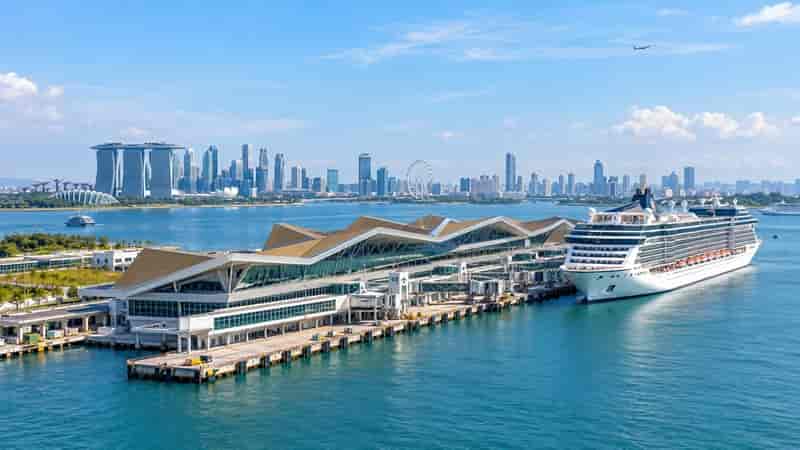
Singapore has rarely built a tourism success story by accident. Airports are planned with military precision, attractions are layered into the city with commercial intent, and even the humble stopover has become something approaching an art form.
Now cruising is getting the same treatment, and the result is beginning to look less like a maritime sideline and more like a serious tourism strategy.
In 2025, Singapore recorded 375 cruise ship calls and more than two million passenger throughput, according to the Singapore Tourism Board (STB). Ship calls rose 10 per cent and passenger throughput increased 9 per cent year-on-year. STB now describes Singapore as Asia’s leading cruise hub.
That description deserves scrutiny because Asia is certainly not short of ambitious cruise ports. Shanghai remains enormous, Hong Kong is rebuilding its cruise business, and other Asian destinations continue chasing ships, passengers and the considerable tourism expenditure that follows them ashore.
Yet Singapore’s competitive advantage is becoming difficult to dismiss.
It combines one of the world’s great international airports, sophisticated cruise infrastructure, extensive hotel capacity, major visitor attractions and easy access to Southeast Asian itineraries all within a remarkably compact destination.
In other words, Singapore is not merely trying to attract more ships.
It is trying to own the fly-cruise journey.
Disney changes the equation
The most obvious symbol of that ambition is Disney Adventure.
The ship arrived at Marina Bay Cruise Centre on 3 March 2026, was christened the following day and departed on its maiden voyage from Singapore on 10 March.
More importantly for Singapore, Disney Adventure is the first Disney Cruise Line ship to homeport in Asia.
That alone changes the conversation.
Disney is one of the most recognisable family entertainment brands in the world, and its decision to make Singapore an Asian homeport gives the destination something that cruise ports spend years trying to secure: a ship capable of creating demand rather than merely satisfying it.
Disney Adventure operates three- and four-night voyages from Singapore. Its seven themed areas draw upon Disney, Pixar and Marvel storytelling, positioning the vessel as both the journey and the destination.
And it is no modest floating mouse-house.
Disney’s updated official specifications put the ship’s capacity at about 6,700 guests and around 2,500 crew members, higher than some earlier pre-launch estimates.
The scale matters, but the product may matter even more.
Disney Adventure could introduce cruising to families who may never have considered a cruise holiday. Rather than competing solely for established cruisers, Singapore now has another way to grow the market itself.
Disney has also taken its relationship with Singapore beyond the gangway.
Around the ship’s arrival, Marina Bay hosted a two-month Disney Cruise Line-themed celebration from 26 February to 30 April 2026, including photo opportunities, activities and a special fireworks programme over the bay.
It was clever destination marketing.
The ship didn’t simply arrive, unload passengers, and disappear behind a terminal wall. Singapore turned its arrival into a city event.
That distinction is important because the economic value of homeporting can extend well beyond the cruise fare.
A transit cruise call may bring thousands of passengers ashore for several hours. A homeported ship can generate international flights, hotel nights, airport and port transfers, restaurant spending, shopping, attraction tickets and pre- and post-cruise stays.
Passengers start spending before the ship casts off and may keep spending after it returns.
For a tourism authority, that is considerably more interesting.
Changi makes the fly-cruise model work
Cruise ports can build bigger terminals.
They cannot easily build another Changi Airport.
Singapore’s aviation connectivity remains one of the strongest cards in its cruise strategy. Changi handled 69.98 million passenger movements in 2025, effectively returning the airport to the 70-million-passenger mark.
Its network connects Singapore with more than 170 cities worldwide, providing access to both short-haul Asian markets and long-haul travellers from Australia, Europe, North America and beyond.
That matters enormously in cruise planning.
A successful international homeport needs more than docks. It needs reliable, extensive and competitive air access capable of delivering passengers in large numbers.
For Australian travellers in particular, Singapore has long been an easy proposition.
It is familiar enough to remove much of the friction from an international holiday, yet different enough to remain a destination in its own right. Add a cruise and two or three hotel nights and the traditional Singapore stopover becomes part of the holiday rather than merely somewhere to change aircraft.
That, in a nutshell, is the commercial logic of a fly-cruise hub.
Royal Caribbean adds another heavyweight
Disney is not carrying Singapore’s cruise ambitions alone.
Royal Caribbean’s Navigator of the Seas begins its Singapore programme in October 2026, with the cruise line marketing round-trip voyages from Singapore, including short cruises to Penang and other regional itineraries.
Royal Caribbean already understands the Singapore market and the region’s appetite for shorter cruise holidays.
Navigator’s arrival is therefore significant because it broadens the choice precisely when Disney Adventure is attracting another audience, particularly families and first-time cruisers into Singapore’s cruise ecosystem.
Different ships can do different jobs.
Disney can entice families and cruise newcomers.
Royal Caribbean can attract established cruisers, younger passengers and travellers looking for short regional escapes.
Then comes the next wave.
Explora III and Princess strengthen the pipeline
Singapore’s cruise story does not end with 2026.
STB says Explora Journeys’ Explora III will call Singapore home in 2027, bringing a luxury cruise product into the mix.
Even more significant is the three-year partnership between STB and Princess Cruises, spanning 2027 through 2030.
Princess plans to deploy Diamond Princess, Sapphire Princess and Grand Princess from Singapore.
STB expects the partnership to welcome more than 150,000 passengers, with Princess sailings from Singapore set to double by 2030.
And these will not simply be weekend laps around the neighbourhood.
The programme includes itineraries ranging from 10 to 28 days, including round-trip Southeast Asian voyages visiting destinations such as Malaysia, Thailand and Vietnam, as well as longer voyages connecting Singapore with Japan.
STB has specifically identified Australia, the United Kingdom and the United States as important mid- and long-haul source markets for the Princess deployment.
This is particularly significant for the Australian travel trade.
A Singapore cruise need not be sold as an isolated voyage. It can be packaged with airfares, accommodation, restaurants, attractions and several nights in the city before or after sailing.
For travel advisors, that means a bigger booking.
For Singapore, it means greater visitor expenditure.
For the passenger, it means there is considerably more to the holiday than comparing buffet queues.
Marina Bay gets bigger and smarter
The hardware is catching up with the ambition.
Marina Bay Cruise Centre Singapore can accommodate ships of up to 220,000 GRT, measuring up to 360 metres in length, while its upgraded terminal has capacity for 11,700 passengers.
A S$40 million upgrade, completed in October 2025, significantly improved passenger handling and the terminal’s ability to deal with simultaneous mega-ship calls.
The improvements were not merely cosmetic.
A dedicated check-in hall was created for Pier 2, passenger flows were reorganised, the ground transport area was improved, coach capacity was expanded, and ride-hailing spaces more than doubled.
Early baggage drop was introduced, while baggage transfer services were made available between the terminal, Singapore hotels and Changi Airport.
That last point is more important than it may sound.
Good cruise infrastructure is not simply about how many passengers can fit inside a terminal.
It is about how smoothly they can move through it.
Nothing destroys the romance of an ocean voyage quite like standing beside several thousand suitcases wondering whether the taxi queue has applied for permanent residency.
HarbourFront enters a new era
Singapore added another important passenger-processing improvement in July 2026 by relocating to the new Singapore Cruise Centre at HarbourFront.
The facility began phased operations on 7 July, with cruise operations relocating to the new terminal on 15 July 2026.
There is an important distinction here.
The existing cruise berth locations remained unchanged, so the project should not be described as a large new expansion of cruise berth capacity.
Its significance lies instead in improved terminal operations and passenger processing.
The new facility introduced airport-style technology including self-service check-in kiosks, automated boarding gates and biometric immigration clearance. STB also highlighted an automated baggage-handling system and dedicated VIP lounge for premium travellers.
That tells us something important about Singapore’s approach.
It is not simply pouring concrete and hoping ships arrive.
It is working on the less glamorous machinery of cruising: check-in, baggage, immigration, transport and connectivity between ship, hotel and airport.
Those things rarely make glamorous brochures.
They do, however, make successful homeports.
But is Singapore really Asia’s cruise capital?
Here, the champagne bottle should remain firmly corked for another moment.
Singapore has an excellent claim to being Southeast Asia’s premier cruise gateway and one of Asia’s strongest international fly-cruise hubs.
But declaring it the uncontested cruise capital of all Asia requires more caution.
Shanghai remains formidable.
Shanghai immigration authorities reported 538 inbound and outbound cruise ship movements and 1.83 million cruise passenger trips in 2025, with cruise passenger movements rising sharply year on year.
Hong Kong also remains a serious regional competitor.
Hong Kong government figures show 189 cruise ship calls during 2025 and approximately 631,000 cruise passenger throughput, although the latter figure was published as tentative and subject to final verification.
There is also an important statistical warning.
Treat direct league-table comparisons between Asian ports cautiously, because authorities do not necessarily measure cruise traffic using identical methodologies.
Singapore’s reported passenger throughput, for example, should not simply be placed alongside Shanghai immigration authorities’ figure for inbound and outbound cruise passenger trips and treated as a perfectly like-for-like comparison.
That would create a wonderfully dramatic headline.
It would not necessarily create wonderfully accurate journalism.
Fortunately, cruising is not football. Somebody does not have to be relegated simply because Singapore is doing well.
What Singapore can more comfortably claim is something commercially more interesting: it has assembled one of Asia’s strongest combinations of cruise infrastructure, international air connectivity and destination appeal.
The real prize is on land
And that may be Singapore’s cleverest move of all.
The economic value of a homeport passenger extends well beyond the cruise fare.
International travellers may arrive a day or two early to protect themselves against airline delays. They require accommodation. They eat. They shop. They use transport. They visit attractions.
Many will remain after their voyage.
Singapore is particularly well equipped to capture that spending because its cruise terminals sit inside a destination already highly skilled at turning short stays into substantial tourism business.
Gardens by the Bay, Sentosa, Marina Bay, Chinatown, Little India, the Mandai Wildlife Reserve and Singapore’s celebrated hawker culture can all be folded easily into a pre- or post-cruise itinerary.
Disney has already demonstrated this thinking by extending its cruise presence into Singapore’s broader visitor economy through destination activations and guest promotions.
Princess Cruises’ future programme goes further still. STB specifically notes that Singapore’s tourism offerings create opportunities for international passengers to extend their journeys with pre- and post-cruise stays.
For travel advisors, the lesson is wonderfully simple:
Do not sell Singapore merely as the place where the ship is tied up. Sell Singapore.
Singapore needs Southeast Asia to succeed, too
Another important piece of the puzzle remains.
Singapore’s success as a homeport will depend partly on what happens outside Singapore.
Cruise lines need interesting itineraries, which means attractive, efficient ports throughout Southeast Asia.
Malaysia, Thailand, Indonesia and Vietnam are not simply competitors. They are also essential components of the regional cruising proposition.
Better terminal infrastructure, smoother passenger handling, strong shore excursions and compelling visitor experiences across Southeast Asia make Singapore more valuable as a homeport.
STB clearly understands the relationship.
Singapore serves as ASEAN’s cruise lead coordinator, working with regional neighbours to expand port offerings, develop itineraries and strengthen Southeast Asia’s overall cruise appeal.
The economic argument is already substantial.
A 2026 study by Tourism Economics for Cruise Lines International Association, in partnership with STB, estimated that Southeast Asian cruise tourism generated US$10 billion in total economic output in 2024, with Singapore accounting for 48 per cent of the region’s 3.9 million passenger visits under that study’s methodology.
That suggests Singapore’s opportunity is not necessarily to dominate its neighbours.
It is to become the place from which international travellers most conveniently reach them.
Growth will bring harder questions
Challenges will follow.
More cruise passengers place additional pressure on transport systems, terminals and destination infrastructure.
Environmental performance, emissions, congestion and the impact of increasingly large ships will remain important issues for Singapore and for cruise destinations throughout the region.
The challenge is familiar across global tourism: growth remains valuable only while the experience remains valuable.
Singapore’s advantage is that it has spent decades dealing with precisely this sort of problem: fitting remarkably large numbers of people and businesses into remarkably limited space while somehow keeping most things moving.
Cruising now becomes another test.
Singapore’s strongest cruise advantage is Singapore
The most revealing aspect of Singapore’s cruise strategy is that no single development explains it.
Disney Adventure matters, but Singapore is not dependent on Disney.
Navigator of the Seas matters, but Royal Caribbean is not the whole story.
Princess Cruises and Explora III strengthen the future pipeline, but cruise ships themselves are only half the equation.
The other half is Singapore.
Changi provides extraordinary international access.
Marina Bay can handle mega-ships.
HarbourFront is improving passenger processing.
Hotels, restaurants and attractions give cruise passengers good reasons to arrive early and leave late.
And Southeast Asia provides an extraordinary collection of destinations within practical sailing distance.
Put those pieces together, and the argument becomes compelling.
Singapore may not yet possess an uncontested crown as “Asia’s cruise capital”, and sensible editors should resist turning a strong story into an unnecessary absolute.
But in 2026, it is doing something considerably more important than collecting titles.
It is building a cruise ecosystem.
And if the next few years deliver what Disney Cruise Line, Royal Caribbean, Princess Cruises, Explora Journeys and the Singapore Tourism Board now have in the pipeline, Asia’s cruise hierarchy may discover that one small island has become very difficult indeed to sail around.
By: Maria D’Souza – © 2026.
Read Time: 10 minutes.
Author Bio:
 Maria D’Souza brings a suitcase of experience to the travel industry, shaped by Victoria, Queensland and New South Wales. A seasoned traveller, she has explored, collecting the sort of practical insight no brochure, however glossy, can provide.
Maria studied communications at RMIT University and also holds a Bachelor of Arts, giving her a foundation in storytelling, people and the fine art of getting a message across clearly. Her professional journey has included roles with various travel agencies, where she developed a sound understanding of customers, destinations and the occasional itinerary determined to misbehave.
Away from the office and airport lounge, Maria plays netball, bringing the same teamwork, energy and sharp eye she applies to travel. Warm, capable and endlessly curious, she combines industry knowledge with genuine enthusiasm for helping others discover the world and return home with stories worth telling.











