

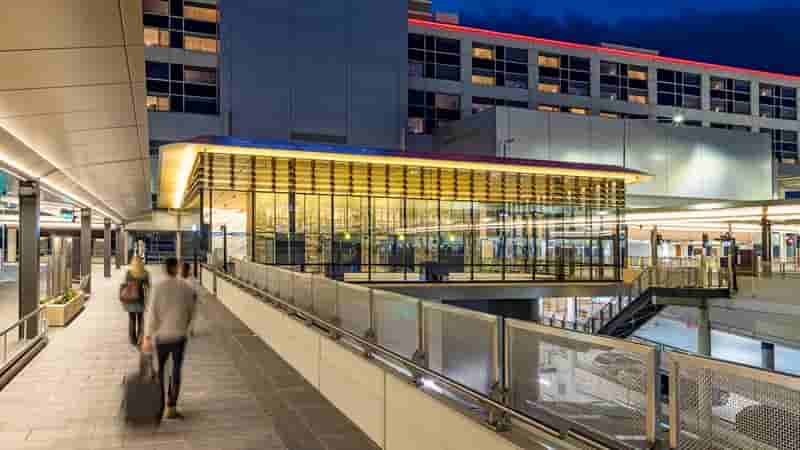
After more than half a century of emotional airport farewells, hurried kisses, frantic luggage shuffles and the occasional driver testing just how flexible the words “no standing” might be, Melbourne Airport has closed one of its most familiar pieces of infrastructure.
The terminal departures ramp, which has carried passengers to the doors of Melbourne Airport since the airport opened in 1970, closed to public traffic at 9 pm on 5 October 2026 after 56 years of service.
From 4 am on 6 October, passenger pick-up and drop-off for Qantas domestic services at Terminal 1, international passengers at Terminal 2 and Virgin Australia passengers at Terminal 3 moved to new, larger zones inside the T123 Transport Hub.
It is far more than a change of road signs.
It represents a significant reset in how Melbourne Airport manages the vast procession of cars, taxis, rideshares and family chauffeurs that descend on Tullamarine every day, usually at precisely the moment somebody discovers the passport is still sitting on the kitchen bench.
A $500 million change to Melbourne’s airport journey
The new arrangement forms part of the $500 million Naarm Way project, delivered following two years of construction and described by Melbourne Airport as the biggest change to its road network since the airport opened in July 1970.
For motorists, the most important instruction is also delightfully simple:
Leave the Tullamarine Freeway earlier.
Drivers heading to the new T123 passenger pick-up or drop-off zones need to take Exit 19, Naarm Way, rather than continuing towards the traditional terminal approach.
Melbourne Airport has published full directions, maps and updated passenger information on its dedicated Pick Up and Drop Off Hub.
Miss the exit through force of habit, and you may find yourself enjoying an unscheduled tour of Melbourne Airport’s road system, rarely the sightseeing experience travellers have in mind.
The new free drop-off zone is located on Level 3 of the T123 Transport Hub and provides substantially more space than the former terminal arrangement.
The pick-up zone is on Level 2, offering passengers an undercover waiting area with easier access to seating and toilets a modest improvement on paper, perhaps, but rather more impressive when Melbourne’s weather decides to demonstrate four seasons before breakfast.
A new era and some old habits to break
Melbourne Airport CEO Lorie Argus acknowledged that the transformation would require some adjustment.
“This is an exciting change for us, but it’s a big change, and it will take all of us some time to adjust to it,” she said.
“From tomorrow, drivers will need to leave the Tullamarine Freeway at Exit 19 (Naarm Way) to access pick-up and drop-off for all airlines and all terminals.
“We’ll have plenty of extra support on hand tomorrow and across the coming weeks to help people navigate the new airport layout, but we’d encourage everyone to plan ahead and allow extra time while we get used to it.
“Being dropped off right at the door has been part of Melbourne Airport since the day it opened in July 1970, but to cater for our growing city we now need to do things differently.
“Closing the departures ramp and opening our new Pick up and Drop off zones will enable us to start work expanding the footprint of our international terminal.”
Airport habits are remarkably durable. Regular travellers and family drivers can follow a familiar airport road almost on autopilot. From now on, however, Exit 19 matters.
Melbourne Airport has urged drivers to plan ahead and allow additional time while passengers and motorists become accustomed to the revised layout.
From 155,275 passengers to 75 million
The figures tell their own story.
According to Melbourne Airport, just 155,275 passengers passed through the airport in its opening year, 1970.
Today, the airport says it regularly welcomes more than 120,000 travellers in a single day.
“When the departures ramp opened in 1970, we welcomed 155,275 passengers across the year, but now we regularly welcome more than 120,000 travellers each day!” Argus said.
“By 2047 we’re expecting to welcome 75 million passengers each year so it’s imperative that we build the infrastructure now to support that growth.”
That is an extraordinary transformation — and explains why infrastructure designed when flared trousers, Holden Kingswoods and paper airline tickets were commonplace cannot necessarily be expected to handle Melbourne’s future aviation needs.
Accessibility assistance expanded
The changes also extend Melbourne Airport’s free accessibility assistance into the T123 Transport Hub.
“As part of this change we’ll be expanding our free Melbourne Airport Assist program to the T123 Transport Hub, with buggy and powered wheelchair assistance available on demand for people requiring mobility assistance from 3am to 1am seven days a week,” Argus said.
Travellers requiring mobility assistance should review the airport’s current accessibility information before travelling and allow additional time during the transition to the new road arrangements.
What travellers need to know
The biggest practical change is straightforward: passengers being dropped off or collected for Terminals 1, 2 and 3 should now follow signs for Naarm Way and the T123 Transport Hub.
Drivers should take Exit 19 from the Tullamarine Freeway.
Passengers and drivers can check the latest official directions, maps and traffic guidance at:
Melbourne Airport Pick Up and Drop Off Hub
Those travelling through Melbourne Airport should also check the main Melbourne Airport website before leaving home, particularly while motorists become familiar with the new traffic arrangements.
More than concrete and traffic lanes
For Melbourne Airport, retiring the departures ramp is both practical and strangely sentimental.
Airports are built around movement, but they also accumulate memories.
For generations of Victorians, that elevated stretch of roadway was where overseas adventures began, honeymoons departed, business trips launched, children were waved off, and relatives returned home carrying suitcases, duty-free bags, and stories that invariably got better with every retelling.
Countless Australians have stood beside a car there for one last hug before somebody disappeared through the terminal doors.
Now, after 56 years, the concrete gives way to capacity.
There will inevitably be a few wrong turns while Melbourne adjusts. There may also be some colourful commentary from drivers discovering, slightly too late, that Exit 19 was the exit they really did need.
But the broader logic is difficult to dispute.
Melbourne Airport is preparing for a future in which tens of millions more passenger journeys must be accommodated efficiently, safely, and with considerably more room than the original 1970 airport designers could reasonably have imagined.
The old departures ramp served Melbourne for more than half a century.
It witnessed millions of hellos and goodbyes.
Now it has made its own final departure.
And, appropriately enough for an airport, progress has already taken the next exit.
By: Christine Nguyen – © 2026.
Read Time: 5 minutes.
Author Bio:
 Christine’s story is one of quiet courage, told without fuss and lived with remarkable grace. She arrived in Australia as a young refugee from Vietnam, carrying little more than hope, family, and a curiosity that refused to be extinguished. Sydney became home, built patiently, brick by careful brick.
She studied Tourism at TAFE and soon found her place in inbound travel, working with one of the city’s leading destination companies. Christine loved showing visitors the Australia that lives beyond postcards, warmer, truer, and far more interesting.
When the sea began to whisper, and life asked for a gentler rhythm, she listened. Designing brochures, writing blogs, she discovered storytelling waiting quietly inside her.
Today, at EGT Media, Christine writes with warmth and wisdom, reminding us, softly and persuasively, why travel still matters.











