

The humble corporate travel report may be heading for the same cupboard as the fax machine.
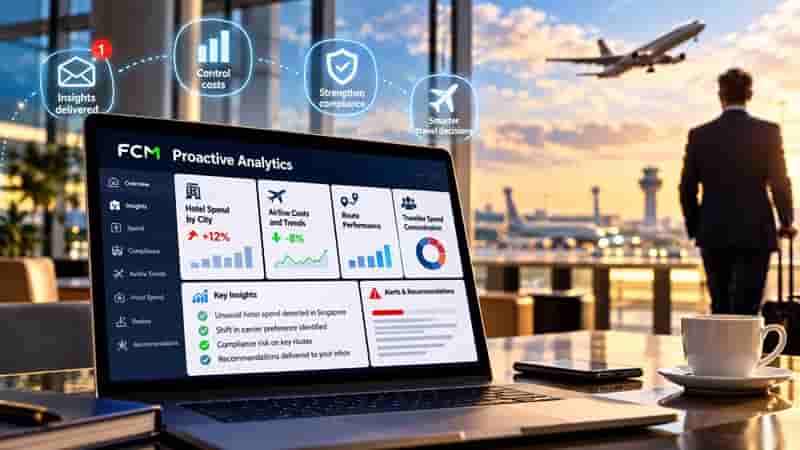
FCM Travel has launched FCM Proactive Analytics, a new capability designed to watch corporate travel programmes around the clock and send analysis directly to travel managers before a small spending wobble becomes a full-blown budget headache.
Launched on 6 October 2026, the system shifts reporting away from the familiar ritual of logging into a dashboard, hunting through filters and asking the right question after the damage has already been done.
Instead, FCM says the technology continuously scans travel data for patterns, anomalies and opportunities, then delivers recommendations directly to the inbox. FCM’s Australian reporting platform describes Proactive Analytics as an always-on intelligence capability that scans travel data 24/7, identifies issues, and transforms raw information into actionable narratives.
That distinction matters.
Corporate travel programmes generate mountains of information, but data sitting politely in a dashboard is useful only when somebody notices what it is trying to say. A sudden rise in hotel spend in Singapore, a shift away from a preferred airline, weakening compliance on a key route or too much expenditure concentrated among a small group of travellers can all become expensive long before the quarterly review arrives.
At launch, FCM says Proactive Analytics can provide scheduled analysis covering hotel spend by city, airline cost and carrier trends, route performance and traveller-spend concentration, with reports delivered weekly, monthly or quarterly.
The proposition is wonderfully straightforward: instead of the travel manager chasing the data, the data comes knocking.
More than another dashboard
FCM is positioning the launch as the second of three ways customers can work with their travel data.
The first is the established dashboard model within FCM Platform, where customers can access benchmarking, self-service reporting and defined metrics. FCM says its reporting and analytics suite includes more than 100 reports and thousands of data points spanning supplier performance, finance, expenditure, sustainability and traveller wellbeing.
The second is proactive monitoring, now represented by FCM Proactive Analytics.
The third, due to develop further in the coming months, is conversational access through Model Context Protocol (MCP) technology.
FCM has already outlined plans for customers to interact with travel information using natural-language questions through AI environments they already use. Its current technology roadmap also points towards MCP extending capabilities into tools including ChatGPT, Claude and Gemini.
In other words, dashboards tell you what happened, proactive analytics tries to tell you what needs attention, and conversational analytics aims to let you ask why.
That is a rather more useful evolution than simply giving yesterday’s spreadsheet a shinier jacket.
Humans still have a job, thankfully
FCM is also making an important point: the technology isn’t meant to push account managers out of the picture.
Quite the opposite.
Its stated model is to automate the watching so experienced people can spend more time advising.
“A managed travel programme has always been about more than bookings – it’s about having someone in your corner who understands your business”, said Jessica Dunderdale, Global Head of Product for FCM Travel. “Proactive Analytics strengthens that relationship: our technology does the watching, so our people can do the advising. For customers, that means a travel programme that isn’t just managed, but genuinely looked after.”
That is arguably the most commercially important part of the pitch.
Artificial intelligence can spot an unusual number. It can identify that hotel rates have climbed, policy leakage is worsening, or one carrier is taking a larger share of spend.
What it cannot do by itself is understand every political, operational and commercial wrinkle inside a company.
That is where the account manager and, for larger structural problems, FCM Consulting remain relevant.
FCM says it can deliver insights to both customers and its account managers, allowing the human conversation to begin earlier. If a pattern suggests a broader sourcing, policy or programme-design problem, consulting expertise can then help determine what needs fixing rather than merely explaining what went wrong.
Independent reporting on the launch also confirms that FCM sees earlier intervention on costs and compliance, reduced manual reporting and more useful management narratives as central benefits of the new capability.
Data governance joins the sales pitch
For corporate buyers, however, clever analytics are only half the conversation.
The other half is trust.
FCM says Proactive Analytics operates within its governed data environment and that it does not use customer data to train third-party AI models.
That is no small footnote.
As artificial intelligence becomes more deeply embedded in corporate travel, companies will increasingly need to ask not only what a system can do, but what information it sees, where that information travels and how recommendations are produced.
FCM’s broader commentary on artificial intelligence has similarly stressed the importance of reliable underlying data, explainable recommendations and clear guardrails.
That will matter increasingly as travel-management companies seek to connect booking, expense, traveller-profile and policy information with generative AI platforms.
The attraction is obvious.
So is the sensitivity of the information involved.
From rear-view mirror to early warning system
FCM’s roadmap does not stop at scheduled analysis.
The company says real-time, trigger-based alerts are planned for Proactive Analytics, which could allow customers to respond when an urgent issue emerges rather than discovering it during the next reporting cycle.
FCM’s conversational-data ambitions go further still. MCP technology is expected to eventually allow customers to ask questions about their travel information in natural language, with the broader vision extending to connections between travel data and corporate HR, sales and expense systems.
If delivered securely and intelligently, that could shift corporate travel reporting from a rear-view mirror to something closer to an early-warning system.
For travel managers who have spent years downloading reports, cleaning spreadsheets, checking fare movements and preparing PowerPoint explanations for why the travel budget has wandered off course, that could be an especially welcome development.
Because the numbers have always been there.
FCM’s latest wager is that the real value lies in ensuring the right person sees them before the finance director does.
By: My Thanh Pham – © 2026.
Read Time: 4 minutes.
Author Bio:
 My Thanh Pham has lived more of a life of travel than most people ever do. After studying tourism, she went straight into the work of building journeys across South-East Asia, temples, beaches, night trains, and all, quietly fixing the messy bits so others could enjoy the ride.
She was never meant to stay behind a desk. Airline life followed, dividing her days between reservations and the airport floor, right where travel shows its true colours. Missed flights, tight hugs, frayed tempers, sudden joy, she saw it all, close up.
Now at EGT Media, My Thanh has traded ticket stubs for a keyboard. She writes the way she once worked: steady, clear-eyed and respectful of the road’s unpredictable rhythm, guiding readers through a world she knows from the inside.











