

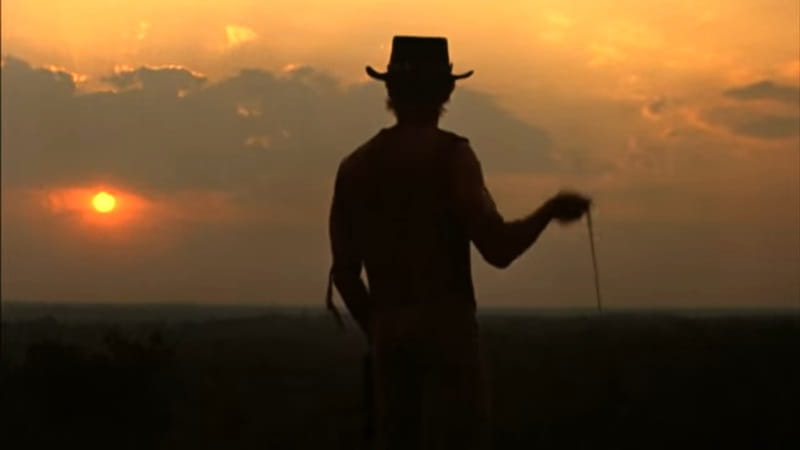
Forty years after Mick Dundee strode onto American cinema screens, Australia is still enjoying the tourism dividend from a bloke with a battered hat, a formidable knife and perhaps the most commercially successful grin this country has ever exported.
Crocodile Dundee opened in the United States on 26 September 1986 and promptly did something Australian films rarely managed at the time: it became an international phenomenon.
Produced for about A$8.6 million, the film ultimately grossed approximately US$328 million worldwide. In the United States, it finished its remarkable run with about US$174.8 million, sitting behind only Top Gun among the year’s great box-office success stories. Forty years later, the National Film and Sound Archive still describes it as Australia’s most commercially successful film.
Yet the biggest legacy may not be sitting in a box-office ledger.
It is stamped across Australia’s tourism industry.
When Hollywood discovered the Australian bush
Paul Hogan was already selling Australia to overseas audiences before Dundee appeared. His famous tourism advertising had introduced millions of Americans to an Australia of sunshine, beaches, humour and the invitation to put another shrimp on the barbecue.
Then came Mick Dundee.
Suddenly the Australian bush was not simply somewhere at the other end of a very long flight. It was an adventure waiting to happen.
Tourism Australia says international visitor numbers subsequently doubled to more than two million annually by 1990, growth influenced by a period of intensive Australian destination marketing in which Hogan and the Dundee phenomenon became enormously recognisable international assets. The film should not, of course, be credited single-handedly for Australia’s tourism expansion, but its contribution to Australia’s global image is difficult to overstate.
Tourism Australia Managing Director Robin Mack said Hogan and producer John Cornell did far more than sell cinema tickets.
“Crocodile Dundee really conveyed the sense of wonder that an Australian holiday can offer from the spectacular natural beauty of our landscapes and wildlife to the warm and welcoming nature of our people. Forty years on these attributes continue to inspire international travellers to see Australia for themselves.”
That message remains remarkably contemporary.
Tourism marketers now call it set-jetting: travellers choosing destinations after seeing them on film or television. Back in 1986, Mick Dundee was doing it before anybody had invented a fashionable expression for it.
No TikTok. No Instagram reels. No influencer campaign.
Just Kakadu, Paul Hogan and some particularly effective cinematography.
Kakadu remains Dundee country
The Northern Territory provided many of the film’s unforgettable landscapes, with Kakadu National Park taking a starring role almost as important as Hogan himself.
Ubirr, Anbangbang Billabong, Burrungkuy, formerly widely known as Nourlangie and Gunlom are among the locations associated with the film. Kakadu Tourism has even produced a self-guided guide that lets visitors retrace famous scenes.
At Ubirr, visitors can look across the floodplains that helped introduce international cinema audiences to Kakadu’s immense scale. Anbangbang Billabong provided more familiar Dundee country, while Gunlom, known as Echo Lake in the movie, became another memorable production location.
Gunlom reopened to visitors in July 2025 after repairs and safety work, although Parks Australia stresses that visitors must follow current crocodile and swimming restrictions. This is Kakadu, after all. The crocodiles apparently never received the memo that they were supporting actors.
Following Dundee’s footsteps
For travellers who want to turn cinema nostalgia into an itinerary, Kakadu offers far more than a photograph beside a familiar rock.
Walk the film locations: Kakadu Tourism’s Dundee guide traces several locations associated with Mick and Sue’s journey through the park.
Take the 4WD approach: Dry-season touring opens access to some of Kakadu’s great landscapes, with operators visiting areas including Gunlom and, depending on seasonal access and itinerary, other waterfalls, gorges and swimming locations. Travellers should always confirm current park access before setting out.
Sleep with a sense of theatre: The crocodile-shaped Mercure Kakadu Crocodile Hotel remains one of Australia’s more unmistakable hotels. Nearby Cooinda Lodge offers conventional rooms alongside glamping-style Outback Retreat accommodation and Yellow Water Villas.
Meet the real stars: Yellow Water Cruises takes visitors through Yellow Water Billabong, where saltwater crocodiles share the wetlands with prolific birdlife including magpie geese and whistling ducks.
And unlike Hollywood, nobody needs to yell “action”.
Forty years and still selling Australia
This offers a useful lesson for Australia’s tourism industry.
Destination advertising campaigns come and go. Slogans change. Logos change. Marketing executives change sometimes considerably faster than logos.
But powerful stories endure.
Crocodile Dundee packaged Australia’s landscapes, humour, wildlife and personality into something international audiences could understand instantly. It did not present Australia merely as somewhere to visit. It made the country feel like somewhere worth crossing the world to experience.
Four decades after Mick Dundee arrived in America, visitors are still following him back in the other direction.
For Australian tourism, that’s one heck of a long-running sequel.
By: Anne Keam – © 2026.
Read Time: 4 minutes.
Author Bio:
 Anne Keam’s story begins in Queensland, on a grain farm in the state’s wide western reaches, where the days were long and the lessons simple: work hard, look after your own, and don’t make a fuss. Those early years left their mark.
She later studied Arts at the University of Queensland, before doing what felt natural at the time, heading back home to the family property. But the world was calling. Anne packed a backpack and went looking, spending years on the road and finding herself most alive in South America.
She wrote everything down along the way. Those notebooks, full of dust, colour, and curiosity, eventually became her blog, a quiet, personal record of seeing the world and learning from it.











