

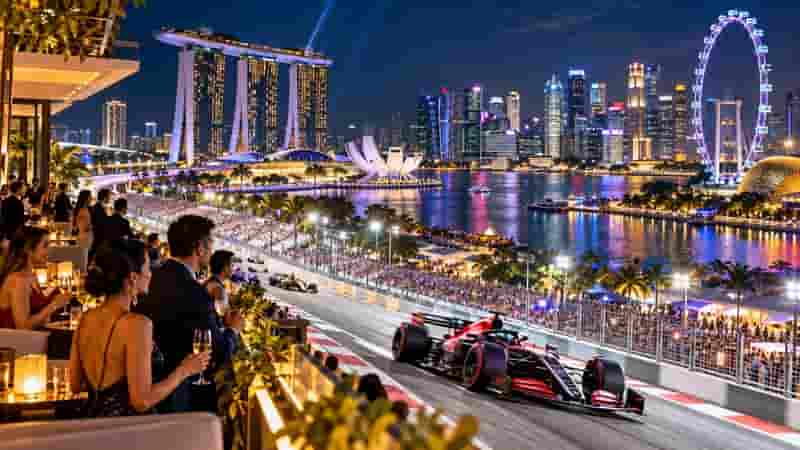
Singapore has always understood that a great event should do more than fill grandstands. It should fill hotel rooms, restaurant tables, airport lounges, shopping bags and, preferably, a few expense accounts as well.
That is exactly what the Formula 1 Singapore Airlines Singapore Grand Prix has become: not merely a motor race, but one of Asia’s most compelling examples of destination-led event tourism.
Grand Prix Season Singapore 2026 will run from 2 to 11 October, building 10 days of city-wide activity around the Formula 1 weekend from 9 to 11 October. Singapore will also stage its first-ever F1 Sprint, adding another competitive session and another good reason for visitors to arrive early to an event already designed to make the entire city feel involved.
The strategy is simple enough to describe, but considerably harder to execute: use one globally recognised sporting event to sell an entire destination.
Singapore has become very good at it.
The race that sells the city
When Singapore joined the Formula 1 calendar in 2008, it made history by hosting the sport’s first night race. The concept was immediately distinctive: very fast cars, floodlights, humid tropical air and one of the world’s most recognisable city skylines wrapped around the Marina Bay Street Circuit.
For 2026, the Grand Prix will run over 62 laps of the 4.927-kilometre circuit, with the race scheduled to start at 8 pm local time on Sunday, 11 October.
Yet from a tourism perspective, what happens outside the barriers may be almost as significant as what happens between them.
The Singapore Tourism Board has built Grand Prix Season Singapore, or GPSS, around the event, extending the visitor proposition beyond race weekend with entertainment, dining, retail, nightlife, pop-ups and themed experiences across the city.
That matters because a major event reaches its tourism potential only when spectators become broader visitors.
A fan who buys a ticket is valuable. A fan who also books several hotel nights, eats well, shops enthusiastically, visits attractions and perhaps stays for a few days after the chequered flag is considerably more valuable.
Singapore has clearly learned that lesson.
S$2.2 billion reasons to keep racing
The numbers give the strategy considerable weight.
Singapore Tourism Board said in 2025 that, since its inception, the Formula 1 night race had attracted more than 720,000 international visitors and generated S$2.2 billion in tourism receipts.
Those figures make the Grand Prix far more than an exercise in international visibility. It is a measurable tourism asset with a long economic tail stretching into accommodation, food and beverage, retail, transport, attractions, entertainment and business events.
The 2025 race underlined its continuing pulling power. Official Singapore GP figures show the event attracted 300,641 people across the three-day weekend, up 11.7 per cent on 2024 and representing the second-highest crowd in the event’s history.
The Grand Prix also sits inside a tourism sector that entered 2026 with considerable momentum.
Singapore welcomed 16.9 million international visitors in 2025, while full-year tourism receipts reached a record S$32.8 billion, according to the Singapore Tourism Board.
Australia deserves particular attention from the travel trade.
It was Singapore’s fourth-largest visitor market in 2025, delivering a record 1.3 million Australian visitors, an 8 per cent increase over the previous record set in 2024. Australia also ranked among Singapore’s three biggest tourism-receipt-generating markets.
For Australian travel advisors, that makes the Grand Prix an obvious premium short-break proposition in a destination already enjoying strong demand from this market.
Hotels join the race
Few sectors feel Grand Prix week more directly than Singapore’s hotels.
The relationship is substantial enough to be formally recognised within Singapore’s tourism framework.
For the 2025 race, designated hotels were required to contribute a Formula 1 tourism cess. Singapore Tourism Board explains that hotels are expected to benefit from increased revenue generated through higher room rates and/or higher occupancy associated with the event.
That is a useful clue for travel advisors.
Grand Prix week places considerable pressure on Singapore’s hotel inventory, supporting stronger room rates and occupancy as demand builds around race weekend. Waiting until the last moment may therefore prove an expensive exercise in optimism.
The stronger opportunity is to package beyond the circuit.
A Singapore F1 itinerary can include pre-race dining, rooftop bars, shopping, Sentosa, Gardens by the Bay, neighbourhood exploration, premium airport services, cultural precincts and a post-race recovery day requiring absolutely no discussion of tyre degradation.
The race gets clients to Singapore.
The destination can then persuade them to stay longer and spend more.
Then Singapore turns up the music
Singapore’s Grand Prix proposition has also become as much an entertainment festival as a sporting event.
The official 2026 Circuit Park entertainment line-up includes Lana Del Rey, Janet Jackson, The Killers, Zara Larsson, JJ Lin, James Arthur, Mark Ronson, DJ Snake, Split Enz, Goo Goo Dolls and numerous other performers across the weekend.
The promoter says more than 100 hours of entertainment will be staged across the three-day event.
That is not incidental programming. It substantially broadens the appeal beyond committed Formula 1 followers.
A couple can travel together even if only one knows the difference between a pit stop and a drive-through penalty. Corporate groups can combine hospitality with music and dining. Leisure travellers can treat the race as the anchor for a broader Singapore break.
Beyond Circuit Park, Grand Prix Season Singapore extends the energy city-wide with after-parties, exclusive dining offers, retail experiences, immersive pop-ups and other race-themed activities.
This is where Singapore’s destination management becomes particularly effective.
The event is not simply quarantined behind circuit fencing. Businesses across the city are encouraged to participate in the visitor economy it creates.
Business travel gets a seat at the table
Formula 1 is also a substantial corporate hospitality platform.
Premium race products combine trackside viewing with lounges, restaurants, entertainment and hospitality, making the Grand Prix highly relevant to incentive groups, customer entertainment and corporate travel.
Demand for 2026 provides a practical indication of how strong that market can be.
As of 25 September 2026, Singapore GP says most premium hospitality categories are sold out online, while only limited inventory remains in some categories and occasional client returns may become available as race day approaches. Products listed as sold out include the Formula 1 Paddock Club, Sky Suite, Observ@3, TWENTY3 and The Green Room.
That makes early-booking advice rather more than a convenient sales line.
For companies operating across Asia-Pacific, Singapore is already a significant meetings and events hub.
Its MICE sector generated S$2.3 billion in tourism receipts in 2025, up more than 35 per cent from 2024, according to the Singapore Tourism Board.
The Grand Prix therefore sits naturally inside an established corporate-travel ecosystem.
A client may arrive for Formula 1 hospitality on Saturday evening and still be talking business over breakfast on Monday.
In Singapore, the line between major-event tourism and business travel can become wonderfully thin.
Local business also wins
The economic value of Formula 1 stretches well beyond hotels, restaurants and champagne-filled hospitality suites.
When Singapore announced that it would continue hosting Formula 1 through 2028, authorities said 90 per cent of race organisation was subcontracted annually to Singapore-based companies, benefiting sectors including engineering, construction and hospitality.
Around 30,000 staff, contractors and stakeholders were also accredited annually to work at the Marina Bay Street Circuit under the operating model described when the contract extension was announced.
Those figures matter because they demonstrate how deeply the event reaches into the local economy.
Successful event tourism is not simply about importing spectators, selling tickets and waving goodbye on Monday morning.
It is about creating a commercial ecosystem around an event, one that supports suppliers, employment, hotels, restaurants, entertainment businesses and international destination marketing.
Why travel advisors should move early
For travel advisors, Singapore Grand Prix week offers several client profiles at once.
There is the committed Formula 1 fan, naturally. But there is also the luxury traveller, corporate guest, incentive group, couple seeking a high-energy city break and the accompanying partner whose principal interest may lie considerably closer to a tasting menu than a timing screen.
The smartest sales approach is therefore to package Singapore, not merely Formula 1.
Advisors should also encourage clients to commit early. Race tickets, premium hospitality, preferred hotels and attractive flight options can tighten as the weekend approaches, and the current state of 2026 hospitality inventory already demonstrates the point.
This year provides another selling proposition.
Singapore’s first F1 Sprint means competitive action begins earlier in the weekend.
Sprint Qualifying is scheduled for Friday, 9 October at 8.30 pm. The Sprint follows on Saturday at 5 pm, with Grand Prix qualifying at 9 pm that evening. The main Grand Prix begins at 8 pm on Sunday, 11 October.
The Sprint also carries championship points, making Friday and Saturday more consequential than a conventional weekend built primarily around practice before Grand Prix qualifying.
For spectators, that means more meaningful track action.
For tourism, it means one more good reason to arrive before the weekend properly begins.
For Singapore tourism, that may be the most satisfying podium finish of all.
The real victory comes after the chequered flag
Perhaps the cleverest element of Singapore’s Formula 1 strategy is that the destination itself has become part of the show.
The skyline is not merely behind the circuit.
It is part of the television picture.
Hotels are not simply places to sleep after the race.
They form part of the commercial engine.
Restaurants, bars, retailers, entertainment venues and attractions are not competing with Formula 1 for visitors’ attention. During Grand Prix Season, they are positioned to benefit from its extraordinary international reach.
That is the broader lesson for destinations considering expensive global sporting events.
The race itself is only the beginning.
Singapore has managed to wrap an entire visitor economy around 62 laps of Marina Bay, turning motorsport into hotel demand, entertainment, dining, shopping, corporate hospitality and international destination marketing.
When the final car disappears into the garage, and the Marina Bay fireworks fade, thousands of visitors will still need breakfast, a hotel bed, perhaps another day of sightseeing and, in many cases, a Singapore Sling.
Preferably before checking the credit-card statement.
By: Michelle Warner – © 2026.
Read Time: 7 minutes.
Author Bio:
 Michelle Warner has always carried stories the way others carry passports lightly, faithfully, and with purpose. She learned her craft in newsrooms, shaping sentences with care, before swapping deadlines for departures as a flight attendant with some of the world’s great airlines. Years aloft sharpened her eye for character and deepened her fondness for the small, dignified rituals of travel, the quiet kindness of strangers, the poetry of arrival, the patience learned between time zones.
Now grounded by choice, Michelle has come home to writing with the same calm authority she once brought to turbulent cabins. Her prose blends an editor’s discipline with a traveller’s wonder, tinged with humour and reverence for travel’s golden age. Each piece feels like a handwritten boarding pass, gracious, observant, and unmistakably alive.











