

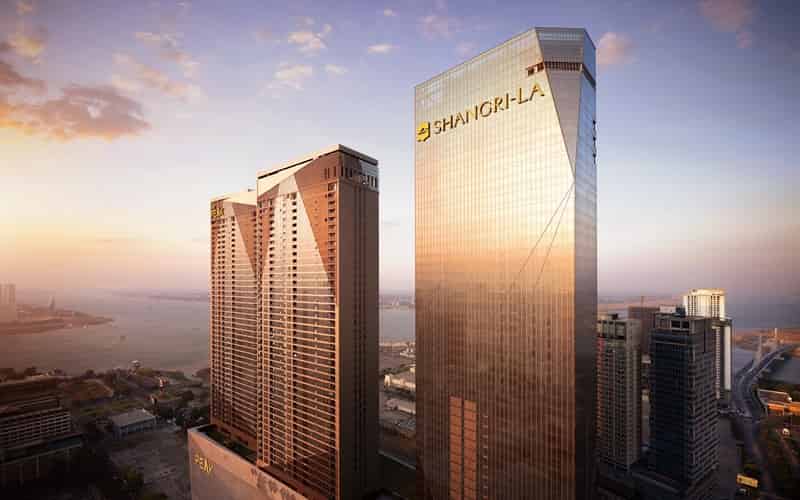
The arrival speaks to Phnom Penh’s new confidence.
A polished Rolls-Royce at the entrance of the Shangri-La Phnom Penh is an appropriate introduction to a hotel that has brought a new level of international luxury to Cambodia’s capital. But the view from above makes a lasting impression.
Rising 54 floors above the rapidly developing Koh Pich, or Diamond Island, district, Shangri-La Phnom Penh commands extraordinary views across the city and the rivers that define it. The hotel opened in December 2024 and has 303 rooms and suites, combining contemporary comfort with French Art Deco influences and Khmer-inspired details.
From Level 54, the city seems to stretch endlessly beneath you. The Mekong, Tonlé Sap and Tonlé Bassac rivers form a shimmering network through the urban landscape, while Phnom Penh’s old neighbourhoods, new towers and rapidly expanding skyline provide a fascinating contrast.
The hotel’s rooftop infinity pool shares this spectacular setting, while Altitude, the rooftop bar on Level 54, bills itself as one of Cambodia’s highest rooftop bars. The hotel also offers a spa and wellness facilities, restaurants and lounges, extensive meeting facilities and the kind of service expected of a major international five-star property.
For business travellers, couples and visitors looking for a comfortable base from which to explore the capital, Shangri-La provides a distinctly modern introduction to Phnom Penh.
The rooms are spacious and inviting, with floor-to-ceiling windows making the most of the city and river views. The overall effect is polished without feeling anonymous: contemporary luxury is softened by Cambodian references, warm materials and an emphasis on natural light.
That is perhaps the best way to understand modern Phnom Penh: a city looking forward without entirely letting go of what came before.
PHNOM PENH: DESERVES MORE THAN A DAY
For years, many travellers treated Phnom Penh as little more than a stopover on the way to Siem Reap and Angkor Wat.
That is increasingly difficult to justify.
Cambodia’s capital has become more confident, sophisticated and cosmopolitan. New hotels, restaurants, cafés, galleries, shopping centres and high-rise developments have changed the skyline, while established neighbourhoods, markets, temples and the riverfront continue to provide the texture that makes the city distinctive.
The result is a destination that rewards curiosity.
Phnom Penh is still busy and sometimes chaotic, but compared with some of Southeast Asia’s megacities, it retains a relatively human scale. It offers an appealing mix of French colonial architecture, Khmer heritage, modern Asian development, and everyday Cambodian life.
It is a city for eating, exploring, shopping, and simply watching the streets come alive.
And now, getting there has changed too.
In 2025, Phnom Penh’s new Techo International Airport opened, replacing the former Phnom Penh International Airport as the capital’s principal commercial gateway. The US$2 billion airport, located south of the city in Kandal province, has capacity for around 13 million passengers, with planned expansion to 30 million by 2030 and 50 million by 2050.
For international visitors, it is a significant upgrade and another indication of Cambodia’s ambitions.
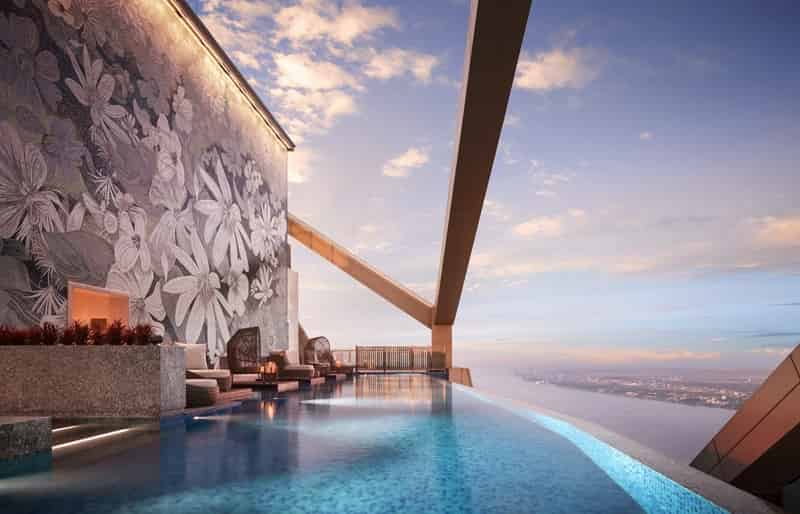
Shangri La Swimming Pool
A CITY OF RIVERS AND HISTORY
Phnom Penh was established as the capital in the fifteenth century and later developed substantially under French colonial rule. Today, its position at the meeting of the Mekong, Tonlé Sap and Tonlé Bassac rivers remains central to the city’s character.
The best way to appreciate Phnom Penh is to give it time.
Start with the Royal Palace, one of the city’s most recognisable landmarks. Its glittering roofs and elaborate Khmer architecture provide a spectacular introduction to Cambodia’s royal heritage. The complex includes the Throne Hall, the Silver Pagoda and beautifully maintained gardens. The palace remains the King’s official residence, although several areas are protected and closed to visitors.
Nearby, the National Museum of Cambodia provides essential context. Established in 1920, it houses more than 14,000 objects and has one of the world’s most important collections of Khmer art, including sculpture, ceramics, bronzes and ethnographic material spanning centuries of Cambodian history.
For anyone interested in understanding Cambodia beyond its beaches and temples, this is time well spent.
Wat Phnom, the temple on the city’s only significant hill, offers another glimpse of Phnom Penh’s religious and cultural history. And along Sisowath Quay, the riverside promenade becomes a stage for everyday life: families strolling, cafés filling, river boats passing and the city cooling down as the sun disappears.
MARKETS, SHOPPING AND THE NEW PHNOM PENH
Shopping in Phnom Penh remains one of the city’s great pleasures.
The Central Market, or Phsar Thmey, is both an architectural landmark and a functioning market. Built in 1937, its distinctive Art Deco structure spreads out from a huge central dome into four wings filled with stalls. Visitors will find jewellery, clothing, food, souvenirs, electronics and countless other Cambodian products.
For a more local-market experience, head to Tuol Tompoung Market, commonly known as the Russian Market. It is a place to browse for textiles, clothing, handicrafts, souvenirs and food while experiencing the energetic atmosphere of a traditional Phnom Penh market.
The shopping landscape has also changed dramatically. Modern malls and new developments have added international brands, supermarkets, cinemas and restaurants to a city once dominated by markets and small independent shops.
AEON Mall Phnom Penh and other newer developments reflect the changing aspirations of Cambodia’s growing middle class, while Koh Pich has become one of the most visible symbols of the city’s transformation.
Yet the old Phnom Penh is never far away.
Turn a corner, and the towers give way to a food stall, a small temple, a colonial façade or a neighbourhood where life continues at a slower pace.
SIGHTSEEING WITH A DIFFERENCE
Phnom Penh’s attractions are not all easy viewing, and some are profoundly confronting.
A visit to the Tuol Sleng Genocide Museum, the former S-21 prison and the Choeung Ek Genocidal Centre, commonly known as the Killing Fields, provides an essential understanding of Cambodia’s recent history and the atrocities committed under the Khmer Rouge between 1975 and 1979.
These places are difficult to visit, but they matter. They also help explain modern Cambodia’s resilience and remarkable transformation.
The city’s cultural attractions provide a broader picture. The Royal Palace and National Museum reveal centuries of artistic and royal heritage; Wat Phnom offers a spiritual connection to the city’s origins; and the riverfront provides a window into contemporary Cambodian life.
Together, they make a compelling argument for staying longer.
AFTER DARK
Phnom Penh changes character after sunset.
As temperatures fall, restaurants, cafés and bars fill, and the city becomes more relaxed. Cambodian food is the obvious place to begin.
Fish amok remains one of the country’s signature dishes, but Phnom Penh’s dining scene now extends far beyond traditional Khmer cuisine. Contemporary Cambodian chefs are rediscovering regional ingredients and heritage recipes, while French, Chinese, Thai, Vietnamese, Japanese and international restaurants reflect the city’s increasingly cosmopolitan population.
The riverside remains a popular evening destination, while Bassac Lane and the nearby emerging restaurant and bar districts in the BKK1 area, including Langka Lane, have become some of Phnom Penh’s trendiest food hubs.
Rooftop venues have become another Phnom Penh signature. From high above the streets, cocktails and dinner come with an entirely different perspective on the city.
At Shangri-La Phnom Penh, that experience reaches Level 54 at Altitude, where the rooftop setting combines panoramic views with an infinity pool and an evening menu designed for sunset and after-dark dining.
For those who prefer a quieter evening, Phnom Penh also has an increasingly sophisticated café and cocktail culture, with independent venues competing alongside the international hotels.
THE CITY IS CHANGING – BUT THAT IS THE ATTRACTION
The most interesting thing about Phnom Penh in 2026 is not that it has become another Singapore, Bangkok or Ho Chi Minh City.
It hasn’t.
Nor should it.
Its appeal lies in the mixture: Khmer tradition alongside glass towers; monks and motorbikes sharing the streets with luxury SUVs; old markets operating beneath an increasingly modern skyline; sophisticated restaurants a short ride from neighbourhood food stalls.
The transformation is visible everywhere.
New infrastructure, including the Techo International Airport, is making the capital more accessible. New hotels and high-rise developments are changing the skyline. A growing creative and culinary scene is giving the city a new cultural confidence. And international visitors are beginning to recognise that Phnom Penh is more than a gateway to somewhere else.
There is still grit here. There is still noise, traffic and plenty of rough edges.
But that is part of the story.
Phnom Penh is a city in motion, modernising rapidly while carrying the weight of a complicated history and a remarkably resilient culture.
Stay for a few days, and the city begins to make sense.
Stay longer, and it may surprise you.
From the 54th floor of Shangri-La, the view makes the argument particularly well: Phnom Penh is no longer simply somewhere to pass through.
It is somewhere to stay, and veteran Shangri-La General Manager Ody Odayappan and his professional, knowledgeable staff will always welcome you warmly.
https://www.shangri-la.com/phnompenh/shangrila/
The GM hosted some special guests who had just experienced the New Discovery Tour on the Mekong aboard the 14-cabin Toum Tiou 2. Discounts are available for 2026/27 cruises: www.cfmekong.com.
Written by John Savage and Grahame Cox – © 2026.
Read Time: 8 minutes.
Author Bio:
 John Savage has spent more than three decades doing what the travel industry values most: telling good stories, building trusted relationships and knowing when a message deserves the spotlight.
Before public relations came journalism. John wrote for The Australian, The Daily Telegraph, The Sydney Morning Herald, Cumberland Newspaper Group, and Australian Associated Press, and his broadcasting career included Channels 9 and 10, 2UE, 2UW, 2WS, the ABC, and affiliated networks.
Through Savage Communications, he went on to represent many of travel, tourism and hospitality’s best-known organisations, helping clients grow their brands across traditional and digital media.
His career has attracted public relations, marketing and tourism awards, but his strongest credential remains an enviable reputation across the industry.
Today, John continues doing what he knows best: writing sharp, informed travel stories for EGT MEDIA’s widely read trade and consumer travel newsletter.











