

MUNCH is pleased to present a major exhibition by celebrated German artist Katharina Grosse, known for her immersive, large-scale works that transform architecture, landscapes, and interiors into vibrant fields of colour. For this exhibition Grosse will create a new body of work, in dialogue with Edvard Munch and his artistic legacy.
For over three decades, Katharina Grosse has challenged conventional ideas of painting. Treating the world itself as a site for painting, she applies colour directly onto buildings, objects, landscapes, and canvas, using a spray gun to extend her reach as far as her eye can see. In her work, there is no clear distinction between artwork, architecture, environment and viewer; painting can appear anywhere.
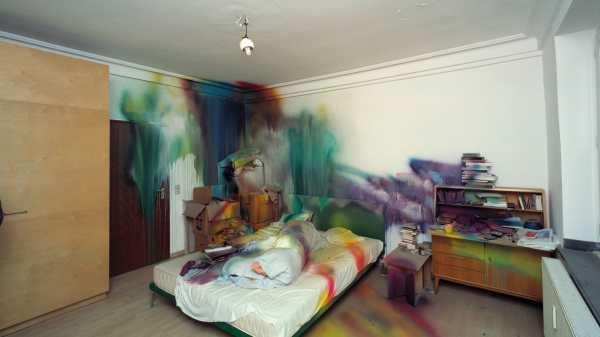
At the heart of the exhibition at MUNCH is Black Bed (2026), a newly commissioned installation that revisits Grosse’s seminal work Das Bett(2004). In the original work, the artist spray-painted her bedroom in Düsseldorf, along with her furniture, clothing and personal belongings, radically transforming her private environment into a single painted image. The work marked a turning point in her practice, incorporating, for the first time, symbolic and narrative elements that expanded her understanding of painting’s transformative possibilities.
Black Bed likewise marks a development in Grosse’s work through its use of black – a colour she has largely avoided throughout her career. Grosse has since her student days been inspired by Edvard Munch, notably his monumental painting The Sun (1912–13), in which a dazzling sun rises over a rocky archipelago. Conceived as an homage and dark counterpoint to this painting, Black Bed connects the exhibition to themes of life and death in Munch’s work. While Munch took the landscape as his subject, Grosse transforms the landscape as a surface for painting. Black Bed envelops the exhibition space in its unsettling atmosphere, inviting viewers into a profound emotional and psychological experience.
Bringing together two artists separated by more than a century, the exhibition illustrates their shared interests in colour, emotion, monumental scale and the transformative potential of art.
In preparation for the exhibition, Grosse worked in Munch’s historic studio at Ekely in Oslo, creating new works that extend the dialogue between the two artists. The exhibition highlights Grosse’s experimental approach and her willingness to embrace the unpredictable forces of the world around her – an openness she shares with Munch.
Katharina Grosse said: “Working in Munch’s studio marks the first time I have used a studio designed by another painter specifically for his own work and needs. The daylight is directed in the most beautiful way through a double ceiling into the center of the space, illuminating its full volume. While working in Ekely, I sensed the extreme vitality coming from the relationship of Munch´s indoor and outdoor studio life. How to stage that vitality will be the center of my upcoming show.”
Curator Katrine Elise Agpalza Pedersen said: “In the exhibition at MUNCH, we encounter a formative moment in Katharina Grosse’s practice through Das Bett (2004). This early work, which I also explore in my catalogue text “Katharina’s Bed”, already contained the conceptual premise of the large-scale installations for which she is widely known today. Grosse has engaged with Edvard Munch’s work since her student years, and what is particularly compelling here is how she brings a literal darkness, rooted in that 2004 turning point, into dialogue with the radiant light of Munch’s The Sun – while also developing new works within his own studio at Ekely, Norway.”
Throughout the exhibition, visitors move through Grosse’s painted environments and encounter colour as a physical presence. Rather than representing the world, her paintings alter our experience of it, with architecture, objects, surfaces, and the viewer themselves, becoming part of a continuously shifting field of perception.
The exhibition is curated by Katrine Elise Agpalza Pedersen, with Trine Otte Bak Nielsen as co-curator.
The exhibition is accompanied by a publication featuring new texts by Katrine Elise Agpalza Pedersen and Mathias Danbolt, alongside a conversation between Trine Otte Bak Nielsen and Katharina Grosse. The publication is designed by Irma Boom and edited by Line Ulekleiv and Agpalza Pedersen, published by MUNCH Publishing, distributed in Germany by Hatje Cantz and elsewhere worldwide by ACC Art Books.











