

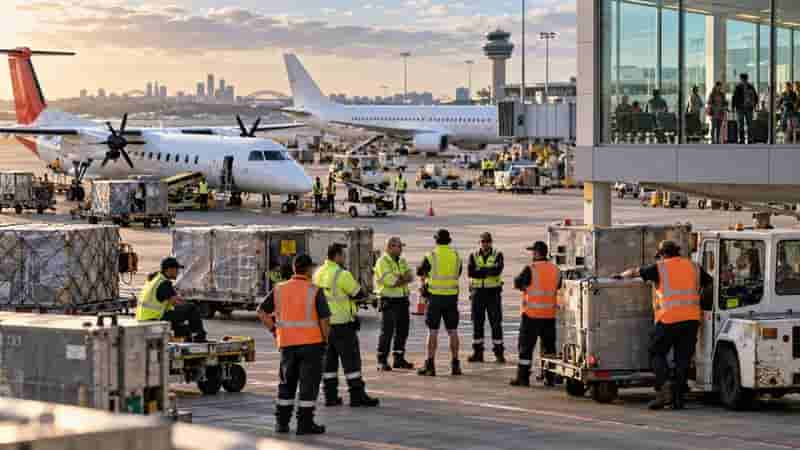
Australia’s September school-holiday rush has acquired an unwelcome complication, with hundreds of Qantas ground workers scheduled to stop work for 24 hours in a dispute over pay, job security and working conditions.
The Transport Workers’ Union has announced protected industrial action for Wednesday, 23 September in Victoria and Thursday, 24 September across the rest of Australia. The action involves workers employed through Qantas subsidiaries Qantas Ground Services and Australian Air Express, with most of the affected workforce working across Qantas Freight and a smaller group supporting QantasLink operations at Sydney Airport.
For passengers, the distinction matters. This is not a system-wide Qantas shutdown.
The workers involved do not service Qantas mainline domestic or international flights, and they do not service QantasLink operations at airports other than Sydney. The direct passenger risk is therefore concentrated on some QantasLink services from Sydney, while freight is potentially the larger operational headache. ABC reports that about 650 ground-service workers are involved, most of whom work in freight.
That may lack the drama of a nationwide grounding, but it is rather more useful information for travel advisors and passengers than discovering the fine print at the departure gate.
School holidays make timing awkward
The timing could scarcely be less convenient.
Queensland state-school holidays began on Saturday, 19 September and run until Monday, 5 October. Victorian government-school holidays run from Monday, 21 September to Friday, 2 October, while the Northern Territory’s Term 3 finished on Friday, 18 September.
That places the planned industrial action squarely inside a busy family-travel period and gives any disruption a sharper edge, particularly for regional passengers travelling through Sydney.
Qantas says it has “well developed contingency plans” intended to minimise the impact on QantasLink customers and its operations. It also says negotiations are continuing and that it remains committed to an agreement that includes annual pay rises and addresses employee priorities such as more full-time opportunities.
For travel advisors, the message is straightforward: monitor, verify and avoid unnecessary alarm.
Clients booked on QantasLink services from Sydney on Thursday, 24 September deserve particular attention. Passengers on Qantas mainline services should not assume their flights are affected simply because the words “Qantas” and “strike” have appeared in the same headline.
Freight is where the pressure could bite
The potentially larger commercial effect sits in freight.
Most of the workers involved are connected with Qantas Freight operations. The TWU has specifically warned that freight disruption could extend to Australia Post shipments.
Australia Post, however, says it has detailed contingency plans and will work closely with freight partners to minimise any effect on customers and delivery services if industrial action occurs.
That distinction is important. A strike creates a risk of delays; it does not mean every parcel will automatically arrive late.
Still, freight disruption can ripple quickly across a country as large as Australia. Express parcels, urgent documents, commercial consignments and time-sensitive goods all depend on tight transport schedules. An interruption may also leave freight operators dealing with delayed consignments after the stoppage ends.
For tourism and hospitality businesses, freight may not be the glamorous side of the industry, but it becomes very interesting when a resort, hotel or regional operator is waiting for an urgent component, document or supply.
A broken refrigeration part has never shown much respect for a guest’s check-in time.
Ballot numbers show strong support for action
The protected-action ballots provide a clearer picture than the rounded numbers used in some early reports.
Official Fair Work Commission records show 417 ballots were issued to Qantas Ground Services employees. On the specific question of unlimited 24-hour stoppages, 344 employees voted yes and eight voted no, from 352 valid votes. That represents almost 98 per cent support among those who cast a valid vote on that question.
Australian Air Express workers conducted a separate ballot. Of 77 ballots issued, 67 employees voted in favour of unlimited 24-hour stoppages and one voted against, from 68 valid votes on that question.
Those figures do not determine the merits of the enterprise-bargaining dispute, but they demonstrate strong support among participating voters for having 24-hour stoppages available as protected industrial action.
The TWU says the dispute centres on pay, job security, conditions and the structure of employment across Qantas subsidiaries. It argues that keeping work groups within different Qantas-owned companies has weakened employment security and conditions and wants employment arrangements brought more closely into line.
Qantas disputes parts of the union’s characterisation, including claims concerning deteriorating safety standards. The airline says it is focused on reaching an agreement that provides annual pay increases and addresses what employees have identified as priorities, including more full-time opportunities.
That is where careful attribution matters. The union’s allegations are claims made during an industrial dispute; Qantas’s response is the company’s position. Neither should quietly be converted into editorial fact.
Eleven months at the bargaining table
The dispute follows about 11 months of negotiations.
Qantas and TWU representatives continued discussions through the Fair Work Commission on Friday, 18 September, but the dispute remained unresolved when they made their latest public statements. Qantas characterised the discussions as constructive and said negotiations were continuing.
The TWU subsequently announced the 24-hour stoppages for 23 and 24 September. Its 18 September announcement remains the union’s published timetable for the action.
That means the story remains fluid.
Industrial disputes have a habit of producing late agreements, amended action or further proceedings just when editors have confidently put the page to bed. Any publication close to the strike dates should therefore include one last status check.
Qantas has plenty else on its plate
The dispute also lands during a challenging financial period for the airline.
Qantas reported underlying profit before tax of $2.064 billion for FY26, down $330 million from $2.394 billion in FY25.
The airline said the Middle East conflict had a net impact of about $420 million on underlying EBIT in the second half of the financial year, driven mainly by higher fuel costs. Qantas put the fuel-cost impact at $610 million, net of about $400 million of benefit from its fuel-hedging program.
Those figures do not settle an industrial-relations argument. A profitable company and its workforce can still disagree sharply over wages, employment structures and conditions.
They do, however, underline the operational squeeze confronting airlines: labour, fuel, fleet renewal, reliability and customer expectations all eventually meet in the same set of accounts.
Passengers tend to use a simpler accounting method. They bought a ticket and would quite like the aircraft to leave on time.
What travel advisors should watch
The trade faces three immediate issues.
First is whether negotiations produce a settlement, postponement or other change before Wednesday and Thursday.
Second is whether Qantas announces specific changes to QantasLink services from Sydney. Based on information available on 20 September, that is where passenger exposure is most direct. The workers involved in this dispute do not service mainline Qantas domestic and international flights.
Third is freight. Even if passenger operations escape with limited disruption, freight movements remain an important part of the dispute, with Australia Post sufficiently concerned to have contingency arrangements prepared.
Advisors with clients on QantasLink services from Sydney on 24 September should check flight status close to departure and ensure passenger contact details are up to date.
There is no justification for alarming clients travelling on unaffected mainline Qantas services.
Good advice, after all, is usually rather more valuable than a dramatic push notification.
The bottom line
The scheduled industrial action is significant, but precision is essential.
About 650 ground-service workers are involved according to current reporting, with most working in Qantas Freight and a smaller proportion servicing QantasLink flights at Sydney Airport. The workforce does not service Qantas mainline domestic or international flights, nor QantasLink operations at other airports.
The strike dates also collide with school holidays in Queensland, Victoria and the Northern Territory, increasing the potential inconvenience if selected regional flights or freight movements are disrupted.
Qantas says contingency arrangements are in place. Australia Post says it has its own detailed plans to minimise delivery impacts. The TWU, meanwhile, says the action follows months of unsuccessful bargaining.
For travellers, the sensible response is to watch the booking rather than the headline.
For Qantas, the union and freight customers, the next few days will determine whether this remains a contained industrial dispute or becomes a considerably more public school-holiday headache.
In aviation, timing is everything.
This dispute has certainly chosen its moment.
By: Stephen Peters – © 2026.
Read Time: 6 minutes.
Author Bio:
 Stephen Peters has spent much of his career proving that the straight-and-narrow path is considerably overrated. Armed with a Bachelor’s degree in Technology from the University of Queensland and a Master’s in Management, he first ventured into hospitality, working in and helping open several five-star hotels across Sydney and Asia.
After deciding he had experienced quite enough of five-star hospitality from the operational side of the desk, Stephen returned to technology, working with major US tech companies while based between Australia and Asia.
Then came the ultimate change of scenery. Stephen built his own yacht and, with his family aboard, sailed from Florida through the United States and its Great Lakes before crossing the Pacific to Asia. Several memorable years followed, exploring Indonesian waters before the Peters family eventually returned to Australia with considerably more sea miles, stories and perspective than when they left.











