

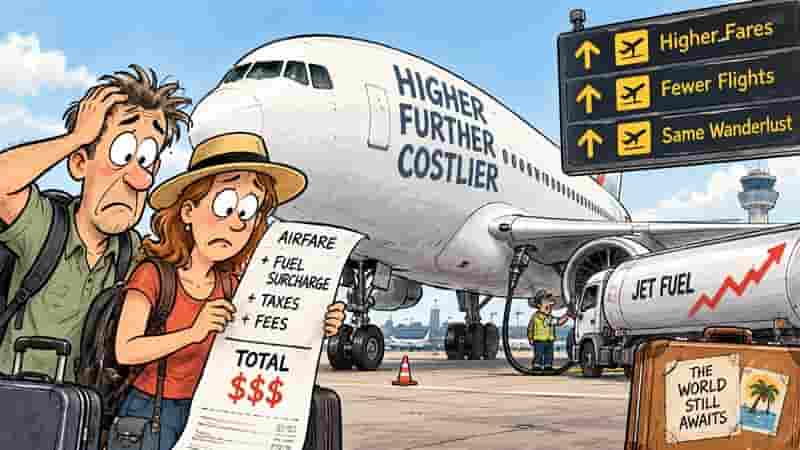
The airline industry’s fuel headache is becoming considerably more expensive, with soaring jet-fuel costs forcing carriers to juggle higher fares, hefty fuel surcharges and capacity cuts as the Middle East conflict continues to disrupt global energy markets.
For Australian travellers, the uncomfortable reality is that the cost of keeping an aircraft in the sky is increasingly being passed on to passengers.
It may be called a fuel surcharge. It may simply appear as a higher airfare. Or travellers may discover fewer cheap seats as airlines trim capacity on routes that no longer stack up commercially.
Whatever the terminology, somebody eventually has to pay the fuel bill and increasingly, passengers are helping to pick up the tab.
Qantas already passing on part of the pain
Australia is hardly immune.
Qantas has confirmed that fuel costs increased significantly after the escalation of the Middle East conflict in March, with jet-fuel prices more than doubling from levels incorporated in its earlier FY26 guidance.
In an April market update, Qantas said it had responded with international network changes, capacity adjustments and fare increases.
The scale of the problem became clearer in its FY26 results.
Qantas reported that passenger revenue increased partly because of “fare increases to partially offset higher fuel costs”, while its annual report said fuel expenses had increased significantly because of the elevated fuel-price environment.
The airline also reported a roughly A$1 billion gross second-half fuel impact before hedging and other mitigation measures.
That makes one point abundantly clear: Australians don’t need to see the words “fuel surcharge” printed separately on a ticket for expensive fuel to hit their wallets.
Korean Air shows how surcharges bite
Korean Air provides a more visible example.
For tickets issued from 1 October 2026, the airline’s international fuel surcharge on flights departing Korea ranges from KRW49,000 to KRW362,600 one way, depending on distance.
Australian routes attract some substantial charges.
The October surcharge on Brisbane is KRW226,800 one way, while Sydney attracts KRW322,000.
Interestingly, not every surcharge is moving in the same direction. Brisbane rises from KRW216,000 in September, while Sydney slips slightly from KRW325,500.
That distinction matters because the current fuel crisis isn’t producing a uniform increase across every airline, route, and market.
Korean Air reviews its international surcharge monthly, with the amount determined by the ticket issue date rather than the travel date.
For travel advisors, it is another reason to look beyond the headline fare when comparing competing international itineraries.
Emirates walks the pricing tightrope
Emirates presents another fascinating case.
Deputy president and chief commercial officer Adnan Kazim said this month that Emirates was approximately half protected against higher fuel costs through its hedging position and half exposed to market movements.
The airline is trying to contain ticket-price increases because pushing fares too high risks suppressing passenger demand.
That is easier said than done when oil and jet-fuel costs remain elevated.
Emirates’ existing surcharge arrangements demonstrate just how substantial these charges can become in individual markets.
For tickets originating in Korea from 1 September, Emirates lists a one-way fuel surcharge to Australia and New Zealand of US$302 in Economy and Premium Economy.
First and Business Class passengers face a remarkable US$958 one-way surcharge.
Those figures apply to the Korean originating market and must not be confused with charges on tickets originating in Australia. Nevertheless, they show how large carrier-imposed fuel charges can be.
Emirates says it announces those surcharges monthly and determines them based on the ticketing date.
JAL feels the heat
Japan Airlines is also feeling the pressure.
JAL operates an established fuel-surcharge mechanism for international passenger tickets, with rates reviewed periodically based on movements in Singapore kerosene-type jet fuel and currency exchange rates.
The Middle East crisis has become significant enough for the Japanese Government to introduce emergency measures moderating the impact of high fuel prices.
The situation is particularly apparent in air cargo.
JAL Cargo reported that the average jet-fuel price during the second half of August reached US$150.97 per barrel.
After taking Japanese Government emergency measures into account, the applicable fuel-price index was placed in the US$140 to below US$145 per barrel range.
For the second half of September, JAL Cargo’s applicable surcharge became ¥150 per kilogram on long-haul Americas and Europe services and ¥80 per kilogram on specified Asian services.
Those numbers further show how dramatically aviation’s fundamental cost equation has shifted.
America starts trimming flights
The consequences are moving beyond ticket pricing.
American Airlines, United Airlines and Southwest Airlines are reducing planned flying as persistently expensive fuel changes the economics of marginal routes.
American estimates its fourth-quarter fuel costs have increased by approximately US$1 billion compared with assumptions made in July.
United has already removed some planned December flying and indicated further adjustments could follow into early 2027 if fuel prices remain elevated.
Southwest has also reduced its planned capacity growth.
Demand remains comparatively resilient, but airlines cannot indefinitely operate marginal services simply to maintain market share when one of their largest variable expenses has surged.
That creates another potential problem for passengers.
Fewer seats can give airlines greater pricing power on routes where demand remains strong.
In other words, expensive fuel can hit travellers twice: first through the direct cost of operating the aircraft and again if reduced capacity puts upward pressure on fares.
Australia particularly exposed
Australia’s geography makes the issue especially important.
Getting Australians to Europe, North America and the Middle East involves some of the world’s longest commercial air journeys, requiring enormous quantities of fuel.
Australia also depends heavily on international aviation for inbound tourism and outbound travel.
Airlines therefore face a delicate balancing act.
Pass too much of the fuel increase onto passengers, and demand can soften. Absorb too much and airline margins suffer. Remove capacity, and the resulting seat shortage can push fares higher anyway.
Qantas has already demonstrated that fare increases and capacity adjustments can form part of the response.
International competitors serving Australia face variations of precisely the same equation.
Frequent flyers should watch the fine print
Another group should pay particular attention: frequent flyers.
An award ticket bought with points isn’t necessarily completely free.
Depending on the airline, loyalty program, itinerary and originating market, travellers can still face taxes, airport charges and carrier-imposed fees.
Consequently, a redemption that initially looks remarkably cheap can become considerably less attractive when the cash component appears on the final booking screen.
Travel advisors comparing frequent-flyer options should therefore examine the complete booking cost rather than simply comparing the number of points required.
Fuel shock is already rewriting airline pricing
The important question now isn’t whether higher fuel costs will affect aviation.
They already are.
The bigger question is how long the elevated prices persist.
Airlines can withstand short-term volatility through hedging, cash reserves, pricing adjustments and operational changes. A prolonged period of expensive jet fuel is much harder.
Emirates’ position illustrates the balancing act neatly. It has substantial fuel protection extending into future financial years but remains exposed to part of the market and is trying to keep ticket prices low enough to protect demand.
Qantas, meanwhile, has already confirmed fare increases and capacity adjustments as part of its response to higher fuel costs.
Across the Pacific, US carriers are reconsidering marginal flying.
And across Asia, established fuel-surcharge mechanisms are translating volatile energy prices into highly visible charges for passengers.
So, are fuel surcharges coming back?
That isn’t quite the right question.
For some airlines and markets, they never went away. What is changing is their scale and significance as expensive fuel once again becomes one of aviation’s defining commercial problems.
Other airlines will recover at least some of the additional expense through the fare itself rather than displaying a separate surcharge.
Either way, Australian travellers and travel advisors should watch fares, carrier charges and capacity particularly carefully over the coming months.
Because aviation’s oldest piece of arithmetic hasn’t changed much since the first commercial aircraft took to the skies.
When fuel becomes expensive enough, somebody eventually pays, and there’s every chance they’re sitting in 37A.
By: Sandra Jones – © 2026.
Read Time: 5 minutes.
Author Bio:
 Sandra has spent a working lifetime quietly rescuing journeys, one itinerary, one anxious caller, one impossible connection at a time. Years in Australia’s finest travel agencies taught her the art of calm, how to find a flight in a fog of cancellations, how to soothe a traveller when luggage wanders, how to turn nine frantic days in Europe into something resembling sense. Qualified, seasoned, endlessly patient, she learned that good travel advice is part logistics, part listening.
But the storyteller in her was always waiting its turn. Writing offered a new map, a way to turn experience into reflection, detail into delight. At Global Travel Media, Sandra now writes the truths only insiders know: the mishaps, the laughter, the grace found between gates and goodbyes. She reminds us that travel, for all its fuss, is still one of life’s better ideas.











