

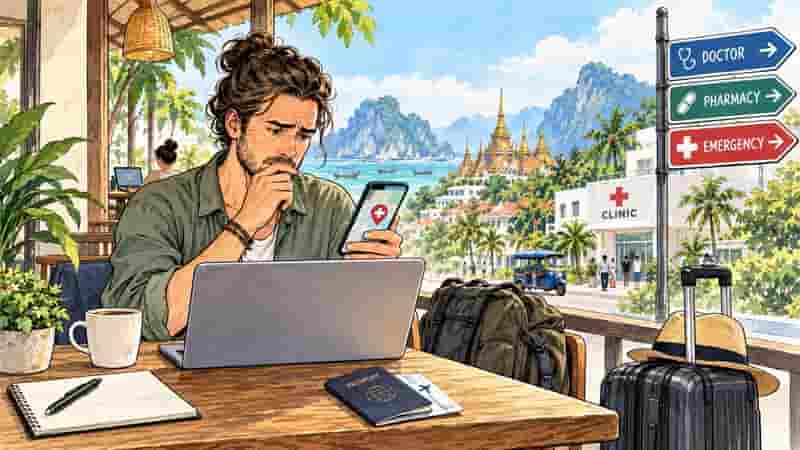
A cheap flat, warm weather and fast Wi-Fi can make a city look perfect. Then you get sick. At that point, the rooftop bar and beach view lose their shine very fast.
That is the point behind the new Holafly Plans Healthcare Index 2026. The study looks at how hard it may be for digital nomads and long-stay travellers to get medical help in 17 countries.
Holafly used seven broad measures. They cover access to doctors and hospital beds, emergency care, health standards, insurance rules, language, specialist wait times, and access to pharmacies. Each country gets a deficit score from zero to 100. A higher score means care may be harder to reach.
One key point to keep in mind: Holafly is an eSIM company, not a health agency. Its index is a commercial research product. Use it as a travel-planning guide, not an official verdict on a nation’s health system.
That said, the issue is very real.
Almost half have put off medical care
Holafly says 47.5 per cent of frequent and long-stay travellers in its research had put off or avoided medical care abroad even when they felt they needed it.
A further 20.3 per cent said they were not sure they could find a doctor or healthcare provider they could trust.
For Australians, that should ring a fairly loud bell.
Medicare does not usually cover treatment overseas. Smartraveller also warns that travellers may have to pay the full cost of medical care themselves and may be asked to pay up-front.
Good travel or expatriate insurance is therefore not optional. It is part of the basic kit along with the passport, laptop and that collection of power adaptors nobody can ever identify at first glance.
Indonesia heads the healthcare challenge list
Indonesia sits at the top of Holafly’s list of the toughest places in the world for digital nomads seeking medical care.
Vietnam ranks second and Thailand third. They are followed by South Africa, Colombia, Malaysia, Mexico, the United Arab Emirates, Peru and Bulgaria.
Indonesia’s result is also supported by broader health data.
The World Health Organisation has reported gaps in the nation’s health workforce and uneven access between regions. In March 2026, WHO said 78.1 per cent of Indonesian public hospitals had the full set of seven basic specialist services.
It also said only 65 per cent of primary healthcare centres met minimum staffing requirements across nine basic health-worker groups. WHO has since continued to identify shortages and uneven distribution of doctors and specialists as challenges to healthcare access in Indonesia.
That does not mean travellers cannot find very good care in Indonesia.
The same applies to Thailand, Vietnam and every other country on the list. Large private hospitals in major cities can differ greatly from clinics in smaller towns, islands, or remote areas.
That is why a country ranking only tells part of the story.
The more useful question is remarkably simple: what medical care can you actually reach from where you are staying?
Vietnam and Thailand also face hurdles
Holafly says Vietnam recorded the weakest emergency-care score in its study. It points to limited emergency infrastructure in Ho Chi Minh City and fewer doctors available.
Thailand’s third-place result reflects a mix of healthcare coverage, language barriers and formal insurance requirements.
At the other end of the table, Germany emerged as Holafly’s strongest overall performer.
The United Arab Emirates recorded the strongest emergency-care result, while Spain had the longest specialist waiting time among the countries reviewed, at close to three months.
Holafly COO Metin Kastro put the issue this way:
“Healthcare is rarely the first thing people look at when choosing where to spend a few months abroad, but perhaps it should be higher on the list. For people living across borders, understanding how easily they could get help if something goes wrong is just as important as understanding what everyday life in a destination will look like.”
Travel advisers have a role to play
For travel advisers, the lesson is clear.
A digital nomad is not simply a holidaymaker carrying a laptop. Many stay away for months. Some move from country to country. They may need cover for long stays, prescription medicines, pre-existing health issues or medical evacuation.
The pre-trip conversation should therefore go well beyond visas, Wi-Fi and where to stay.
Travellers should know the local emergency number. They should find out which reputable hospitals or clinics are close to their home or hotel. They should check whether staff speak English. They should understand how to pay bills.
And they should save their insurer’s emergency contact details somewhere that doesn’t require six passwords and a functioning hotel Wi-Fi network to access.
Smartraveller advises Australians to contact local emergency services immediately in a medical emergency and then contact their travel insurer, most of which have 24-hour assistance lines.
Do not forget the medicine cabinet
Medicines need the same care.
Smartraveller advises Australians to check whether their medication is legal at the destination and available there. Travellers should carry the required prescriptions and supporting medical documentation.
Insurance also needs close reading.
A policy may contain limits or exclusions for pre-existing conditions, certain activities, long stays or medical evacuation. Australians living or working overseas for an extended period should make sure their cover remains valid for the full length of their stay.
The fine print may not be exciting.
Neither is a hospital bill with too many zeroes.
The old travel rule still works rather well: plan for the problem before it becomes your problem.
Digital nomads may have changed the office forever. They have not changed the human body.
Fast Wi-Fi can keep the working day going.
Good access to medical care can keep the traveller going.
In 2026, anyone choosing a long-stay base should check both.
By: Soo James – © 2026.
Read Time: 4 minutes.
Author Bio:
 There’s nothing rehearsed about Soo James, and that’s precisely the point. Malaysian by heritage, Sydney by schooling, she arrived at UNSW to study Arts, then took a left turn into IT, not out of ambition, but curiosity. Somewhere among systems and schedules, she worked out what really held her attention: people, language, and the quiet spaces between them.
Writing followed naturally. Travel and lifestyle gave her room to observe, to listen, to notice the details others rush past. Soo writes like good travellers do: watching the room before admiring the view, catching the gesture before chasing the headline.
At Global Travel Media, her stories don’t shout or sell. They linger. They slow you down, open a door, and gently suggest there’s more to see if you’re willing to look.











