

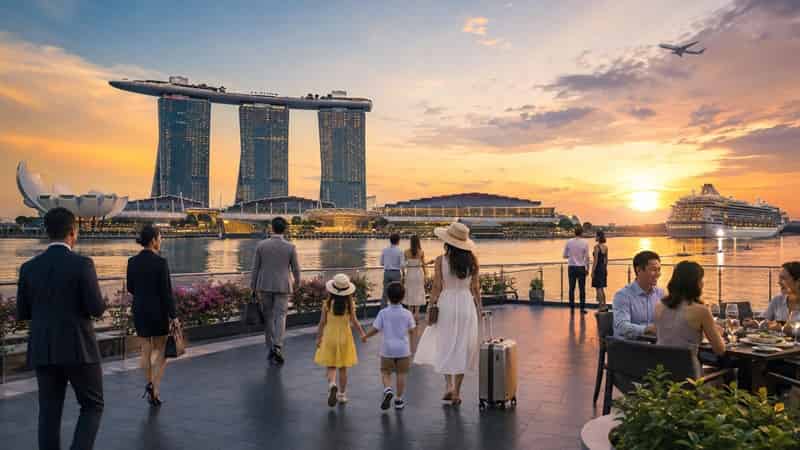
Singapore has never lacked flattering tourism headlines. Record receipts, blockbuster events, gleaming new hotels and another reason to photograph Marina Bay at dusk are hardly scarce commodities.
But the more interesting Singapore tourism story in 2026 is not simply that the city-state is growing.
It is that Singapore is refining what tourism growth is supposed to achieve.
Under its Tourism 2040 strategy, the Singapore Tourism Board wants tourism receipts to grow faster than international visitor arrivals. That does not mean visitor numbers no longer matter. Far from it. Singapore still wants more travellers. The difference is that it also wants each visit to work harder economically, experientially, and increasingly across more parts of the destination.
That is a considerably more sophisticated story than “Singapore is booming”.
In 2025, Singapore welcomed 16.9 million international visitors and generated a record S$32.8 billion in tourism receipts. The year established a formidable base for the next phase of growth.
Then 2026 supplied the useful reminder that tourism rarely travels in a perfectly straight line.
From January to July 2026, Singapore recorded about 9.8 million international arrivals, down 1.9 per cent from the corresponding period in 2025. Yet in the first quarter alone, tourism receipts climbed 5.8 per cent year-on-year to S$8.6 billion, while visitor arrivals increased by 2.9 per cent to 4.4 million.
That is precisely why yield deserves more attention than another simple arrivals league table.
Singapore’s real scoreboard is changing
Tourism 2040 provides the clearest indication of where Singapore is heading.
STB projects tourism receipts of S$47 billion to S$50 billion by 2040 and has said it intends receipts to grow faster than international visitor arrivals. The strategy is built around three broad priorities: cultivating future demand, strengthening Singapore as a destination and developing a future-ready tourism sector.
In plain travel-industry English, Singapore wants more than heads in beds.
It wants visitors who stay longer, spend across more categories, attend events, dine, shop, cruise, explore neighbourhoods and return. It also wants tourism enterprises that can deliver those experiences efficiently and profitably.
Yield management is not particularly glamorous. It will never photograph as well as the Supertrees.
But for a mature, land-constrained destination with high operating costs, it is difficult to think of a more important commercial discipline.
MICE becomes a high-value engine
Meetings, incentives, conferences and exhibitions sit squarely at the centre of that strategy.
Singapore’s MICE tourism receipts reached S$2.3 billion in 2025, up more than 35 per cent from S$1.7 billion in 2024. Singapore also retained its leading Asia-Pacific meeting-city position in the International Congress and Convention Association rankings, with 156 qualifying meetings recorded for 2025.
The reason MICE matters is simple: business-event visitors are valuable.
STB says a MICE visitor spends, on average, about twice as much as a leisure visitor. Singapore aims to triple MICE tourism receipts by 2040, with STB targeting around S$4.5 billion.
The physical infrastructure is being planned accordingly.
Singapore has identified the Straits View area near Marina Bay as the potential location for a Downtown MICE Hub. The proposed integrated development is intended to combine large-scale meeting facilities with accommodation, dining, retail, entertainment and attractions. STB plans to launch a request for proposal in 2027.
That combination matters.
The delegate who merely attends a convention has value. The delegate who also stays two extra nights, books a restaurant, shops, visits an attraction and brings a partner has considerably more.
Even the most romantic travel writer eventually has to admit that the spreadsheet has a point.
Cruise gives Singapore another route to higher yield
Cruise is following the same logic.
Disney Adventure departed Singapore on its maiden voyage on 10 March 2026 and is operating three- and four-night cruises from its Singapore homeport.
Royal Caribbean International’s Navigator of the Seas is also scheduled to homeport in Singapore between October 2026 and February 2027, offering itineraries ranging from short regional escapes to longer Asian voyages.
For Singapore, these ships are not merely floating attractions.
They create an opportunity to turn cruise passengers into Singapore visitors before and after sailing.
A three-night cruise can become a five-night holiday. A family arriving for Disney Adventure can add Mandai, Sentosa, Gardens by the Bay, neighbourhood dining and a hotel stay. A Royal Caribbean passenger can be sold a city break before heading to the terminal.
That is the sort of incremental spend destinations covet because it spreads value across hotels, restaurants, transport, retail and attractions rather than leaving it inside a single tourism product.
Singapore’s cruise industry was already showing momentum in 2025, with 375 ship calls and passenger throughput exceeding two million.
The message to travel advisors is obvious: sell Singapore with the cruise, not merely as the place where the cruise begins.
The visitor is being encouraged to leave the postcard
Another important part of Singapore’s strategy is geographic.
On 11 August 2026, STB and Grab launched a three-month campaign encouraging visitors to explore precincts including Katong-Joo Chiat, Mandai and Sentosa.
The campaign also offers incentives for rides to and from Clarke Quay and Boat Quay between 7 pm and 4 am.
At first glance, a ride voucher might appear rather less consequential than a new airport terminal or cruise ship.
Commercially, it makes perfect sense.
Every extra precinct visited creates another opportunity for food, drinks, shopping, attractions and experiences. Every additional evening spent out rather than in a hotel room gives the visitor economy another chance to earn revenue.
The strategy also helps Singapore distribute tourism beyond its most famous central icons.
Marina Bay will survive without another photograph. Katong’s Peranakan streets, Mandai’s wildlife experiences and the city’s after-dark economy have more to gain from the additional foot traffic.
The point is not simply to move tourists.
It is to make a short Singapore stay feel richer and therefore more valuable.
Australians remain a prized market
Australia remains particularly important.
Singapore received about 1.3 million Australian visitors in 2025, making Australia one of its five largest source markets.
For January to September 2025, Australian visitors generated S$1.54 billion in tourism receipts, excluding Sightseeing, Entertainment and Gaming because STB does not publish that component in its country-level analysis due to commercial sensitivities.
That distinction is important: the S$1.54 billion figure is not a full-year 2025 total.
The momentum continued into the first quarter of 2026. Australia generated S$533.3 million in tourism receipts, excluding the same component, up 1.2 per cent year on year. During the quarter, 311,886 Australian visitors travelled to Singapore, up 1.2 per cent from a year earlier.
Australia’s strategic value is hardly mysterious.
Singapore sits naturally astride major Australian routes into Asia and Europe, and Changi Airport is already deeply familiar to Australian travellers.
The challenge is converting familiarity with the airport into greater engagement with the destination.
For years, Changi has been so good at being an airport that it has occasionally risked becoming Singapore’s main attraction for transit travellers.
A magnificent waterfall is all very well, but tourism authorities would understandably prefer visitors to venture outside before boarding the next flight.
Connectivity is also broadening.
Jetstar introduced same-plane services connecting Newcastle and the Sunshine Coast with Singapore via Bali in March 2026. These are one-stop services, not nonstop flights to Singapore an important distinction.
Singapore Airlines, meanwhile, is scheduled to begin daily nonstop services between Changi Airport and Western Sydney International Airport on 23 November 2026.
Those links create fresh opportunities for Singapore stopovers and holidays, particularly from markets beyond Australia’s traditional Sydney, Melbourne, Brisbane and Perth gateways.
Changi’s latest numbers add useful perspective
Changi Airport itself illustrates why the Singapore story needs nuance.
The airport handled 17.2 million passenger movements in the second quarter of 2026, down 1.5 per cent from the same quarter in 2025.
Across the first half of the year, however, passenger traffic remained 0.4 per cent higher year-on-year.
July brought 5.88 million passenger movements, down 1.4 per cent from July 2025. Changi Airport Group’s figures were current to 21 August 2026.
Those are hardly crisis numbers.
Equally, they are not an excuse to fire the confetti cannon.
Singapore is instead planning for the long term.
Changi’s Terminal 5 is expected to become operational around the mid-2030s and, in its first phase, will handle about 50 million passenger movements annually.
That is classic Singapore: pay close attention to this quarter’s arithmetic while building infrastructure for the next generation.
Hotels face the same value test
Singapore’s hotel sector has more than 450 properties and over 73,000 rooms and contributes approximately 20 per cent of total tourism receipts.
More hotel supply is coming to market.
STB said in October 2025 that more than 1,500 additional hotel rooms were expected to open by the end of 2026. As this remains a forecast rather than a completed addition, it should be treated accordingly.
But new rooms alone do not guarantee profitable growth.
Singapore competes with Bangkok, Tokyo, Hong Kong, Kuala Lumpur, Bali and other destinations investing aggressively in luxury, lifestyle, wellness and experiential hospitality.
High operating costs and demanding, well-travelled guests make differentiation essential.
STB continues to support hotel transformation through its Hotel Rejuvenation Fund, which assists renovation and refurbishment projects aimed at improving guest experiences, operational efficiency and sustainability.
Quite right too.
A traveller paying a premium room rate is unlikely to be consoled by national tourism statistics if the room itself feels tired.
Quality tourism must eventually survive contact with the guest.
S$740 million says Singapore is serious
The Government has also put substantial funding behind Tourism 2040.
At the Tourism Industry Conference in May 2026, Singapore announced a new S$740 million tranche for the Tourism Development Fund over the next five years.
The funding supports the broader Tourism 2040 agenda, including tourism development, technology, industry capabilities, events and new visitor experiences.
That investment matters because Singapore is pursuing its strategy in a difficult regional and global environment.
Competition across Asia is intense. Air capacity can shift quickly. Travellers remain value-conscious. Operating costs are high. Geopolitical and economic uncertainty can alter booking behaviour almost overnight.
Singapore’s own published outlook for 2026 has therefore been measured.
STB forecasts 17 million to 18 million international visitor arrivals and S$31 billion to S$32.5 billion in tourism receipts for 2026, while warning that global economic uncertainty and political instability could affect travel patterns.
The softer arrival numbers through July make that caution look sensible.
Forget the boom story; watch the yield
So, is Singapore tourism booming?
That question is becoming less useful.
The better question is whether Singapore can increase the economic and experiential value created by tourism while preserving its attractiveness as a place to live, visit and invest.
Its strategy suggests the answer will depend on a broad collection of moving parts.
MICE visitors need to stay and spend.
Cruise passengers need to become land visitors.
Transit passengers need to become stopover guests.
Hotel investment needs to produce better experiences rather than simply more keys.
Visitors need reasons to venture into precincts, remain out after dark and extend their stays.
At the same time, Singapore still needs visitor growth.
This is not value instead of volume. It is value ahead of volume as the primary measure of tourism quality.
That distinction is important.
Every successful destination eventually confronts constraints. Airports become busy. Land becomes dearer. Attractions become crowded. Residents rightly expect tourism to contribute more than foot traffic.
Singapore’s answer is increasingly clear: grow demand, certainly, but make that demand more productive.
For the travel industry, that creates opportunity.
The advisor who sells an extra night in Singapore contributes to the strategy. The hotel that persuades a guest to return does too. The conference organiser, cruise line, airline and attraction all become parts of the same yield equation.
Measuring tourism by what it contributes, rather than by how many passports cross the border, may be less dramatic.
But seasoned operators know the old truth.
Crowds make photographs.
Revenue pays the bills.
By: Christine Nguyen – © 2026.
Read Time: 8 minutes.
Author Bio:
 Christine’s story is one of quiet courage, told without fuss and lived with remarkable grace. She arrived in Australia as a young refugee from Vietnam, carrying little more than hope, family, and a curiosity that refused to be extinguished. Sydney became home, built patiently, brick by careful brick.
She studied Tourism at TAFE and soon found her place in inbound travel, working with one of the city’s leading destination companies. Christine loved showing visitors the Australia that lives beyond postcards, warmer, truer, and far more interesting.
When the sea began to whisper, and life asked for a gentler rhythm, she listened. Designing brochures, writing blogs, she discovered storytelling waiting quietly inside her.
Today, at Global Travel Media, Christine writes with warmth and wisdom, reminding us, softly and persuasively, why travel still matters.











