

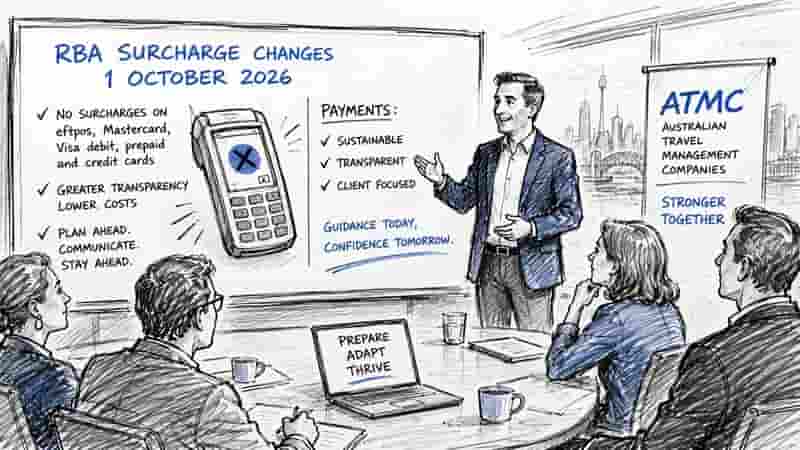
Australia’s corporate travel sector is being urged to get its payment house in order, with the Association of Travel Management Companies (ATMC) putting the looming RBA surcharge changes firmly on the agenda at its July member meeting.
The session brought ATMC members together with payments specialists from American Express, Mint Payments and WEX, according to material supplied by ATMC. Their task was timely: help travel management companies understand what changes on 1 October 2026, and what those changes could mean for client payments.
And October is suddenly looking rather close.
The Reserve Bank of Australia has confirmed that surcharging on designated eftpos, Mastercard and Visa debit, prepaid and credit card payments will end from 1 October. American Express has separately decided to remove surcharging from the same date.
Importantly for the corporate travel sector, the RBA says business-to-business card payments are not automatically exempt. Card-network rules or another legal exemption would be required for different treatment.
That gives travel management companies rather more to consider than simply removing a line from an invoice.
Card acceptance costs do not magically disappear when surcharges do. The RBA says businesses will continue to incur those costs and may instead build them into their overall pricing. At the same time, lower interchange caps and greater fee transparency are intended to reduce merchant costs and make it easier to compare payment providers.
For an industry already balancing airfares, hotel rates, client policies, technology costs and travellers who occasionally regard an expired passport as somebody else’s problem, early preparation would appear prudent.
ATMC Chair David Goldman, who is confirmed as the association’s 2026 chairperson, said the July session provided members with both practical guidance and broader commercial context.
“With the October changes fast approaching, this session gave our members clear guidance on what’s changing and why, alongside a bigger-picture view of payments as a more sustainable and transparent approach to client payments.”
Goldman added:
“For corporate travel management companies navigating these reforms with their clients, that combination of regulatory clarity and commercial insight is invaluable.”
The issue goes directly to the commercial mechanics of corporate travel. TMCs now have a relatively short window to review payment processes, client agreements, pricing structures and communications before the new arrangements arrive.
ATMC’s regular industry forums are therefore taking on added importance. The organisation says its role includes keeping members informed on policy reform, technology shifts, distribution change and wider structural issues affecting corporate travel.
The practical message from July is difficult to miss.
1 October 2026 is not simply another date in the diary. For travel management companies, it is a deadline to understand costs, speak with payment providers and ensure clients know exactly how the new payment environment will work.
Better to tackle that conversation now than discover in October that the surcharge has departed while the cost most certainly has not.
By: My Thanh Pham – © 2026.
Read Time: 2 minutes.
Author Bio:
 My Thanh Pham has lived more of a life of travel than most people ever do. After studying tourism, she went straight into the work of building journeys across South-East Asia, temples, beaches, night trains, and all, quietly fixing the messy bits so others could enjoy the ride.
She was never meant to stay behind a desk. Airline life followed, dividing her days between reservations and the airport floor, right where travel shows its true colours. Missed flights, tight hugs, frayed tempers, sudden joy- she saw it all, close up.
Now at Global Travel Media, My Thanh has traded ticket stubs for a keyboard. She writes the way she once worked: steady, clear-eyed and respectful of the road’s unpredictable rhythm, guiding readers through a world she knows from the inside.











