

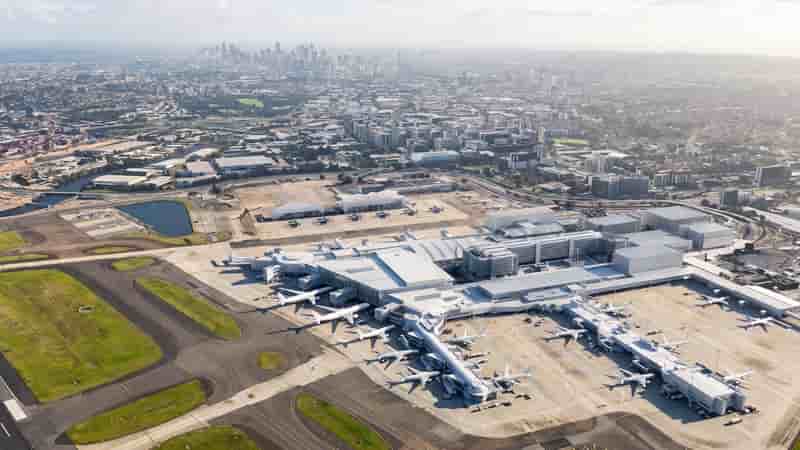
Sydney Airport has the green light for its next big chapter. The Australian Government has approved Master Plan 2045, giving the nation’s busiest airport a 20-year map for growth.
Transport Minister Catherine King approved the plan on 14 August 2026. It lets Sydney Airport plan more terminal space, better links, new passenger facilities and extra freight capacity.
For the travel trade, the scale is hard to miss. Sydney Airport expects 72.6 million passenger movements a year by 2045, a rise of 75 per cent from the plan’s base level. The total includes 36.4 million international passengers and 36.2 million domestic and regional passengers.
Put another way, Sydney’s front door to the world is preparing for a great many more people to walk and now and then sprint through it.
Sydney Airport CEO Scott Charlton said: “As Sydney grows, Sydney Airport must grow with it.”
The airport says its yearly contribution to the economy could reach $70.6 billion by 2045. Direct jobs at the airport are also forecast to rise beyond 105,000. Air freight is tipped to climb from 600,000 tonnes in 2024 to 1.4 million tonnes in 2045.
Terminal plan puts connections first
A key part of Master Plan 2045 is a proposed remake of the domestic precinct. The long-term plan would create a more connected area across T2 and T3, bringing domestic, regional and future international services closer together. The plan also includes expanding the international T1 terminal.
That could be good news for travellers with tight connections. Anyone who has moved bags between Sydney’s separate domestic and international terminals knows that a smoother transfer is no small luxury.
The goal is simple: create room to grow while keeping Sydney at the front of Australia’s aviation gateways.
King captured the philosophy behind the plan in one particularly memorable line: “Airports aren’t artworks, they’re constantly evolving.”
Growth, however, comes with some firm homework.
The Government has asked Sydney Airport to keep working on noise-abatement measures as traffic rises. It must also continue consulting with the Sydney Airport Community Forum and work with Transport for NSW and neighbouring councils on pressure placed on local roads.
One notable point for nearby residents. The Government says the airport’s projected 2045 noise footprint will be lower than current levels, despite expected activity growth.
Greener growth joins the flight plan
Master Plan 2045 also incorporates Sydney Airport’s five-year Airport Environment Strategy. It sets out work to reduce emissions, strengthen climate resilience, and support more sustainable airport operations.
That matters. A bigger airport cannot be judged only by how many people it can move. It must also show that growth can be safe, sound and responsibly managed.
For airlines, travel agents, tour operators and the wider visitor economy, the approval offers much-needed long-range certainty.
International passenger movements are forecast to rise 123 per cent above 2024 levels, while domestic and regional passenger movements are forecast to increase 44 per cent.
Freight also gets a considerably bigger seat at the table. The Government says passenger aircraft could carry as much as 80 per cent of future air-freight volumes, making efficient baggage, freight and ground-handling systems central to Sydney Airport’s next era.
The Master Plan is, importantly, a long-term planning framework rather than a starting pistol for every proposed piece of concrete. Its approval does, however, settle Sydney Airport’s broad strategic course through to 2045.
And that course points firmly upwards.
Sydney sells itself with its harbour, beaches and unmistakable skyline. Yet for millions of overseas visitors, their first taste of the city is still an airport gate, a baggage carousel and that universally cherished sight: a queue that appears to be moving.
By 2045, Sydney Airport plans to be ready for many more.
By: Michelle Warner – © 2026.
Read Time: 3 minutes.
Author Bio:
 Michelle Warner has always carried stories the way others carry passports lightly, faithfully, and with purpose. She learned her craft in newsrooms, shaping sentences with care, before swapping deadlines for departures as a flight attendant with some of the world’s great airlines. Years aloft sharpened her eye for character and deepened her fondness for the small, dignified rituals of travel, the quiet kindness of strangers, the poetry of arrival, the patience learned between time zones.
Now grounded by choice, Michelle has come home to writing with the same calm authority she once brought to turbulent cabins. Her prose blends an editor’s discipline with a traveller’s wonder, tinged with humour and reverence for the golden age of travel. Each piece feels like a handwritten boarding pass, gracious, observant, and unmistakably alive.











