

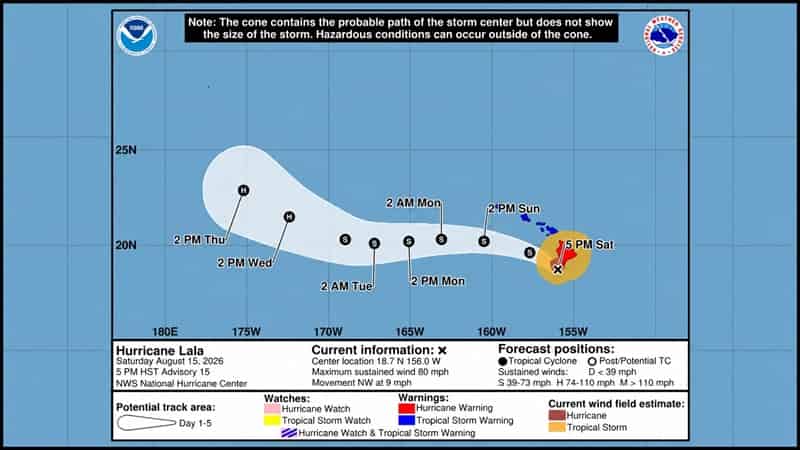
Hurricane Lala has swept past the southern tip of Hawai‘i Island without making an official landfall, but the storm is not leaving quietly. Damaging winds, flooding rain and dangerous surf continue to threaten communities and disrupt travel across the Hawaiian Islands.
The centre of Lala passed south of Hawai‘i Island late on Saturday afternoon. At 5 pm HST, it was approximately 30 miles 48 kilometres south-west of South Point and moving north-west at about 8 mph, or 13 km/h.
Maximum sustained winds were estimated at 75 mph, or 120 km/h, making Lala a Category 1 hurricane. Although the eye remained offshore, the storm’s reach has extended well beyond that neat circle on the map. Hurricanes, like troublesome relatives, need not cross the threshold to rearrange the furniture.
A Hurricane Warning remains in effect for Hawai‘i Island and its surrounding waters. Tropical Storm Warnings cover Maui County, O‘ahu, Kaua‘i and their coastal waters.
The latest National Weather Service Honolulu forecast says Lala will continue west-northwest, remaining south of the smaller islands through Sunday evening. Powerful winds, heavy rain and hazardous surf will nevertheless be felt statewide.
Winds top 100 mph over mountain summits
Hurricane conditions are expected to persist around Hawai‘i Island into Saturday night. Tropical-storm-force winds have spread across Maui County and O‘ahu, with conditions forecast to reach Kaua‘i during the night and continue through Sunday.
The strongest gusts have been recorded over elevated terrain and immediately downwind of mountains. According to the National Weather Service, winds exceeding 100 mph—161 km/h—have been observed at summits on Hawai‘i Island and Maui.
Travel in exposed and mountainous areas is strongly discouraged. Visitors should remain inside their accommodation, away from windows, and follow instructions from hotel staff, emergency managers and local authorities.
Bring loose balcony furniture inside where it is safe to do so. Mobile phones, portable batteries and essential medical equipment should remain charged while electricity is available.
Flooding becomes Lala’s gravest threat
Wind may command the headlines, but water often writes the more damaging chapter.
Heavy rain is continuing across Hawai‘i Island and Maui County and spreading towards O‘ahu and Kaua‘i. Flash flooding and rapidly rising streams have already been reported, while saturated slopes raise the prospect of dangerous landslides and mudslides.
Windward districts of Hawai‘i Island could receive a further six to 10 inches—approximately 150 to 250 millimetres—of rain, with higher local totals possible.
Windward Maui may receive eight to 12 inches, while as much as eight inches could fall elsewhere across the island chain. Leeward districts are not immune, and intense downpours may persist in some areas into Monday.
A Flood Watch remains in effect across the state, although expiry times vary between islands.
Visitors must not drive, walk or cycle through floodwater. Roads can disappear surprisingly quickly beneath fast-moving water, and a hire car’s insurance policy is unlikely to recognise “the satnav told me to” as a sound navigational defence.
Dangerous surf and coastal damage expected
Lala has generated a powerful easterly swell, bringing very large and chaotic seas to exposed eastern and south-eastern shores.
A High Surf Warning remains in effect for east-facing shores of Hawai‘i Island, Maui, Moloka‘i and O‘ahu. A High Surf Advisory covers eastern and southern Kaua‘i.
Forecasters warn of damaging surf, severe beach erosion and water washing across vulnerable coastal roads and infrastructure. Storm surge of up to three feet—about 90 centimetres—is possible along the eastern side of Hawai‘i Island.
Beaches are not viewing platforms during a hurricane. Visitors should remain well away from shorelines, cliffs, harbours, coastal paths and other exposed locations, regardless of how impressive the photographs might appear on social media.
Visitors told to shelter and avoid airports
The Hawai‘i Tourism Authority has advised visitors already in the islands to remain at their hotel or accommodation during severe weather and obey directions from staff and emergency authorities.
Airport terminals are not designed to serve as storm shelters. Travellers should check directly with their airline before leaving their accommodation and should not travel to an airport unless their flight is confirmed and local conditions allow a safe journey.
Airlines remain the best source for flight cancellations, delays and rebooking arrangements. Passengers should use official airline websites and apps, check that their contact details are current and enable mobile notifications.
Tours, cruises, transfers and attractions may close or alter operations at short notice. Current closures listed by the official GoHawaii Hurricane Lala visitor page include:
- Haleakalā National Park, with sunrise reservations cancelled
- Honolulu municipal parks and botanical gardens
- Nāpali Coast State Wilderness Park, including the Kalalau Trail
- Kaua‘i state parks, including Polihale State Park
- Ha‘ena Shuttle services on Saturday and Sunday
Hanauma Bay Nature Preserve is also closed through 19 August for previously scheduled construction unrelated to Lala.
Hotels remain open, and travellers booked to visit Hawai‘i in the coming weeks have not been advised to cancel future holidays. However, anyone travelling during the immediate storm period should confirm flights, accommodation and transfers before departure.
Official advice not social-media guesswork
Visitors and travel advisers should monitor the National Hurricane Centre, National Weather Service Honolulu and Hawai‘i Tourism Authority alerts for changes.
County emergency alerts are also available:
- Hawai‘i Island: Text HAWAIIALERTS to 888777
- Maui, Lāna‘i and Moloka‘i: Text MAUIALERTS to 38276
- O‘ahu: Text HNLALERT to 888777
- Kaua‘i: Text KAUAIEMA to 888777
The Hawai‘i Emergency Management Agency provides official county alert links, radio information and emergency contacts.
Lala is forecast to weaken as it travels away from Hawai‘i Island, but statewide danger has not passed. Heavy rain will continue moving west, and hazardous conditions may remain long after the hurricane’s centre has departed.
The message for travellers is reassuringly old-fashioned: stay inside, listen to the authorities, keep off flooded roads and let trained emergency teams do their work. Hawai‘i will still be beautiful when the weather clears—and it will look considerably better from somewhere safe.
Weather conditions, warnings and transport arrangements can change rapidly. Readers should check the linked official sources immediately before acting.
By: Jason Smith – © 2026.
Read Time: 5 minutes.
Author Bio:
 Jason Smith didn’t learn travel from textbooks. He learned it in airports, taxis and hotel lobbies, watching the business unfold long before he played his own part. Half American, half Asian, he grew up around the quiet workings of tourism, where people come and go, and stories rarely stand still.
Bangkok came first, then formal study, then a career that carried him through Singapore, Malaysia and Vietnam. Each place left something behind. In the end, Thailand felt like home, along with a senior role in hotel sales.
Then everything stopped. Borders shut, planes grounded, and Jason found himself back in America with time to reflect.
Now at Global Travel Media, he writes travel as it really is, not polished, not perfect, but human, and all the better for it.











