

SWISS revenue climbs, but dearer fuel leaves earnings flying into a stiff financial headwind.
Swiss International Air Lines has delivered a resilient first-half result for 2026, proving that while an airline cannot control the price of fuel, geopolitics or the occasional tantrum from an aircraft engine, it can still keep a firm hand on the controls.
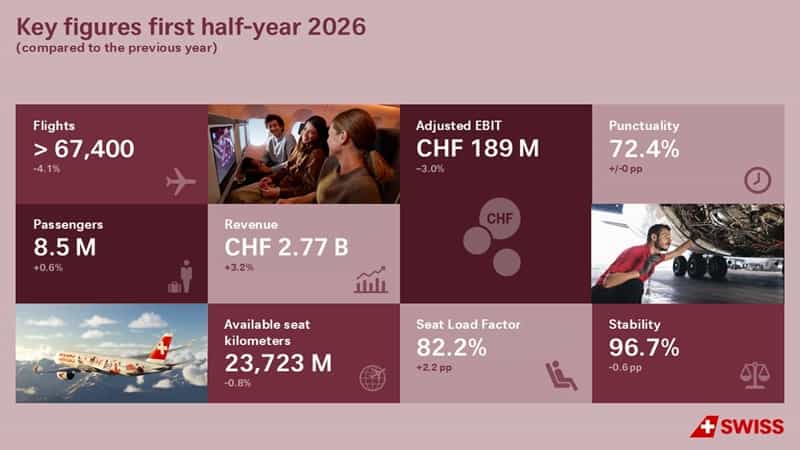
SWISS reported Adjusted EBIT of CHF189.3 million for the six months to 30 June 2026. That was 3.0 per cent below the CHF195.1 million recorded a year earlier, despite total revenue climbing 3.2 per cent from CHF2.69 billion to CHF2.77 billion.
The figures present a curious but increasingly familiar aviation picture: aircraft were fuller, premium demand remained strong, and revenue grew, yet operating earnings still lost altitude.
The principal culprit was fuel. Jet fuel costs rose by about 50 per cent between April and June as the conflict involving Iran disrupted energy markets and sharply increased prices. Fuel is SWISS’s single largest cost item, which means even a modest movement can cause considerable financial turbulence. A 50 per cent jump is less a movement than a determined charge down the runway.
The company’s fuel hedging provided some protection, but not enough to prevent the higher prices from weighing heavily on second-quarter earnings.
SWISS Chief Financial Officer Dennis Weber said the airline had managed an exceptionally testing period with discipline.
“We met the extraordinary challenges with which we were confronted over the last few months well,” Weber said. “But the substantial rises in fuel costs significantly depressed our earnings, despite the hedges we held. Between April and June, fuel costs increased by around 50 percent. Fuel is our single largest cost item.”
He said cost-saving and efficiency measures introduced earlier had already started to soften the financial blow.
“Crucially, however, the savings and efficiency measures that we initiated at an early stage are already having an impact, and are helping us to at least partially mitigate the higher jet fuel prices. If it had not been for these, we would have reported a steeper year-on-year first-half earnings decline.”
The result confirms that SWISS’s immediate challenge is not attracting travellers. They are arriving in respectable numbers and, importantly, many are paying for premium seats. The harder job is converting that demand into stronger profits while fuel, maintenance and operational costs continue to rise.
Premium passengers provide financial lift
Demand for premium-class travel on SWISS’s long-haul network remained particularly healthy during the half. Higher yields and fuller aircraft helped support revenue, giving the carrier a valuable cushion against its escalating cost base.
Premium cabins matter enormously to a network airline. First and business-class passengers occupy a relatively small portion of the aircraft but can make an outsized contribution to route profitability. Economy may fill the aeroplane; premium travellers often help pay for it.
“We were pleased to see favorable trends in both our yields and our load factors in the first-half period,” Weber said. “Demand for our premium travel classes on our long-haul routes in particular remained encouragingly high, and helped bolster our earnings for the period.”
He nevertheless cautioned that strong demand and disciplined spending could not fully offset higher fuel costs.
SWISS also received a temporary commercial boost when several Middle East-based carriers reduced capacity early in the second quarter. Travellers seeking alternative connections, particularly between Europe and Asia, shifted towards SWISS services.
That additional demand lifted revenue, but it was always likely to be temporary. As Gulf airlines restored capacity, the advantage gradually faded. In aviation, a rival’s retreat may provide an opening, but rarely a permanent invitation to rearrange the furniture.
More passengers carried on fewer flights
SWISS transported approximately 8.5 million passengers during the first six months of 2026, an increase of 0.6 per cent over the comparable period.
It achieved that growth while operating more than 67,400 flights, 4.1 per cent fewer than in the first half of 2025. Available seat-kilometres, the industry’s standard measure of passenger capacity, declined 0.8 per cent.
Traffic measured in revenue passenger-kilometres increased 1.9 per cent. As a result, the systemwide seat load factor improved by 2.2 percentage points.
In plain English, SWISS flew fewer services and offered marginally less capacity, yet carried slightly more passengers over a greater combined distance. Its aircraft were being used more productively and leaving with fewer empty seats — welcome news for both the accounts department and anyone who dislikes watching an unoccupied window seat enjoy the scenery for free.
“Our customers’ desire to travel remains undimmed,” Weber said. “While we slightly reduced our capacity in the first-half period, we were still able to sell more seats and raise our load factors. Which tells us that many people consciously decide to use SWISS as their airline and put their trust in us and our services.”
The second quarter provided an even clearer view of the competing forces at work. Revenue rose 5.6 per cent to CHF1.55 billion, and passenger numbers increased 1.4 per cent to approximately 4.9 million. However, Adjusted EBIT fell 16.9 per cent, from CHF191.7 million to CHF159.3 million, as the sharp rise in fuel costs took effect.
Reliability holds amid operational pressure
The airline maintained first-half punctuality at 72.4 per cent, unchanged from the previous year. Schedule stability reached 96.7 per cent, slightly below the 97.3 per cent achieved in the first half of 2025.
Those figures were recorded against a difficult operating background that included geopolitical uncertainty and several extreme weather events.
A punctuality rate of 72.4 per cent also indicates that there remains room for improvement. Reliability is central to a premium airline’s proposition: a beautifully presented cabin is always welcome, but it becomes less enchanting when the departure board insists on an extended courtship.
SWISS said progress had been made in easing resource shortages and improving fleet planning. The carrier had entered 2026 expecting annual production to fall below the previous year’s level. It now believes it can broadly match 2025 production through additional pilot-training measures and targeted cooperation with wet-lease partners.
This revised outlook is commercially significant. It suggests that the airline is gradually securing enough aircraft and crew capacity to protect its schedule and capture continued demand.
Engine maintenance remains an expensive complication
Fuel was not the only cost pressure during the half. SWISS continued to incur elevated maintenance expenses associated with previously disclosed engine problems affecting part of its short-haul fleet.
Aircraft-engine availability has become a persistent challenge across the global airline industry. Longer workshop turnaround times and increased servicing requirements can leave aircraft grounded, disrupt schedules and force carriers to lease additional capacity.
For SWISS, the engine issue reinforces the need to control expenditure elsewhere. Weber made clear that management would concentrate on the costs it can influence rather than wait for external markets to become more accommodating.
“Fuel price trends are beyond our control,” he said. “So it’s all the more vital that we take consistent care of our costs in all those areas in which we are not solely exposed to market developments.”
The airline says its savings program is now producing measurable gains in controllable expenditure. Still, Weber acknowledged that a lasting improvement in profitability would take time.
“Initial progress can already be seen,” he said. “But a sustainable improvement in our profitability still remains some way ahead.”
A transition year, with growth targeted from 2027
SWISS continues to describe 2026 as a transition year. Management is using the period to strengthen the airline’s cost base, improve the use of aircraft and crews, and prepare for sustainable profit growth from 2027.
The strategy is not simply about trimming expenditure. SWISS intends to continue investing in its products, service and overall passenger experience while directing resources towards areas that create the greatest commercial value.
Chief Executive Jens Fehlinger said the airline’s role as Switzerland’s principal international carrier became even more important during uncertain periods.
“As the last few months have proved, SWISS remains a reliable travel partner in testing times, too,” Fehlinger said. “When the world is a less certain place, people and organizations need to count more than ever on having sound air connections. We help keep Switzerland reliably linked with Europe and the world. And we bear this role and responsibility day after day.”
SWISS is part of the Lufthansa Group and a member of Star Alliance. It operates from Zurich and Geneva, while its Swiss WorldCargo division specialises in high-value, time-sensitive and care-intensive freight.
For travel advisers and corporate buyers, the result carries an encouraging message. Demand remains strong, premium cabins continue to perform, and SWISS expects to preserve annual production at broadly the previous year’s level.
The warning is equally clear. Fuel markets remain volatile, geopolitical risks are substantial, booking patterns are becoming more short-term and engine-related maintenance costs have not disappeared into the Alpine mist.
SWISS has not escaped the storm, but it has not surrendered much altitude either. Revenue is rising, aircraft are fuller, and efficiency measures are beginning to work. If fuel prices moderate and operational constraints ease, the groundwork being laid in 2026 could provide a credible departure point for stronger growth in 2027.
That, in airline accounting terms, is not quite clear blue sky — but there is at least a promising break in the cloud.
Key results at a glance
| Measure | H1 2026 | Year-on-year change |
|---|---|---|
| Total revenue | CHF2.77 billion | +3.2% |
| Adjusted EBIT | CHF189.3 million | −3.0% |
| Passengers carried | About 8.5 million | +0.6% |
| Flights operated | More than 67,400 | −4.1% |
| Available seat-kilometres | — | −0.8% |
| Revenue passenger-kilometres | — | +1.9% |
| Systemwide seat load factor | — | +2.2 percentage points |
| Punctuality | 72.4% | Unchanged |
| Schedule stability | 96.7% | −0.6 percentage points |
Figures and quotations were checked against the official SWISS first-half results announcement, published on 4 August 2026.
By: Charmaine Lu – © 2026.
Read Time: 6 minutes.
Author Bio:
 Charmaine has always carried a quiet kind of courage. She grew up in Shanghai, a city that never slows, yet found her own balance there studying accounting for discipline and the arts for beauty. She needed both, and she knew it.
When she arrived in Sydney in the 1980s, she brought little more than a degree, a suitcase and the resolve to begin again. The harbour breeze felt like permission. She met Stephen, and together they built a life that bridged two cultures: a family, a home, plenty of laughter.
Work was never just work. Long before search engines ruled the day, Charmaine was helping businesses be found by telling stories people wanted to read. That remains her quiet gift.
Her life isn’t a résumé. It’s grace under change, structure, and creativity, held together by a generous heart.











