

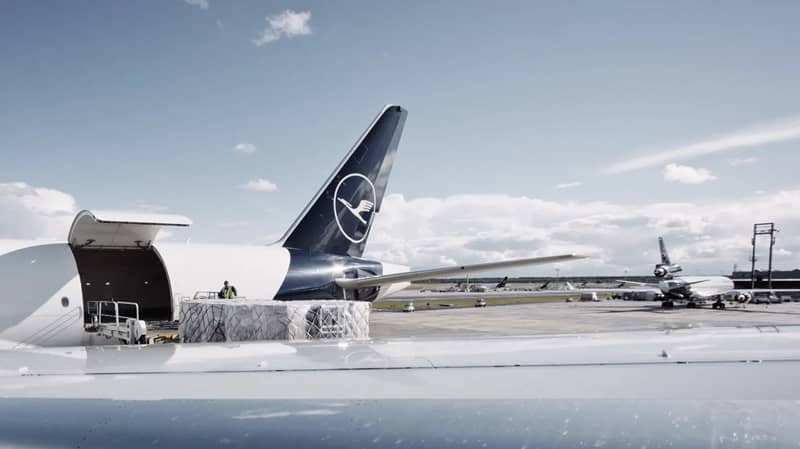
Lufthansa Cargo has delivered a muscular first-half result for 2026, lifting Adjusted EBIT by 47 per cent as stronger demand, expanding capacity and continued growth across Asia helped put fresh wind beneath the carrier’s freighter wings.
The German cargo airline generated revenue of €1.92 billion during the six months, up 16 per cent from €1.65 billion in the corresponding period of 2025.
Adjusted EBIT climbed from €135 million to €199 million, while the Adjusted EBIT margin improved by 2.2 percentage points to 10.4 per cent.
In an industry where margins can occasionally be thinner than the complimentary serviette, moving beyond 10 per cent is no small achievement. It gives Lufthansa Cargo both financial breathing room and greater confidence as it presses ahead with an ambitious modernisation and expansion program.
The result also strengthens the company’s campaign to regain a place among the world’s three largest cargo airlines by 2030, measured by freight tonne-kilometres.
Capacity and demand climb together
Available cargo capacity rose by five per cent to 7.21 billion freight tonne-kilometres during the first half. The expansion was driven largely by additional belly-hold capacity aboard passenger aircraft, including the marketing of cargo space on ITA Airways services.
Demand kept pace with that growth. Traffic increased by five per cent to 4.6 billion freight tonne-kilometres, while the average cargo load factor edged 0.2 percentage points higher to 63.8 per cent.
That modest load-factor rise may lack the theatrical appeal of a 47 per cent earnings surge, but it remains an important signal. Lufthansa Cargo added capacity without materially weakening how efficiently it used that space.
Asia continued to play a leading role, supported by robust business performance and sustained demand. The region remains crucial to international airfreight, particularly for electronics, industrial components, e-commerce consignments and time-sensitive shipments.
Gregor Schleussner, Chief Financial Officer and Chief Human Resources Officer of Lufthansa Cargo, said the result reflected both favourable demand and the progress of the company’s BOLD MOVES growth strategy.
“Alongside sustained strong market demand and continued robust business performance in Asia, we have continued our BOLD MOVES growth strategy and shaped Lufthansa Cargo’s success in the first half of 2026,” Schleussner said.
“At the same time, we recognize that the global air freight market continues to be shaped by volatility, geopolitical uncertainties, rising costs, constantly evolving customer expectations, dynamic market conditions, and increasing competitive pressure.”
He said long-term success would depend on companies becoming faster, more efficient and more adaptable than their competitors.
“Our goal is clear: by 2030, we aim to return to the ranks of the world’s top three cargo airlines.”
Frankfurt hub receives a €600 million overhaul
The earnings improvement arrives as Lufthansa Cargo undertakes one of the most consequential infrastructure projects in its history.
At the end of June, the airline commissioned the ALPHA construction phase of LCCevo, the transformation of the Lufthansa Cargo Centre at Frankfurt Airport.
Completed on schedule, ALPHA represents the first and most important stage of a program designed to turn Frankfurt into Europe’s most advanced air cargo centre by 2030.
The project will cost approximately € 600 million. Plans include highly automated material-handling and conveyor systems, a fully automated high-bay warehouse and specialised storage facilities for temperature-sensitive freight.
The latter is especially significant for pharmaceutical, biotechnology and healthcare customers, whose shipments require tightly controlled conditions and precise monitoring. There is little room for “near enough” when the cargo is a life-saving medicine.
LCCevo is expected to improve handling capacity, operating efficiency and reliability at Lufthansa Cargo’s principal hub. More broadly, it is a tangible statement of intent: the airline is not merely chasing greater volume but building the machinery needed to manage it profitably.
Automation should help reduce unnecessary handling, accelerate transfers and provide better control over increasingly complex cargo flows. Those advantages will become more valuable as customers demand faster service, greater visibility and more dependable delivery windows.
GlobeCross takes cargo beyond the airport
Lufthansa Cargo also broadened its reach during the second quarter by combining the activities of former subsidiaries heyworld GmbH and CB Customs Broker GmbH under the newly established GlobeCross GmbH.
GlobeCross brings together digital e-commerce logistics and customs expertise, allowing Lufthansa Cargo to offer integrated cross-border services extending beyond its traditional airport-to-airport model.
Its service portfolio includes digital customs processing, e-commerce import terminals at major cargo hubs and end-to-end logistics covering transport, customs clearance and final delivery.
This is a strategically important move. The fastest-growing corners of the freight business do not necessarily end at the cargo-terminal door. Retailers and online marketplaces increasingly want a single provider that can move parcels across borders, clear customs, and arrange delivery to the customer.
By entering more of that value chain, Lufthansa Cargo can deepen customer relationships and capture revenue that might otherwise flow to customs brokers, parcel networks and specialist logistics firms.
GlobeCross also gives the airline a more direct foothold in international e-commerce. It is a market with considerable promise, but one marked by fierce competition, regulatory complexity, and customers who expect their parcels yesterday, preferably with free shipping.
Ambition meets an unpredictable market
The first-half performance provides a strong financial foundation, but Lufthansa Cargo’s management is right to keep one eye on the storm clouds.
Airfreight remains exposed to geopolitical conflict, trade restrictions, fuel and labour costs, supply-chain disruption and abrupt changes in consumer demand. Capacity can also shift quickly as passenger airlines add or remove international services.
Nevertheless, Lufthansa Cargo enters the second half of 2026 with rising revenue, improved profitability, greater capacity and two major strategic initiatives moving from blueprint to business.
LCCevo addresses how freight will be handled. GlobeCross expands where the company’s responsibility for that freight begins and ends. Together, they give BOLD MOVES and its 2030 ambition practical substance.
Returning to the global top three will require sustained investment and more than one strong reporting period. Still, a 47 per cent earnings improvement, a double-digit margin and a modernised Frankfurt hub represent a persuasive opening argument.
For Lufthansa Cargo, the destination is ambitious. For the moment, however, the financial flight plan appears firmly on course.
By: Alison Jenkins – © 2026.
Read Time: 4 minutes.
Author Bio:
 Alison Jenkins has lived most of her working life in the slipstream of aviation, where timetables matter, and people matter more. In airline sales, she built a reputation the old-fashioned way: by knowing her clients, her routes, and never missing the human detail.
Quick with a smile, quicker with a solution, she made deals with warmth and kept her edge intact.
Trade shows, FAMILS, airport lounges and hotel lobbies became her second address. And somewhere along the way, notebook in hand, she began writing the journeys rather than selling them. Her reports grew lively, observant, full of the small truths only travellers notice.
That was the moment it dawned on her: she wasn’t simply travelling. She belonged in its stories.











